


Dynamic Strain Analysis Application of EikoTwin DIC: Monitoring the Healthy Operating Status of Mechanical Equipment
Release time:
2025-08-20 16:22
Source:
In the industrial field, health monitoring of mechanical equipment has always been a challenge. Traditional measurement methods struggle to comprehensively capture the strain conditions of equipment during operation. They are not only cumbersome to install but also provide data only at limited points, failing to fully reflect the overall strain condition of the equipment. This often makes it difficult to detect early signs of sudden failures, leading to untimely maintenance, which in turn causes production interruptions or even safety accidents. EikoTwin DIC Simulation and experimental comparison verification DIC The emergence of strain measurement systems is changing this situation. They can directly display experimental measurement data on the finite element model mesh, achieving seamless comparison between simulation and experiment, and promptly identifying differences between the current equipment and the initial state.
01 Pain points in mechanical equipment health monitoring
Health monitoring of complex mechanical systems such as large industrial equipment, aerospace structures, and power energy devices has always faced many difficulties. Traditional strain gauges require direct contact with the measured object's surface, making installation complex and susceptible to electromagnetic interference. More challenging is that single-point measurements cannot fully reflect the overall stress distribution of the structure, making it difficult to accurately warn of potential faults. Many devices operate under high-speed vibration, high temperature, or inaccessible conditions, posing great challenges to traditional measurement methods. Engineers often face the dilemma of "inaccurate and incomplete measurements" and have to rely on periodic shutdown inspections, which affect production efficiency and cannot truly achieve predictive maintenance.
02 Technical breakthroughs in DIC strain measurement
Digital Image Correlation technology ( DIC ) is a non-contact optical measurement method that calculates full-field displacement and strain data by analyzing changes in speckle patterns on the object's surface before and after deformation. Compared with traditional methods, DIC the technology has advantages of full-field measurement, non-contact, and high precision. It does not require contact with the measured object and can obtain strain information from hundreds of thousands of data points, providing rich mechanical behavior data. DIC The strain measurement accuracy of the technology can reach ≤ 20 microstrain, with a measurement range covering 0.002%-2000% , meeting the testing needs of both small and large deformations. The three-dimensional DIC system also supports dynamic acquisition from low to high speed (up to 50000fps ), capable of capturing transient deformation processes.
03 Innovative advantages of EikoTwin DIC
EikoTwin DIC Important innovations have been made based on traditional DIC technology—it processes images based on finite element meshes, allowing test results to be directly displayed on simulation models. This technology uses advanced digital image correlation principles, capturing images before and after deformation through digital photography, selecting window grayscale features, and calculating displacement through grayscale comparison and precise matching algorithms, thereby obtaining full-field displacement data. EikoTwin DIC Its outstanding feature is simulation-oriented measurement. It directly measures displacement and strain on finite element meshes, enabling experimental data to be directly compared with numerical simulation predictions. This technology greatly improves the problem that traditional DIC software can only provide point cloud data, making it difficult to compare with simulation results.
04 Real-time comparison between simulation and measurement to promptly detect equipment anomalies
EikoTwin DIC The strain measurement system, through its core capability of real-time comparison between simulation and measurement, brings a revolutionary solution to the field of equipment health monitoring. It is especially adept at instantly capturing deviations in numerical models and revealing anomalies that are difficult to detect with the naked eye, thus providing strong support for predictive maintenance.
EikoTwin DIC The essential difference from traditional DIC technology lies in its "simulation-oriented" design concept. It does not generate an independent point cloud data set but directly maps experimental measurement data (displacement, strain) in real time onto the original finite element simulation mesh nodes. This process can be summarized as:
Fine mesh mapping - The system calculates displacement and strain fields on the object's surface from images captured by high-speed cameras using digital image correlation algorithms. The key is that this data corresponds directly to and is assigned to the simulation model's mesh nodes, rather than traditional scattered points.
Instant data comparison - Built-in comparison tools in the software calculate the differences (displacement, strain, etc.) between experimental measurements and simulation predictions at each mesh node in real time and present them visually (such as cloud maps, curves).
Anomaly warning and localization - When the deviation between measured and predicted values exceeds preset thresholds, the system issues alerts and highlights the abnormal areas on the 3D model, directly guiding engineers to focus on problem points.
05 Engineering application example
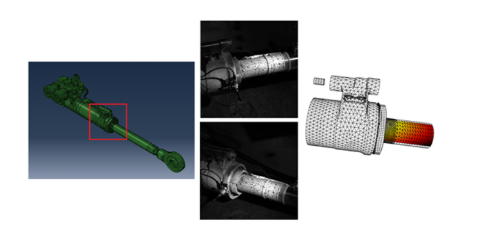
Safran Landing Systems Safran Landing Systems encountered a tricky problem during vibration testing of aircraft hydraulic actuators: at certain natural frequencies, the actuator exhibited a subtle rotation undetectable to the naked eye. 。
- Test setup They placed a pair of high-speed cameras in front of the actuator ( 1000 fps ) to record speckle images on the surface during vibration and used EikoTwin DIC software for processing, directly projecting measurement results onto the actuator's finite element model. 。
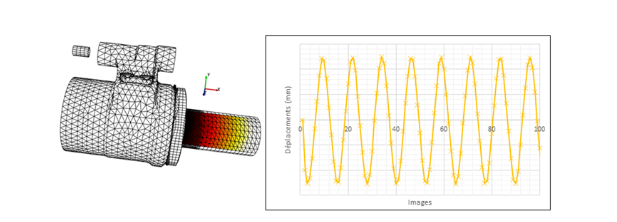
- Anomaly discovered: Vibration test data showed that during vibration, the central cylinder of the actuator exhibited rotation not predicted by the numerical model. This subtle abnormal behavior is difficult to detect with traditional sensors or observation.
- Value highlighted: This discovery indicates that there may be unexpected conditions in the test structure assembly or internal behavior. EikoTwin DIC Not only provides quantitative displacement data, but also offers important qualitative information about structural assembly and its usage behavior, helping the Safran team optimize their numerical models.
This case shows that, EikoTwin DIC it can not only validate simulations but also reveal complex physical behaviors unforeseen during the design phase, which is crucial for ensuring the reliability of high-performance safety-critical equipment such as aircraft landing gear actuators.
06 Technical Prospects and Outlook
With the deepening of digital transformation, EikoTwin DIC the technology shows broad application prospects in the field of mechanical equipment health monitoring. The system is already capable of directly integrating with Altair HyperWorks and other simulation tools to achieve seamless data flow.
In the future, this technology will further combine with the Internet of Things, big data analytics, and artificial intelligence to build a more intelligent equipment health management system, realizing a fully automated process from real-time monitoring and data analysis to early warning decision-making.
Well-known industry companies such as ANSYS 、 ALTAIR 、 DASSAULT SYSTEMES 、 MBDA 、 SAFRAN 、 ARIANE GROUP are all applying EikoTwin DIC the technology.
EikoTwin DIC The technology has demonstrated its value in aerospace, large-scale steel building structures, and automotive manufacturing fields.
With the continuous maturity and popularization of this technology, we expect to build a smarter, more efficient, and more reliable equipment health monitoring ecosystem.
DIC Strain Measurement Based on Simulation Model,EikoTwin DIC,Safran,Large-scale Equipment Health Monitoring,Simulation Model Verification Comparison,Full-field strain measurement