


Challenges and Solutions in DIC Strain Measurement Technology: How to Address the Pain Points of Speckle Preparation and Image Quality Assurance?
Release time:
2025-08-26 17:13
Source:
Digital image related ( DIC ) technology has become an indispensable measurement method in the field of experimental mechanics, capable of obtaining full-field displacement and strain data under extreme conditions such as high temperature, underwater, high speed, and ultra-low temperature.
However, speckle preparation and image quality issues have always been key technical bottlenecks limiting measurement accuracy. DIC With the development of new technologies, these long-standing pain points are gradually being resolved.
01 Speckle challenges in extreme environments
In high-temperature experiments, samples are usually placed in heating devices, and cameras capture images through observation windows. Thermal radiation emitted by the specimen can cause image overexposure, reducing the reliability of the speckle pattern; high temperatures may also cause speckles to fall off during thermal expansion or be ablated due to heat; thermal fog between the specimen and the camera causes light path deviation, leading to image distortion.
In ultra-low temperature environments (close to liquid helium temperature), speckle patterns become more brittle and harder, prone to cracking and falling off during large deformations.
02 Unique challenges in underwater and high-speed environments
Underwater environment DIC Measurements face complex distortions caused by multiple refractions of light. Image distortion is decomposed into two components—refraction distortion and lens distortion.
High-speed photography technology is used to study phenomena such as ballistics, explosions, Hopkinson bars, and high-speed collisions. Synchronization of two high-speed cameras and unstable lighting are major challenges.
Both macro large-scale and micro-scale measurements have their difficulties. In micro-scale measurements, images taken by microscopes are more complexly distorted than those taken by traditional cameras; large-scale measurements require calibration of multiple cameras and algorithmic stitching and merging.
03 Innovative breakthroughs in speckle preparation technology
To address speckle issues in high-temperature environments, New拓三维 XTDIC system uses blue / ultraviolet light, optical filtering, and air knife technology to filter out wavelengths other than blue / ultraviolet light, reducing the impact of thermal radiation.
For thermal flow disturbances, air knives or fans are used between the heating device and the lens to accelerate air circulation and reduce thermal fog effects. To improve the stability of speckle quality, parameterized speckle preparation technology is used in combination with high-temperature resistant materials.
Professor Li Yibin's team at Beihang University developed an ultraviolet - digital image ( UV-DIC ) system that effectively suppresses 3000 ℃ thermal radiation with a single ultraviolet filter, and developed an ultra-high temperature speckle preparation process using hafnium carbide powder as the speckle material.
The team at Lanzhou University developed a new rotational coating speckle preparation method based on PDMS silicone and TiO2 spherical particles, specially designed for ultra-low temperature and large deformation conditions.
Facing challenges and energy in experimental measurement processes, experts and scholars in the industry are striving to find solutions.
04 Image quality improvement and algorithm innovation
To address refraction issues in underwater environments, XTDIC the system establishes different refraction correction models to accurately determine the camera's intrinsic matrix, extrinsic matrix, and deformation parameters, correcting lens distortion.
Deep learning-based methods are revolutionizing DIC data processing workflows. Deep DIC method uses two convolutional neural networks DisplacementNet and StrainNet designed for end-to-end prediction of displacement and strain.
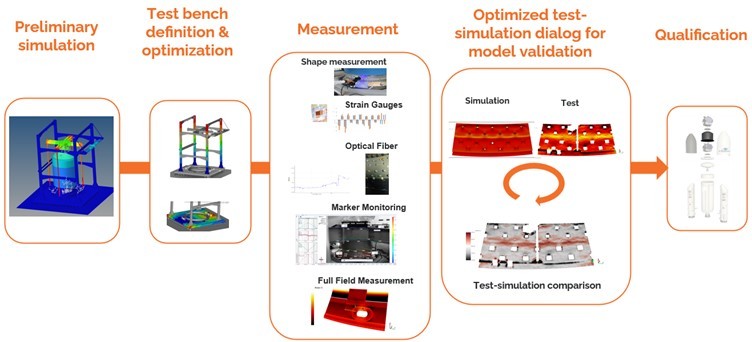
EikoTwin DIC adopts an innovative approach: performing DIC analysis and calculation directly on simulation models. This technology is based on digital image correlation principles, importing CAE simulation models, bridging simulation and measurement, allowing seamless connection between simulation and measurement, effectively promoting CAE optimization of simulation models. Traditional DIC measurement methods consume at least an hour of calibration time, while EikoTwin DIC camera calibration technology is based on physical finite element models, requiring no calibration plate for self-calibration.
EikoTwin DIC Supports multi-view displacement and strain measurements, capable of post-processing images captured by multi-dimensional digital image correlation devices (with at least 2 one camera DIC ), some projects already support up to 8 multiple cameras. EikoTwin DIC The technology has been adopted by ANSYS 、 ALTAIR 、 DASSAULT SYSTEMES and other well-known industry companies. From the automotive and railway industries to aerospace and defense fields, this technology is redefining the relationship between experimental testing and simulation.
Speckle Preparation and Image Quality,DIC Strain Measurement,Full-field strain measurement,EikoTwin DIC,Non-contact strain measurement