


Accurately obtain various biomechanical data for musculoskeletal simulation modeling of athletes
Release time:
2025-08-20 16:58
Source:
With the rapid development of computational biomechanics, musculoskeletal simulation modeling has become a key technology for revealing movement mechanisms, preventing injuries, and enhancing athletic performance. It is quietly transforming the landscape of sports science and clinical rehabilitation. Simulation modeling technology can accurately quantify in vivo biomechanical parameters that are difficult to measure directly through experiments, such as muscle activation levels, joint contact forces, and ligament tensions. By integrating experimental data such as motion capture, ground reaction forces, and even electromyography (EMG) EMG ), these models can replicate complex human movements and reveal their internal mechanical nature.
Two Main Technical Routes
Current simulation modeling methods in the field mainly revolve around two core technical routes: multibody dynamics and finite element analysis.
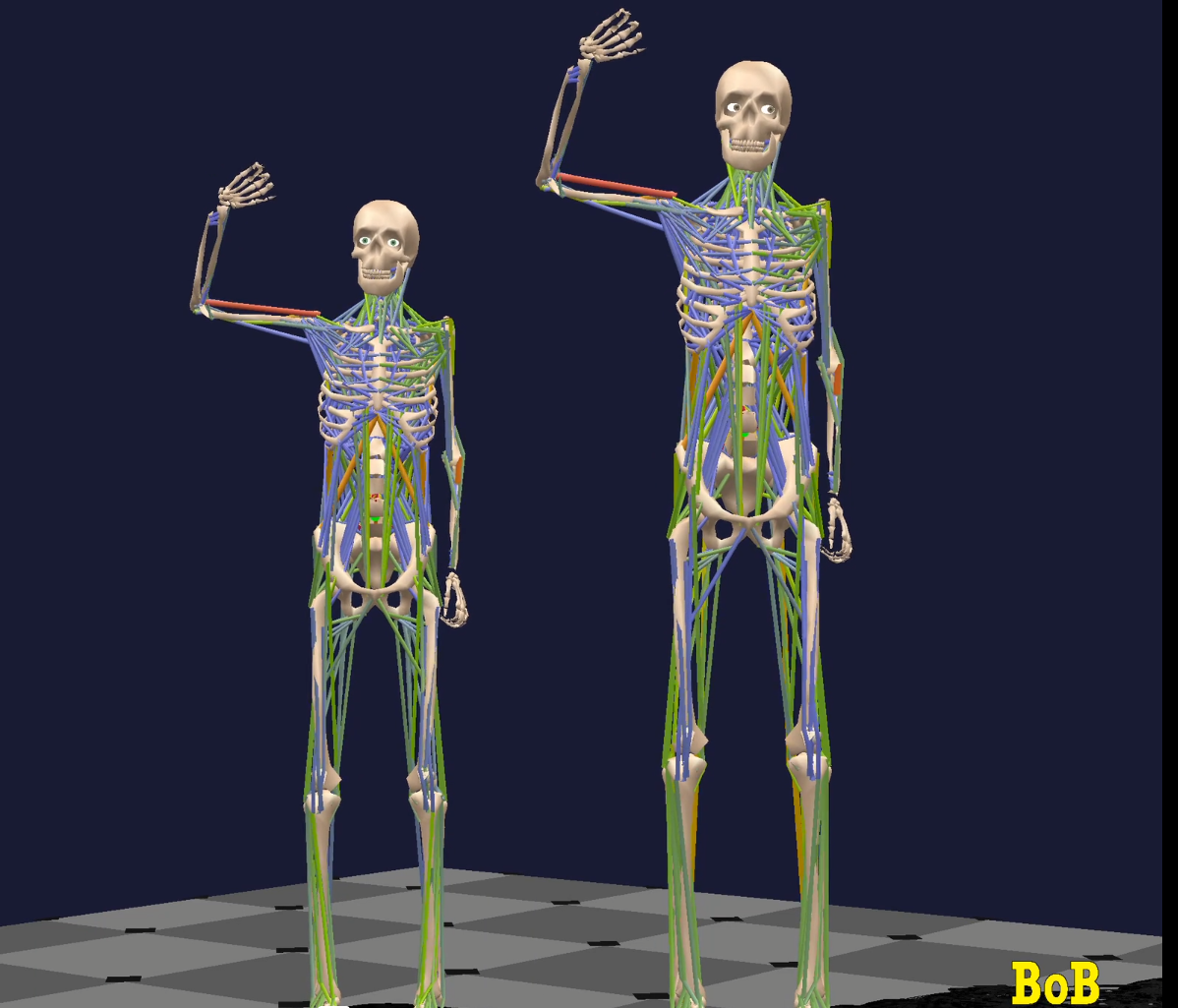
- Multibody dynamics simulation (such as OpenSim 、 AnyBody and BOB ) simplifies the human body into a system of rigid bone segments connected by joints and drives the entire system's movement by mimicking muscle-tendon unit force generators. This method is computationally efficient and excels at analyzing large-scale movements and muscle coordination strategies. - Finite element analysis (FEA) focuses on calculating the stress and strain distribution inside bones or soft tissues at the continuum mechanics level. To balance computational cost, a multiscale modeling strategy is often used: first calculating global muscle and joint forces through multibody dynamics, then importing these as boundary conditions into detailed local finite element models.
- Finite element analysis ( FEA ) then focuses on calculating the stress and strain distribution inside bones or soft tissues at the continuum mechanics level. To balance computational cost, a multiscale modeling strategy is often used: first calculating global muscle and joint forces through multibody dynamics, then importing these as boundary conditions into detailed local finite element models.
Mainstream Software Ecosystem
Open-source software OpenSim is currently one of the most widely used musculoskeletal modeling platforms in academia, developed by Stanford University. It provides a complete set of analysis tools ranging from inverse kinematics (IK), inverse dynamics (ID), to static optimization (SO) and forward dynamics (FD). Its upper limb Holzbaur model and lower limb Arnold model are widely adopted in research. IK Inverse Kinematics (IK) ID Inverse Dynamics (ID) SO Static Optimization (SO) FD Forward Dynamics (FD) Holzbaur Arnold Arnold models are widely adopted in research.
AnyBody Modeling System is another powerful commercial multibody dynamics simulation software. It allows users to define complex musculoskeletal models, with muscle models containing more than 600 muscle units, and can easily exchange data with MATLAB for powerful post-processing and custom analysis.
In addition, BOB biomechanical analysis toolkits such as C3D、 MVNX (from Xsens ) are also applied in specific fields, supporting model building based on various motion data formats.
Quantitative Reading of Simulation Modeling Applications
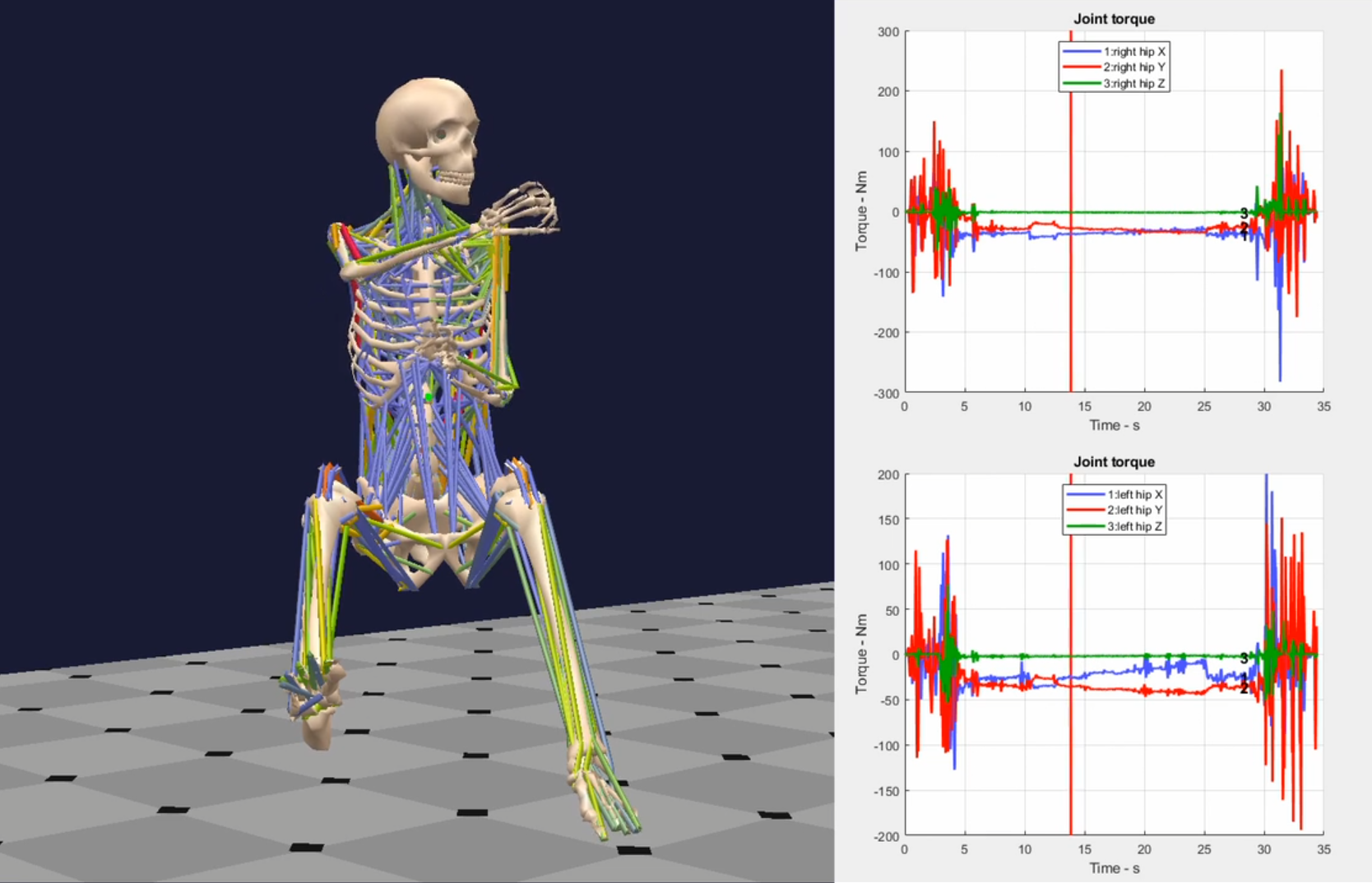
The value of musculoskeletal simulation models has been validated by numerous studies. One study based on OpenSim analyzed lower limb asymmetry (± 5% and ± 10% ) on running, finding that peak knee joint moments on the weaker limb can increase by up to 20% , and vertical ground reaction forces (GRF) GRF are also redistributed. Another study explored the effects of different walking speeds and loads, finding that joint moments and muscle activities (such as soleus and gastrocnemius) are positively correlated with walking speed and load.
In clinical prediction, OpenSim Moco toolkit predicts through optimal control methods that muscle activation patterns change accordingly to reduce knee joint load. EMG Assisted neuromusculoskeletal simulations have been shown to more accurately estimate knee joint contact forces under atypical gait conditions (such as muscle weakness).

Technical Challenges and Future Directions
Despite broad prospects, musculoskeletal simulation modeling still faces challenges in becoming fully clinical and personalized.
The accuracy of model predictions is a core concern. A review of shoulder joint modeling pointed out that 34% studies did not clearly specify the experimental data sources their models relied on, and the lack of high-quality personal data introduces uncertainty. Computational efficiency is also a major bottleneck. Models incorporating more physiological features such as tendon compliance, and addressing muscle redundancy problems (i.e., how to distribute forces among many muscles) require huge computational resources. Future technological development directions include more efficient algorithms, deeper multimodal data fusion (such as integrating IMU and sEMG data), and more user-friendly personalized modeling workflows to accelerate translation to clinical and sports settings. IMU and sEMG data) and more user-friendly personalized modeling workflows to accelerate translation to clinical and sports settings.
It is foreseeable that in the near future, athletes' simulation digital twins will become part of routine training, surgeons will be able to rehearse surgical plans and evaluate their mechanical consequences in virtual space, and rehabilitation specialists will tailor precise rehabilitation plans for each patient.
BOB Human Skeletal Muscle Simulation Modeling Software,Human Motion Biomechanics Analysis,Skeletal Muscle Simulation Modeling