


Are you familiar with the new embodied integration design paradigm for bionic robot motion control driven by neuromuscular data?
Release time:
2025-07-16 11:27
Source:
Bionic robots break free from the shackles of preset programs, perceiving, deciding, and moving as smoothly as living organisms — this is not a science fiction scenario, but a revolutionary vision brought by "embodied fusion design" driven by neuromuscular data. This cutting-edge paradigm, integrating neuroscience, robotics, and artificial intelligence, is reshaping the motion control logic of bionic robots and opening new possibilities for natural human-machine interaction.
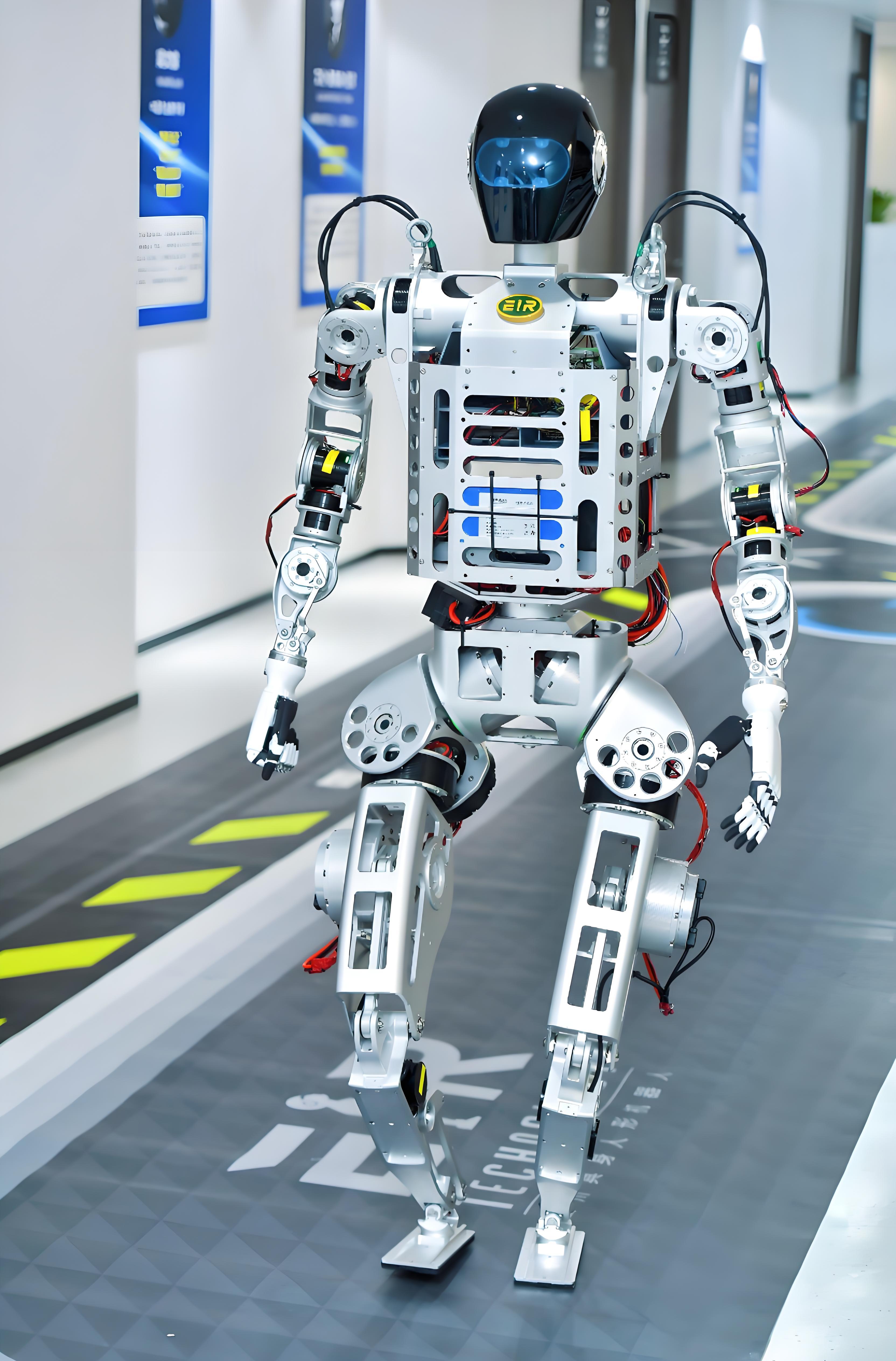
Neuromuscular Data: Decoding the "Codebook" of Life's Movement
Traditional bionic robots often exhibit stiff movements, mainly due to a lack of understanding of the essence of biological motion. In nature, motion control originates from the precise cooperation between the nervous system and muscular system: the brain sends neural signals to drive muscle fiber contraction, forming coordinated actions. Today, scientists capture these valuable biological signals in real time through high-density electromyography ( HD-EMG ) , cortical electrocorticography ( ECoG ) and even invasive brain-machine interfaces ( BMI ), capturing these precious biological signals in real time.
MIT Breakthrough: 2024 Year, MIT The Media Lab team published research in Science Robotics demonstrating that by decoding the movement intention signals of amputees' residual limbs through implanted neural interfaces, they drove bionic knee joints to achieve nearly natural gait. The key breakthrough lies in the algorithm's precise analysis of the temporal features of neural signals, reducing intention recognition delay to the millisecond level and improving gait naturalness by more than 40%。
USTC Dexterous Hand : The University of Science and Technology of China team focused on electromyography signal analysis, revealing in IEEE Transactions on Robotics the nonlinear mapping model between multi-channel surface electromyography ( sEMG ) and hand 19 degrees of freedom motion. Based on this, the developed bionic dexterous hand dynamically adjusts grasping actions with an error less than 5 °, achieving seamless switching between egg grasping and tool use.
Embodied Fusion: From "Mechanical Execution" to "Proprioceptive Awareness"
The core of the new paradigm is "Embodiment" ( Embodiment ) — robots not only execute commands but also perceive their own state and environmental interactions like living organisms, forming a "perception-driven" closed loop. This requires deep coupling of bionic structures, driving materials, and control systems. - ETH Zurich
: Inspired by the musculoskeletal system, their developed " MyoRobot " platform uses artificial muscle fibers driven by tendon-like actuators and integrates strain sensors for real-time deformation feedback. Research shows this proprioceptive-like mechanism shortens the robot's self-recovery time after falling by - Artificial Muscle Breakthrough: The Nankai University team reported in Nature Communications an ionic gel fiber artificial muscle with strain sensing accuracy reaching 60%。
0.1% , and energy consumption only one-tenth that of traditional motors. This material can directly respond to simulated neural electrical signals, achieving a "perception-driven integration" similar to biological muscles. [4] Data-Driven Closed Loop: Dynamic Adaptive "Intelligent Core" Neuromuscular data must be converted into control commands through intelligent algorithms. Combining deep learning (such as LSTM and - Transformer ) with reinforcement learning builds an "intelligent core" that can optimize motion strategies in real time. 。
Adaptive Fluid Environment Research: The Max Planck Institute
mimics fish C 、 -type and S
-type swimming mode switching mechanisms, using neural networks to analyze fluid resistance data in real time, enabling underwater robots to autonomously switch swimming modes within milliseconds, reducing energy consumption by Humanoid Robot Gait Optimization: Boston Dynamics' Atlas latest gait control system uses deep reinforcement learning models to continuously analyze foot pressure and joint torque data, dynamically optimizing gait parameters, reducing fall rates on complex terrain by Future Vision: The "Neural Bridge" for Human-Machine Integration This paradigm is moving from the laboratory to application: Rehabilitation Field 22%。
: Johns Hopkins University APL laboratory's brain-controlled exoskeleton decodes movement intentions through EEG to help spinal cord injury patients achieve autonomous walking training, accelerating neural function reconstruction. 85%。
Industrial Collaboration
: Toyota's "
" humanoid robot uses electromyography control, allowing operator movements to be mapped to the robot in real time with latency below :约翰霍普金斯大学APL实验室的脑控外骨骼,通过EEG解码运动意图,帮助脊髓损伤患者实现自主行走训练,患者神经功能重建速度提升35%。
工业协作:丰田“T-HR3”人形机器人采用肌电控制,操作者动作可实时映射至机器人,延迟低于30ms Providing a "human-machine integration" operational experience for precision assembly.
"Embodied fusion design is not only a technological iteration but also a leap in philosophical concepts." MIT Bionic Robotics Expert Hugh Herr The professor pointed out, "When machines possess life-like 'body perception' and 'neural drive,' the boundary between humans and machines will truly dissolve, ushering in a new era of co-evolution."
Conclusion
Anchored in neurobiology, driven by data, and culminating in embodied experience—this is not just a technological revolution but a philosophical exploration redefining 'machine life.' When bionic robots begin to 'feel' their own existence, the true dance between humans and machines will commence.
Muscle activity and neural control data guide driving and control strategies,Bionic Robot,Neuromuscular,Robot Design