


Breaking through simulation verification bottlenecks: DIC strain measurement injects unique value into simulation model validation
Release time:
2025-07-15 16:38
Source:
How to Break Through the Bottleneck of Simulation Verification? DIC Strain Measurement Injects Unique Value into Simulation Model Verification
In today's increasingly stringent pursuit of CAE simulation accuracy, model verification has become a key bottleneck to ensure that the virtual world accurately maps physical reality. The limitations of traditional strain measurement methods under complex geometries, dynamic loads, or extreme environments are becoming increasingly apparent. Digital Image Correlation technology, with its unique advantages of full-field, non-contact, and high resolution, is bringing revolutionary breakthroughs to simulation model verification.
Full-field Strain: Capturing Details "Invisible" to Traditional Methods
Traditional strain gauges only provide discrete point data, making it difficult to reveal the true strain field of complex structures (such as stress concentration areas and geometric discontinuities). DIC technology can map the complete strain distribution on the component surface. The Sutton team at the University of South Carolina recently used DIC to measure the full-field strain of complex aluminum alloy aircraft turbine blades under thermo-mechanical coupled loads. Compared with high-fidelity finite element models, they found that relying solely on traditional strain gauge data could lead to prediction errors exceeding 15% in local high-strain areas. However, after introducing DIC full-field verification, the error in key model regions was successfully reduced to within 3.5%. This significant improvement is attributed to DIC's precise capture of strain gradients in critical stress concentration areas such as blade dovetails.
Real Operating Condition Data: Bridging the "Simulation-Reality" Gap
DIC's non-contact nature allows it to operate stably in extreme environments where traditional sensors struggle, such as high temperature, high-speed impact, and complex vibrations, obtaining valuable "real operating condition" data. In a recent experiment, the University of Magdeburg in Germany, in collaboration with industrial partners, used a high-temperature DIC system to monitor the real-time deformation of an internal combustion engine exhaust manifold under thermal cycling. The transient full-field strain data obtained at nearly 900°C directly drove iterative optimization of the thermo-mechanical coupled simulation model, significantly improving the reliability of engine thermal fatigue life predictions.
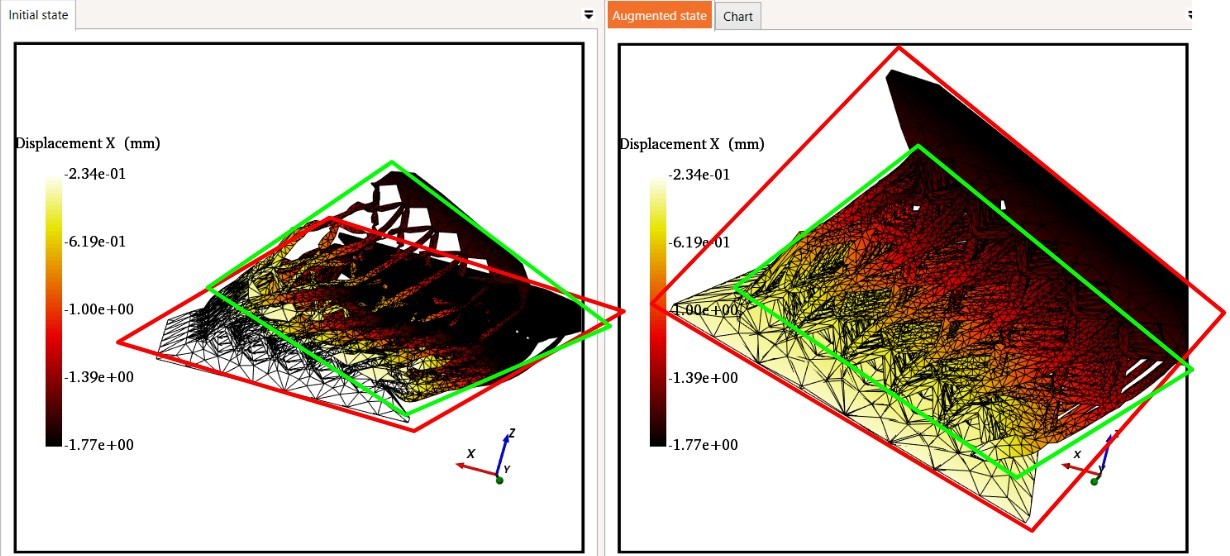
Complex Materials and Failure Verification: Revealing Microscopic Mechanisms
The mechanical response of heterogeneous materials such as composites and additive manufactured parts is highly complex. DIC not only provides macroscopic strain fields but its high-resolution version can reveal microscopic-scale deformation heterogeneity and failure initiation processes. Professor Schreier's team at the University of Waterloo published a paper in "Composites Part A" indicating that by combining microscopic DIC technology, they successfully observed the precise locations and evolution paths of internal microcrack initiation and interlaminar delamination in carbon fiber composite laminates under load, providing indispensable validation evidence for establishing more accurate progressive damage and failure simulation models for composites.
Efficiency Improvement: From "Point" Verification to "Field" Optimization
DIC's ability to acquire full-field data in a single test greatly improves verification efficiency. Ford Motor Company's R&D department reported that in the verification of a new aluminum alloy car door dent resistance simulation model, using DIC technology, a single experiment could obtain strain cloud maps composed of thousands of data points. Compared to the traditional scheme of arranging dozens of strain gauges, the verification cycle was shortened by 60%, and the data dimension was richer, laying the foundation for rapid iterative optimization of the model.
Challenges and Future Directions
Despite its significant advantages, the widespread adoption of DIC in simulation verification still faces challenges: equipment cost, requirements for optical conditions, processing of massive data, and development of benchmarking algorithms. However, with improvements in high-speed camera performance, advances in computer vision algorithms (such as AI-assisted speckle tracking), and progress in standardization efforts (such as ASTM E08 committee standards development), DIC is becoming more powerful and easier to use. Airbus has already listed DIC as a recommended full-field strain monitoring method in some component fatigue testing specifications.
Conclusion
DIC strain measurement technology, with its unique ability to obtain real operating condition, full-field, high-resolution strain data, is breaking the bottleneck of traditional simulation verification. It is not only a verification tool but also an important engine driving simulation models toward higher fidelity. With technological maturity and cost reduction, the deep integration of DIC and CAE simulation will undoubtedly become a new paradigm for the design and verification of complex engineering systems.
Simulation Results Verification,Simulation and Actual Measurement Data Comparison,Strain Measurement,Full-field strain measurement,Optical Strain Measurement,Non-contact strain measurement