


New Breakthroughs in DIC Technology for Strain Measurement in Composite Materials and Material Deformation Analysis
Release time:
2025-07-07 18:29
Source:
New Breakthroughs in DIC Technology for Strain Measurement and Material Deformation Analysis of Composites
Due to their lightweight, high strength, and excellent designability, composite materials have become the core structural materials for high-end equipment such as aerospace, wind turbine blades, and new energy vehicles. However, their complex multiphase structure and internal damage evolution mechanisms have made precise measurement of their full-field strain and deformation behavior under actual loads a major challenge in engineering testing and research. Traditional strain gauge measurement methods are highly contact-based and have limited coverage, making it difficult to capture the true mechanical state inside complex structures.
Breaking Through Bottlenecks: DIC Technology Illuminates the "Invisible" World of Deformation
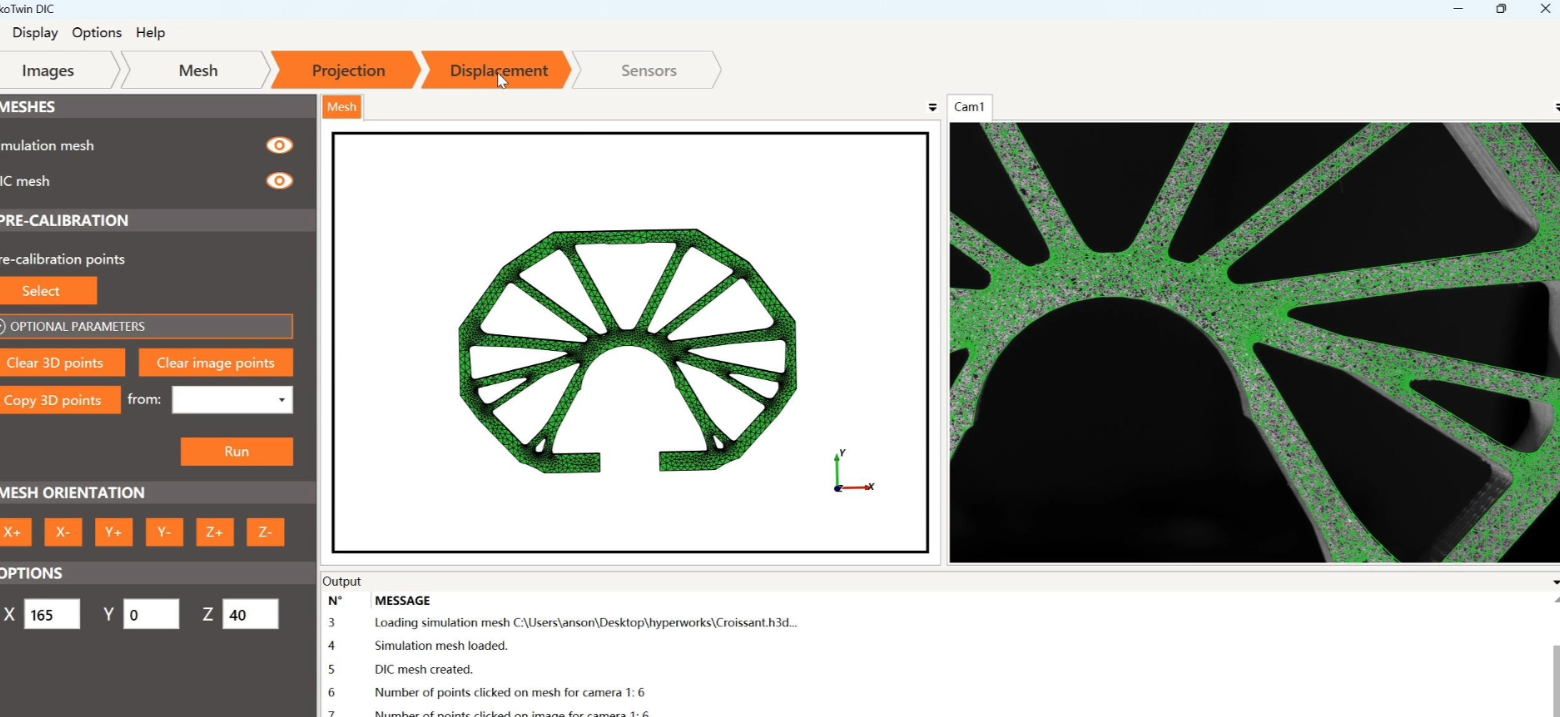
Digital Image Correlation (DIC) technology, as a revolutionary non-contact optical measurement method, has achieved significant breakthroughs in the field of composite material strain measurement in recent years. Its core principle is to track the subtle displacement changes of random speckle patterns on the material surface under high-resolution cameras, combined with advanced algorithms, to reconstruct the three-dimensional morphology and full-field displacement/strain distribution of the object surface. Compared with traditional methods, DIC has core advantages such as non-contact, full-field measurement, high accuracy, and wide applicability, enabling intuitive presentation of the deformation process, damage initiation, and propagation paths of composites under complex loads (such as impact, fatigue, thermo-mechanical coupling).
Innovative Integration: Closed Loop of Simulation-Driven and Experimental Validation
The greatest leap of DIC technology lies in its deep integration with advanced computer simulation models, forming a powerful "virtual-experimental" closed loop:
1. High-precision experimental data drives model optimization: The full-field real strain data of composites provided by DIC is a key input for calibrating and validating finite element (FE) simulation models. For example, NASA, in its advanced composite research, repeatedly adjusts material model parameters using DIC data, significantly improving the accuracy of failure prediction of composite structures under extreme conditions (such as aerodynamic loads on aircraft and landing impacts).
2. Simulation models guide testing of critical regions: Complex composite structures (such as aircraft wing joints and wind turbine blade roots) often have areas of high stress concentration. By predicting these "hot spots" through preliminary simulations, engineers can more precisely deploy DIC systems (such as the EikoTwin DIC strain measurement system) to focus on capturing subtle strain changes and potential damage signals in these key areas, greatly enhancing testing efficiency and reliability.
3. Real-time comparison between virtual and real: In the development of automotive composite parts, some leading laboratories have realized online comparison of physical test data collected in real time by DIC with running digital twin simulation models. This instant feedback mechanism can quickly identify model deviations and accelerate design iterations. The U.S. National Renewable Energy Laboratory (NREL) also relies on this method to validate its fatigue life prediction models in large wind turbine blade testing.
Application Frontiers: From Sky to Green Energy, DIC Penetrates Core Scenarios
Aerospace: Airbus has densely deployed DIC systems in static tests of its new generation wing composite box sections, successfully capturing the complete strain field evolution of key failure modes such as skin buckling and stringer debonding, providing irreplaceable experimental evidence for structural safety margin assessment.
Wind Power: Facing the complex bending-torsion coupled deformation of ultra-long blades under strong wind and gravity, DIC has become the core technology for monitoring full-field strain distribution and verifying structural integrity. A recent article in the internationally authoritative journal "Composite Science and Technology" confirmed that DIC-based test data is key to optimizing blade layup design and extending service life.
Frontier Exploration: The application of DIC is rapidly expanding to more microscopic and extreme environments. Researchers are combining it with microscopy techniques to observe fiber/matrix interface failure at the microscopic scale of composites; meanwhile, specialized DIC solutions for harsh environments such as high temperature, low temperature, and high-speed impact are continuously maturing. Recently, it has also shown unique value in studying the mechanical behavior of bio-composites (such as orthopedic implants).
Insight into the Future: Data-Driven Intelligent Design of Composites
The breakthrough application of DIC technology combined with simulation models is profoundly changing the research paradigm and engineering practice of composites. The massive, high-precision full-field strain data it provides is the cornerstone for building high-fidelity digital twins and realizing the full-process digitalization of composite structure "design-manufacture-validation." With continuous advances in high-speed imaging and AI image processing algorithms, the measurement speed, accuracy, and automation level of DIC will further improve, promising to open new frontiers in real-time health monitoring and predictive maintenance of composite structures.
From precise understanding in laboratories to reliable assurance on engineering frontlines, DIC technology, with its unique advantages of non-contact and full-field insight, is continuously pushing the boundaries of composite strain measurement and deformation analysis, providing indispensable "insight" and solid data foundation to unlock greater potential of this advanced material. It is not only a tool for observing deformation but also a key bridge connecting the physical world and digital space, driving intelligent design and safe application of composites.
Material Deformation Analysis,DIC Strain Measurement,Full-field strain measurement,Non-contact strain measurement