


Application of Dynamic Surface Pressure Measurement in Insoles and Gait Analysis
Release time:
2025-06-16 10:19
Source:
With the continuous development of health monitoring technology, plantar pressure measurement has become an important technique in fields such as sports biomechanics, medical rehabilitation, and footwear design. By analyzing the distribution and changes of plantar pressure, it is possible not only to assess foot health status but also to provide scientific basis for personalized insole design and gait abnormality diagnosis. Against this background, surface pressure dynamic measurement technology, especially the application of the SPI-Tactilus foot pressure testing system, is driving innovation in related fields.
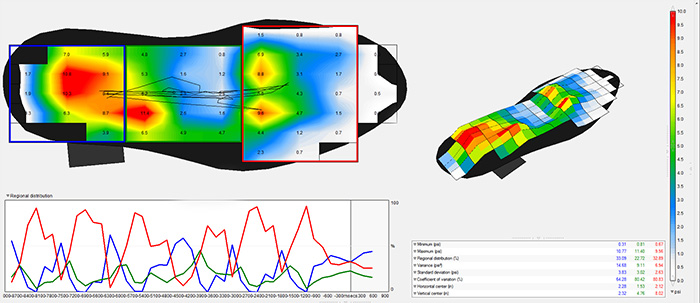
The Importance of Plantar Pressure Measurement
Plantar pressure measurement technology provides quantitative data for gait analysis by recording the pressure distribution, temporal parameters, and mechanical characteristics of the foot sole during static or dynamic states. These data have wide applications in multiple fields:
1. Medical Rehabilitation: Helps diagnose conditions such as flat feet and diabetic foot, and provides objective evaluation for postoperative rehabilitation.
2. Sports Science: Optimizes athletes' training postures and reduces sports injuries.
3. Footwear Design: Designs more ergonomic insoles and shoes through pressure distribution analysis.
Traditional plantar pressure measurement methods include footprint methods, force plates, and optical detection systems, but these technologies often suffer from insufficient accuracy or limited usage scenarios. The emergence of modern wearable devices and dynamic pressure measurement systems offers new solutions for real-time, high-precision plantar pressure analysis.
Advantages of the SPI-Tactilus Foot Pressure Testing System
The SPI-Tactilus foot pressure testing system is an advanced real-time contact surface pressure analysis tool, with core features including:
1. High-precision dynamic measurement: The system uses a flexible sensor array capable of capturing subtle changes in plantar pressure in real time, with a resolution of multiple sensing points per square centimeter, ensuring data accuracy and reliability.
2. Multi-scenario applicability: Whether standing still or walking and running dynamically, the system can operate stably, meeting the needs of both laboratory and real-world sports scenarios.
3. Instant visual analysis: Through supporting software, users can view pressure distribution maps, pressure center trajectories, and other key parameters in real time, quickly generating reports to support scientific research or clinical decisions.
4. Personalized adaptation: The system supports customized sensor layouts and can adjust measurement schemes according to different application scenarios (such as medical rehabilitation and sports training).
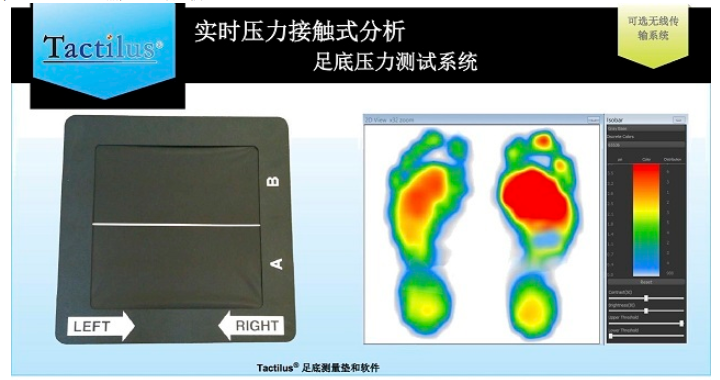
The introduction of this system significantly improves the efficiency and practicality of plantar pressure measurement, especially excelling in personalized insole design and gait correction.
Application in Insole Design
Orthotic insoles are common means to treat foot problems such as flat feet and high arches, but their effectiveness highly depends on precise pressure distribution measurement. The SPI-Tactilus system optimizes insole design through the following methods:
1. Pressure hotspot identification: The system can accurately locate high-pressure areas on the sole (such as metatarsals or heel), providing a basis for insole support and cushioning design.
2. Dynamic evaluation: By recording pressure changes during walking or running, it assesses insole performance in actual use, avoiding the limitations of static testing.
3. Material selection: Combining test data of materials with different hardness, it helps designers choose the most suitable insole material, balancing comfort and support.
For example, a study on children with flat feet showed that 3D-printed orthotic insoles based on dynamic pressure data can significantly improve arch support and reduce fatigue during walking.
Innovation in Gait Analysis
Gait analysis is an important method for evaluating motor function and diagnosing abnormal gait. The application of the SPI-Tactilus system further promotes development in this field:
1. Abnormal gait detection: By comparing pressure distribution differences between healthy individuals and patients, the system can assist in diagnosing gait abnormalities caused by diseases such as Parkinson's and stroke.
2. Rehabilitation progress monitoring: Real-time recording of pressure changes during rehabilitation training provides data support for adjusting treatment plans.
3. Sports performance optimization: Helps athletes analyze gait symmetry and force patterns to improve training efficiency.
Research shows that combined with machine learning algorithms, dynamic pressure data can also achieve automatic classification of gait patterns, laying the foundation for the development of intelligent rehabilitation devices.
Future Prospects
With advances in sensor technology and artificial intelligence, plantar pressure measurement will develop towards more intelligent and personalized directions. The application of the SPI-Tactilus system demonstrates the potential of dynamic pressure measurement in medical, sports, and daily health monitoring. In the future, by integrating with other biomechanical data (such as electromyography signals and joint motion trajectories), this technology is expected to provide more comprehensive solutions for human health management.
Insoles and Gait Analysis,Surface Pressure Dynamic Measurement,SPI-Tactilus Foot Pressure Testing System