


Analysis of the Advantages of Digital Image-Related Technology for Strain Measurement in Extreme Environments
Release time:
2025-06-16 10:37
Source:
In fields such as materials science, aerospace, energy development, and civil engineering, accurately measuring the strain behavior of materials under extreme environments is crucial. Traditional contact strain measurement methods (such as strain gauges) are often difficult to apply under conditions of high temperature, high pressure, strong corrosion, or high dynamic loads. Digital Image Correlation (DIC), as a non-contact optical measurement method, is gradually becoming the preferred solution for strain analysis in extreme environments due to its high accuracy, full-field measurement capability, and excellent environmental adaptability.
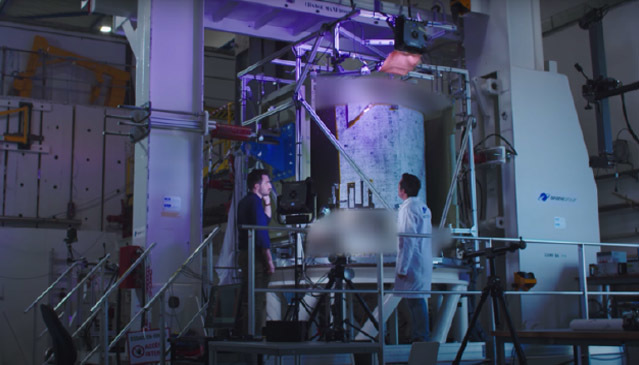
Core Advantages of DIC Technology in Extreme Environments
1. Non-contact measurement, adaptable to complex environments
Under extreme conditions such as high temperature, low temperature, strong vibration, or corrosive media, traditional strain gauges may fail or be damaged due to physical contact. However, **DIC technology only requires high-resolution cameras to record speckle images on the surface of the measured object, combined with algorithms to calculate displacement and strain fields before and after deformation**, completely avoiding interference caused by direct contact between sensors and the measured object.
For example, in thermal fatigue testing of aero-engine blades, temperatures may exceed 1000°C, where strain gauges cannot operate stably for long periods, but the DIC system can still achieve precise measurements through high-temperature resistant optical windows.
2. Full-field measurement, capturing local strain concentration
Traditional strain measurement methods usually can only obtain data from limited measurement points, whereas DIC provides full-field displacement and strain distribution, helping researchers identify local strain concentration phenomena in materials or structures, which is crucial for predicting crack initiation and fatigue life.
NASA used DIC technology in low-temperature testing of rocket fuel tanks and successfully identified abnormal strain concentrations in weld areas, optimizing structural design.
3. High dynamic range, suitable for transient process analysis
Transient events such as explosions, impacts, or high-speed collisions require measurement systems with extremely high temporal resolution. Modern DIC systems (such as EikoTwin DIC) can be paired with high-speed cameras to achieve microsecond-level sampling, accurately capturing the strain evolution of materials under extreme dynamic loads.
In automotive crash safety research, DIC technology has been widely used to analyze the dynamic deformation behavior of vehicle body materials, providing data support for lightweight design.
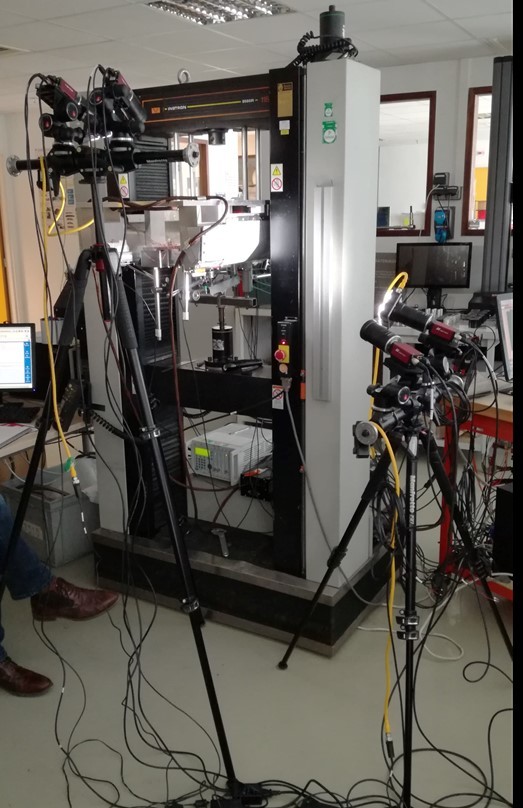
EikoTwin DIC: A non-contact strain measurement system optimized for extreme environments
Among many DIC solutions, the EikoTwin DIC system stands out due to its high-precision algorithms and strong environmental adaptability. The system uses advanced image processing technology to maintain stable measurement accuracy even under low light, high noise, or severe vibration conditions.
Key Features:
- Sub-pixel displacement resolution (up to 0.01 pixels), suitable for micro-strain measurement.
- Supports multi-camera synchronization for complex 3D deformation analysis.
- Compatible with extreme experimental environments such as high temperature, low temperature, and vacuum, and can be integrated into industrial on-site real-time monitoring.
The French Alternative Energies and Atomic Energy Commission (CEA) used EikoTwin DIC in irradiation-thermal coupling experiments on nuclear reactor materials, successfully obtaining full-field strain data under high-temperature irradiation conditions, providing key evidence for the safety design of next-generation nuclear power plants.
Future Outlook
With improvements in computing power and algorithm optimization, DIC technology will further develop towards **real-time and intelligent** capabilities. Combined with artificial intelligence (AI) for automatic defect identification and predictive modeling, DIC is expected to play a greater role in extreme environment monitoring, providing more powerful tools for material failure warning and structural health management.
Breakthrough in Extreme Environment Adaptability,Full-field strain measurement,Non-contact strain measurement,DIC Strain Measurement,Optical Strain Measurement