


In which fields does the grid-based digital image correlation (DIC) strain measurement have unique advantages?
Release time:
2025-06-12 11:30
Source:
1. Technological Innovation and Core Advantages
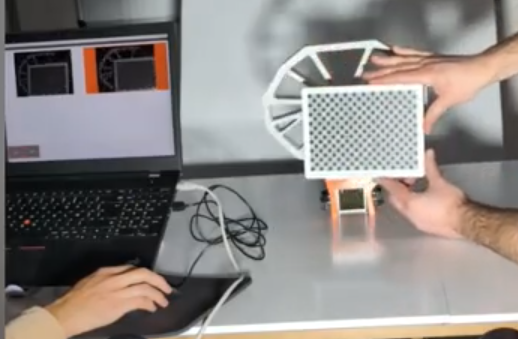
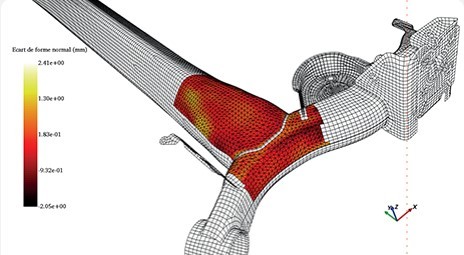
The grid model DIC technology achieves full-field strain measurement with micron-level accuracy by tracking the three-dimensional displacement of surface grid nodes, increasing data density by three orders of magnitude compared to traditional strain gauges. The EikoTwin DIC system, exclusively represented by Beijing Qiaoze Technology, uses FEM simulation models as a reference for digital image correlation processing, allowing direct comparison of FEM simulation data and measured strain data on the same platform. The analysis results of displacement and strain data collected by the DIC software can be seamlessly compared with the FEM simulation model, and the FEM model can even be directly improved based on experimental data, enabling users to work faster and more efficiently, reducing the number of physical experiments, and ensuring or advancing the completion of work objectives.
2. High-Value Applications in Aerospace
Large Aerospace Structure Validation
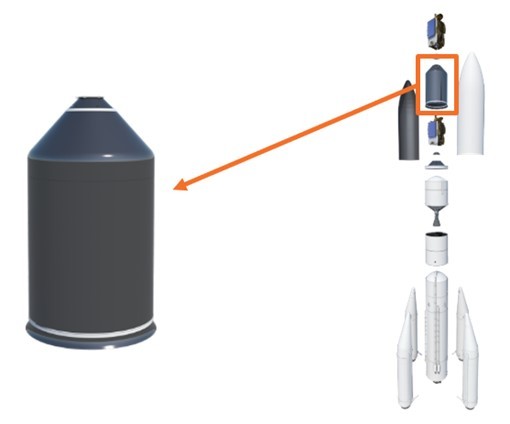
In the Galileo satellite dispenser qualification test of the Ariane 6 rocket by the French Ariane Group, the EikoTwin system enabled direct comparison between experimental data and finite element models, significantly improving simulation reliability. The system uses digital continuity technology to seamlessly integrate DIC data into industrial testing platforms.
In turbine blade testing, the system successfully captured damage evolution of ceramic matrix composites (CMC) under thermal gradient loads, providing critical data support for environmental barrier coating design.
Dynamic Monitoring of Aircraft
The vibration compensation algorithm effectively solves image blur caused by airflow disturbances and has been applied to dynamic deformation monitoring of wings, achieving real-time full-field strain analysis of wing structures with spans of 40 meters.
3. Innovative Practices in New Energy and Rail Transit
Power Battery Safety Research
EikoTwin testing services quantify inter-layer strain gradients in lithium battery cells during charge and discharge through full-field strain analysis, accurately identifying material expansion concentration zones under fast charging conditions.
Rail Transit Component Optimization
In fatigue testing of high-speed train bogies, the system completed 2 million cyclic load experiments, precisely locating strain concentration areas on brake disc mounting seats, helping reduce fatigue life prediction errors from ±15% to ±5%.
4. Advanced Materials and Biomedical Research
Thermomechanical Behavior Analysis of Composite Materials
The Safran Technology Center, in collaboration with the French Aerospace Research Center, used EikoTwin to map laser thermal load experimental data onto finite element meshes, revealing crack propagation mechanisms in ceramic matrix composites under thermal shock.
Performance Verification of Medical Implants
Fluorescent grid marking technology enables dynamic visualization of strain in artificial joint contact areas, providing quantitative basis for the design of new orthopedic implants.
Full-field strain measurement,Non-contact strain measurement,DIC Based on Grid Model