


Surface pressure measurement main application exploration: Revealing the pressure distribution measurement scheme of sealing strips
Release time:
2025-06-12 10:27
Source:
Exploration of Surface Pressure Measurement Applications: Revealing the Pressure Distribution Measurement Scheme of Sealing Strips
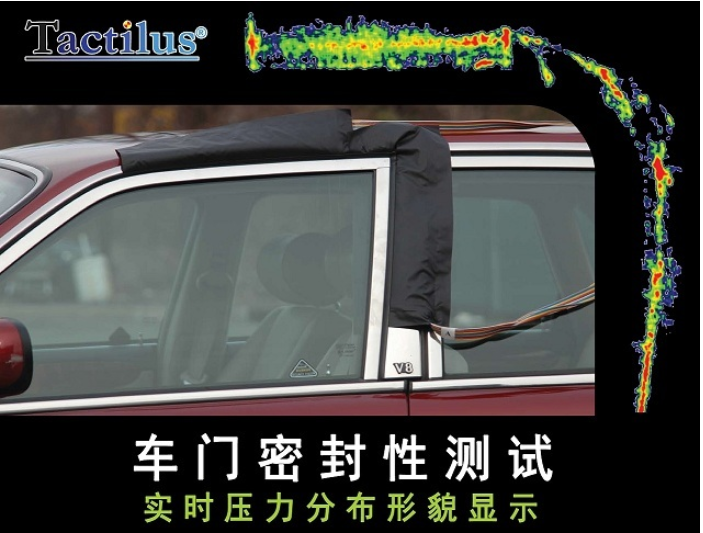
In the automotive manufacturing field, a long-standing challenge for engineers has been how to accurately measure the pressure distribution of car door sealing strips. Traditional methods struggle to capture microscopic pressure changes during dynamic contact, leading to noise or water leakage due to uneven sealing pressure while driving. With the introduction of the SPI Tactilus pressure distribution measurement system, this challenge is meeting a brand-new solution — it uses flexible sensors and real-time analysis technology to provide engineers with unprecedented pressure distribution visualization capabilities.
1. Breakthrough Measurement Technology Principles and Applications
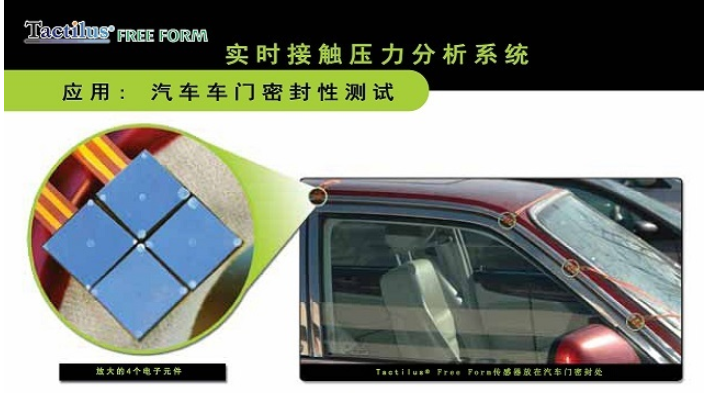
The SPI Tactilus automotive door seal precision pressure distribution testing system consists of three core components: flexible sensors, data acquisition units, and analysis software, designed specifically to solve the problem of measuring sealing strip pressure distribution. Its sensor thickness is less than 1 millimeter and can be customized in length and width according to customer requirements, perfectly fitting the curved surface structure of car doors.
The system uses a resistive sensing principle, achieving pressure conduction through conductive fabric or silver-plated materials. When the sealing strip contacts the car door, thousands of sensing units distributed on the sensor surface (with a dot density of up to 1024 points) capture pressure signals in real time, with a sampling frequency of 1000Hz, accurate to four decimal places.
1) Software System Supports Multidimensional Dynamic Analysis:
- Real-time Visualization: Displays 2D/3D pressure distribution maps in a blue-green-yellow-red spectrum, accurately locating high-pressure peaks and low-pressure valleys.
- Dynamic Tracking: Records the movement trajectory of the force center point, supports test process video recording and slow-motion playback.
- Quantitative Output: Exports data in Excel/TXT formats, with units covering PSI, KPa, bar, and other engineering units.
2) Practical Pressure Optimization for Automotive Sealing Strips
At automotive manufacturing sites, the uniformity of sealing strip pressure distribution is directly related to NVH (Noise, Vibration, and Harshness) performance. A certain car manufacturer found when comparing two sealing strips with the same total pressure that:
- Problem Sample: The 3D pressure map shows obvious peaks and valleys in the middle, indicating a risk of seal failure (Figure 1).
- Optimized Sample: Pressure peak reduced by 40% and distribution flattened, effectively preventing water leakage and abnormal noise (Figure 2).
Through pressure-time curve analysis with the SPI system, engineers further discovered that the impact pressure peak at the moment the car door closes far exceeded design expectations. Based on this, the team reconstructed the density gradient of the sealing strip's foam material, increasing the contact width by 15%, ultimately extending the seal life to 100,000 open-close cycles.
3) Calibration Reliability Guarantee: The system is pre-calibrated at the factory by NIST (National Institute of Standards and Technology, USA), with a measurement error rate below 0.5% within the 0-10 PSI range, requiring no secondary calibration by users.
2. Technical Advantages and Expanded Application Scenarios
The system's value has surpassed the traditional automotive field, forming cross-industry radiation:
- New Energy Battery Sealing: Monitoring pressure attenuation of battery pack sealing strips under vibration environments to prevent electrolyte leakage.
- Aerospace Sealing: In cabin door seal testing, verifying reliability under -40°C to 200°C conditions through temperature-pressure coupling analysis.
- Building Door and Window Sealing: Quantifying pressure distribution mutation points under typhoon-level wind and rain loads to guide reinforcement rib layout.
After combining with CAE simulation technology, the system demonstrates powerful design optimization capabilities. A company imported measured data into the Ogden material model, successfully predicting the lip edge flare trend of the sealing strip under bending and optimizing the cross-sectional structure accordingly, reducing wrinkle defect rates by 90%.
As new energy vehicles demand increasingly stringent quietness, sealing strip pressure optimization has become a key battlefield in whole vehicle R&D. The SPI Tactilus system, with its millisecond-level dynamic capture capability and micron-level spatial resolution, is reshaping the quality standards of seal design. From laboratories to production lines, from automobiles to aerospace, this technology proves that those invisible pressure trajectories will ultimately become visible coordinates driving industrial advancement.
Seal Strip Pressure Distribution,Surface Pressure Measurement,Dynamic Pressure Measurement