


DIC Experiment: How to Use the DIC Strain Measurement System for Experimental Validation of CAE Simulation Results
Release time:
2025-05-15 16:23
Source:
Introduction
In engineering design and analysis, computer-aided engineering (CAE) simulation has become an indispensable tool. However, the accuracy of simulation results is often affected by various factors, making experimental validation of simulation results particularly important. At this point, the emergence of Digital Image Correlation (DIC) technology provides us with a more efficient method for experimental validation.
Introduction to DIC Technology
DIC is a non-contact optical measurement technique that precisely measures deformation and displacement of an object during loading by analyzing changes in the surface images of the object. Compared to traditional measurement methods, DIC not only provides high-precision data but also enables real-time monitoring under complex loading conditions.
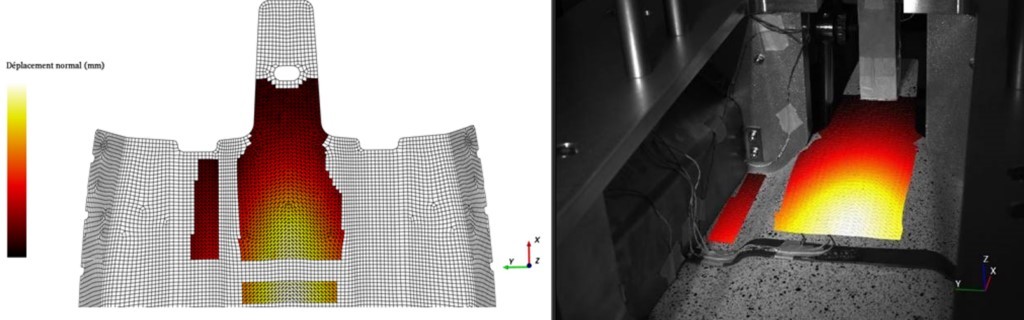
Combination of Simulation and Experiment
When performing experimental validation of simulation results, the introduction of DIC technology undoubtedly provides strong support. By comparative analysis of CAE simulation results, we can gain a more comprehensive understanding of material performance in practical applications. The key to this process lies in how to effectively combine simulation and experiment.
EikoTwin DIC The simulation design comparison and verification system was introduced by Beijing Qiaoze in 2020. It is a highly interactive 3D full-field optical strain measurement and analysis system composed of hardware such as computers and cameras, and the EikoTwin software analysis system. This system has made many improvements based on traditional DIC measurement systems. Using the FEM simulation model as a benchmark, it performs digital image correlation processing, allowing FEM simulation data and measured strain data to be directly compared on the same platform:
* Image processing based on finite element mesh
* Automatic calibration around the mesh
* Multi-view (no technical limit on the number of cameras)
EikoTwin DIC The software system requires image files and FEM model files in matching formats to operate normally, for example:
1) Supported formats for images captured by visible light cameras: .tif, .png, .jpg, .bmp
2) Supported formats for infrared camera images: .mat (-v.4)
3) Supported MESH model formats:
▪ Abaqus format (.inp): compatible with any type of linear and nonlinear elements and all element type formats (from 2018 version onwards)
▪ Samcef format (.dat): compatible with Tri/Tetra, Quad/Hex, and Wedge types of linear and nonlinear elements, as well as the following format
written as «AEL» type: «I element number FRAME local landmark number»
▪ Gmsh format (.msh): compatible with any version up to 4.1, except 4.0
▪ HyperWorks format (.h3d)
Optimizing Simulation Models
First, DIC technology can help us identify potential problems in simulation models. For example, in material testing, the real deformation data recorded by DIC allows us to discover unreasonable assumptions or parameters in the simulation model, enabling optimization. Oh, that's a great idea!
Data Accuracy
Secondly, the high-precision data provided by DIC can be used to calibrate simulation models. By comparing with experimental data, we can adjust material properties, boundary conditions, and other parameters in CAE simulations to ensure that simulation results match actual conditions. This calibration process not only improves the credibility of simulations but also provides a reliable basis for subsequent designs.
Case Study: Application of DIC in Engineering
Let's look at a specific case. In a fatigue test of a structural component, researchers used DIC technology to record deformation data under different loading conditions. Subsequently, this data was used to validate CAE simulation results. The results showed that the stress concentration areas predicted by the simulation highly matched the actual deformation areas measured by DIC, verifying the accuracy of the simulation model.
Importance of Experimental Validation
In this case, experimental validation of simulation results not only enhanced confidence in the simulation model but also provided important references for subsequent engineering designs. As the old saying goes: "Practice makes perfect." Through DIC technology, we can gain a deeper understanding of material behavior, enabling wiser decisions during design.
Summary and Outlook
Overall, DIC technology plays a crucial role in the experimental validation of simulation results. It not only improves the reliability of simulation results but also enables engineers to design in a more scientific manner. In the future, with continuous technological advancements, we believe the integration of DIC and CAE will become closer, driving innovation and development in engineering design.
So, dear readers, are you ready to apply DIC experiments to your engineering projects to optimize your CAE simulation results?
Experimental validation of simulation results