


Exploring how non-contact strain measurement methods empower simulation result comparison and validation
Release time:
2025-04-25 01:18
Source:
The Charm of Non-Contact Strain Measurement Methods
In modern engineering and scientific research, precise strain measurement is particularly important. Especially in some special environments, such as high temperature and highly corrosive environments, traditional contact strain gauges are often not very suitable. At this time, non-contact strain measurement methods have emerged, becoming the "favorite" of many researchers.
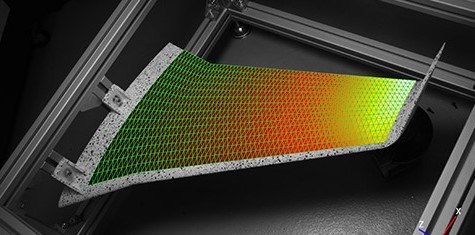
What are the non-contact strain measurement methods?
When it comes to non-contact strain measurement methods, people may think of several technologies:
- Optical Strain Measurement Using optical technologies, such as laser interferometry and digital image correlation (DIC), to obtain strain information by analyzing changes in the surface images of objects.
- Electromagnetic Strain Measurement Measuring displacement changes of objects through reflection and propagation of electromagnetic waves, thereby indirectly calculating strain.
- Ultrasonic Measurement Using the propagation characteristics of ultrasonic waves to determine the strain on the material surface, especially suitable for structural health monitoring.
Applications of Optical Strain Measurement
Optical strain measurement is currently the most popular non-contact method. DIC technology achieves high-precision strain measurement by tracking random patterns on the object's surface, and it is simple to operate and widely applied. Imagine, researchers only need to spray some specific patterns on the object's surface to monitor strain in real-time on a computer screen — truly "marvelous"!
The Importance of Comparing Simulation Results with Experimental Data for Validation
When applying these non-contact strain measurement methods, comparing simulation results with experimental data for validation is especially important. Through comparison, the accuracy of simulation models can be verified, the reliability of measurement methods improved, and the integration of theory and practice further promoted.
For example, when researchers use optical strain measurement methods, they usually combine finite element analysis (FEA) for simulation. After obtaining simulation results, comparing them with experimental data can effectively evaluate the model's rationality. This process not only helps identify potential problems but also guides subsequent research. If differences between simulation and measured data, or even boundary condition data, can be directly obtained from experimental measurements, it would undoubtedly greatly improve R&D efficiency!
Typical Case Sharing
A research team at a university used DIC technology to measure strain while studying the mechanical properties of composite materials. In a laboratory environment, by comparing simulation and experimental data, they not only verified the mechanical properties of the materials but also optimized the experimental design. This spirit of "combining theory with practice" is truly commendable!
Future Outlook
With continuous technological advancement, non-contact strain measurement methods will become more refined. Combining artificial intelligence and big data analysis, future strain measurement will be more intelligent and automated. At the same time, research on comparing simulation results with experimental data for validation will continue to deepen, providing more precise solutions for various industries.
In summary, non-contact strain measurement methods are not only the result of technological development but also an indispensable important tool in future scientific research and engineering practice. Let us look forward to these technologies shining brightly in more fields!
Comparison and validation of simulation results with experimental data