


Sharing application solutions for high-precision localization and analysis of noise sources in the automotive and motorcycle industries
Release time:
2025-09-03 16:02
Source:
With the continuous improvement of NVH (Noise, Vibration, Harshness) performance requirements in the automotive and motorcycle industries, high-precision noise source localization and analysis technology has become a key means to enhance product quality and improve user experience. In recent years, noise source localization methods have been continuously iterated and upgraded, from traditional subjective evaluation to AI-based intelligent recognition, providing strong technical support for controlling abnormal noises in vehicles and components.
1. Evolution and Application Challenges of Noise Source Localization Technology
Automotive abnormal noise (BSR, Buzz, Squeak, Rattle) is characterized by randomness, low-frequency energy, and susceptibility to being masked by background noise. Traditional methods such as subjective evaluation by human ears, step-by-step operation, and near-field sound pressure measurement are simple and easy to use but rely on engineers' experience and have limited accuracy. Especially with the popularization of electric vehicles and the reduction of background noise, abnormal noise issues have become more prominent, urgently requiring high-precision and quantifiable localization methods.
2. High-Precision Localization Technical Solutions and Typical Equipment
1. Array Acoustic Imaging System
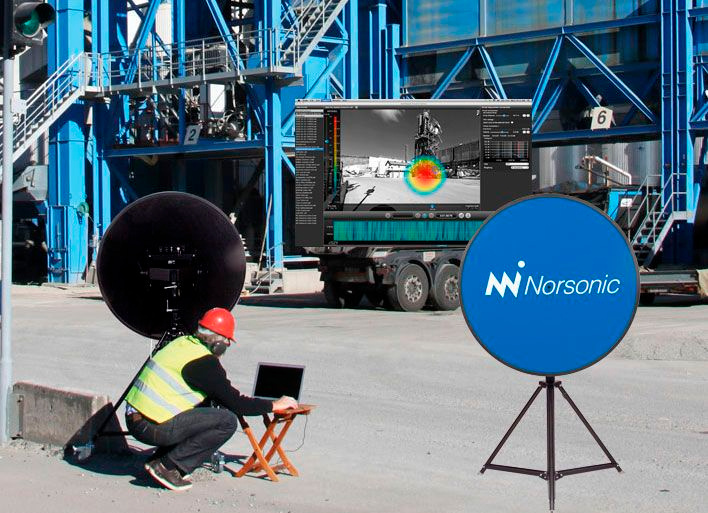
Beamforming technology is suitable for mid-to-high frequency far-field noise source localization. Typical equipment such as the Norsonic far-field sound and vibration measurement system can visualize noise sources through a multi-microphone array and is widely used in analyzing mid-to-high frequency noises like door closing sounds, wind noise, and tire noise. However, this method has low resolution in the low-frequency range and is not suitable for locating low-frequency abnormal noises inside vehicles.
2. Near-field Acoustic Holography (NAH)
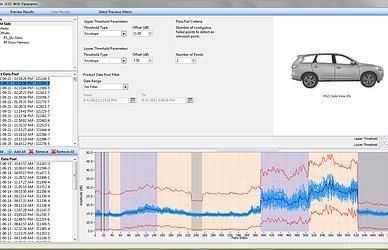
Near-field acoustic holography technology performs excellently for low-frequency noise. For example, the Synave near-field 3D acoustic holography measurement system can reconstruct the phase and amplitude information of the sound field through a dense microphone array, achieving high-precision imaging of low-frequency noise sources. Studies show that this method is effective in locating engine abnormal noises and dashboard vibration noises, especially suitable for frequencies below 200Hz. However, its complex sensor arrangement and high cost still limit its large-scale engineering applications to some extent.
3. Integrated Noise Diagnosis Platform
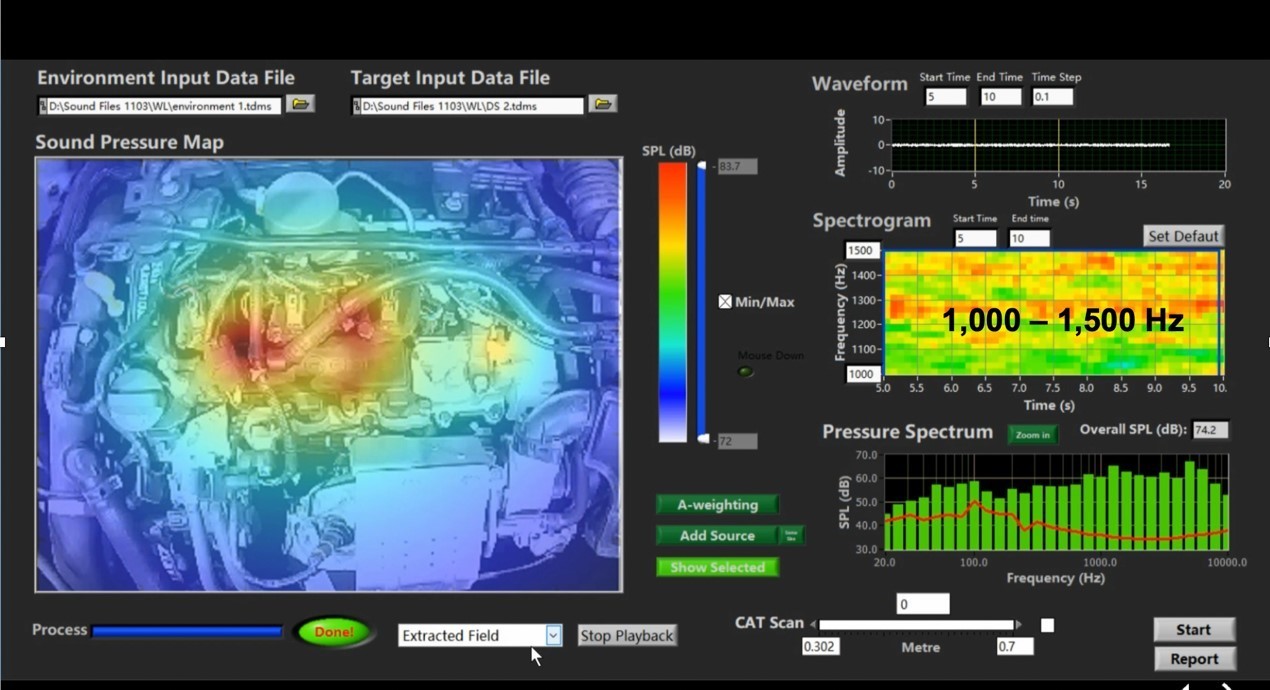
To accommodate analysis of both high and low frequencies and multiple noise types, the SOUNDVIEWER integrated noise diagnosis and analysis system combines various sensors and signal processing algorithms. It supports multiple modes such as sound pressure, vibration, order analysis, acoustic holography, and beamforming, suitable for vehicle NVH testing, abnormal noise tracing, and sound quality optimization. Such systems usually have strong data processing capabilities and can improve abnormal noise signal recognition and localization accuracy by integrating machine learning algorithms.
3. Industry Application Cases and Data Support
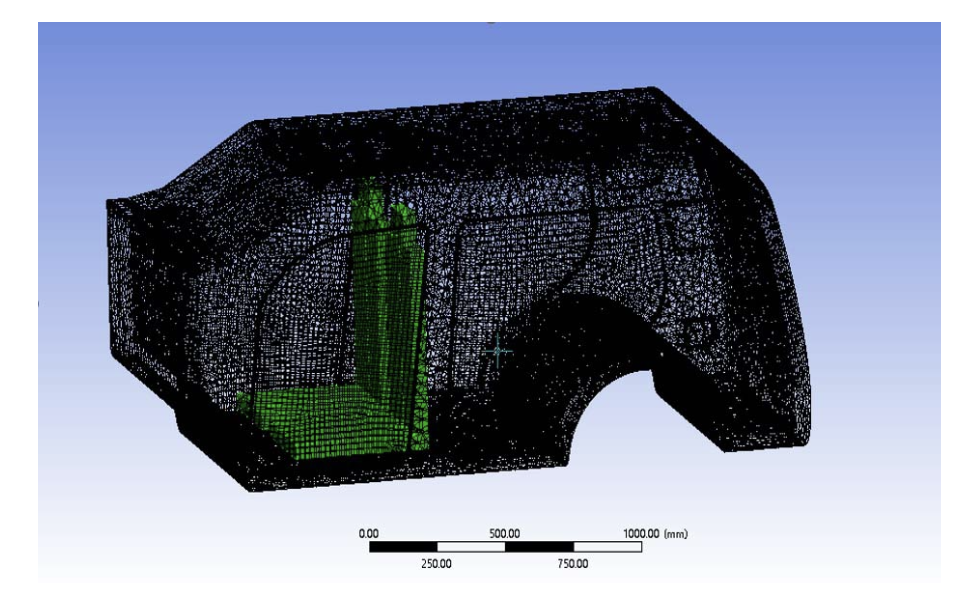
In the development of a certain SUV model, researchers identified the rear quarter window and C-pillar areas as the main contributors to interior noise using near-field acoustic holography technology. After structural reinforcement and damping material application, the sound pressure level at the driver's right ear decreased by 4.31dB and 3.63dB at 38Hz and 140Hz respectively. In another study, an acoustic camera system based on beamforming successfully located the electromagnetic noise source of an electric motorcycle's drive motor, and structural optimization reduced the vehicle's overall noise by 2.5dB(A).
4. Future Outlook: Intelligent Integration and System Integration
With the introduction of artificial intelligence technologies such as compressed sensing, time reversal methods, and machine learning, noise source localization is developing towards "fewer sensors, higher precision, and strong anti-interference." For example, a bionic microphone array based on a binaural auditory model has achieved preliminary success in low-frequency localization at 500Hz. In the future, intelligent NVH systems that integrate multi-physical field data and combine virtual simulation with actual measurement verification will become standard tools for OEMs and component suppliers.
References:
[1] Zhao Weidong et al. Research Progress and Prospects of Automotive Abnormal Noise Source Localization Methods [J]. Journal of Chongqing University of Technology, 2022.
[2] Zhang Y. et al. Door-closing sound quality improvement based on beamforming method [J]. SAE International Journal of Engines, 2020.
[3] Li L. et al. Application of near-field acoustic holography to engine start-up noise issue [J]. SAE Technical Paper, 2015.
[4] Ahn H. et al. Deep-learning-based approach to anomaly detection for large acoustic data [J]. Sensors, 2021.
[5] Yang Yuanxiong. Coupled Acoustic-Structural Analysis and Optimization of SUV Interior Noise [J]. Sensor Technology and Applications, 2024.
[6] Zeng Zhixin et al. Research on Aerodynamic Noise of Engine Cooling Fan and Bionic Improvement [J]. Mechanical Science and Technology, 2022.
[7] Qian Weijie. Research on Principles and Methods of Sound Source Localization [D]. University of Science and Technology of China, 2019.
High-precision localization and detailed analysis of noise sources,Noise Source Localization,Automobile Noise Detection,Noise Diagnosis and Analysis
Previous Page