


Key to Environmental Noise Control: How to Develop Solutions Based on Real and Accurate Noise Data?
Release time:
2025-08-28 18:24
Source:
In the hustle and bustle of the city, noise pollution has become the second largest urban environmental risk after air pollution, and precise noise data has become the cornerstone of governance decisions. Early morning 7 hours, square dance music penetrates residents' windows; in the evening, the screams from children's play areas drown out the birdsong—these daily scenes reflect common conflicts in the use of public spaces. 2022 The 2021 United Nations Environment Programme's Environmental Frontiers report pointed out that with urban development, noise has become an emerging global environmental concern. According to data from the Ministry of Ecology and Environment, noise pollution complaints in China have increased from 2020 the year 201.8 ten thousand cases to 2023 the year 570.6 hundred thousand cases, with complaint volumes closely related to urban development and population density.
01 The complex nature of noise pollution
Urban noise mainly falls into three categories: noise from cultural and sports activities such as square dancing, high-frequency composite noise generated by children's play and pet activities, and background noise from commercial facilities and equipment operations. These noise issues collectively reflect planning and management shortcomings in park sound environment governance. Noise significantly erodes the quality of life of surrounding residents, causing health problems such as anxiety and insomnia, and forming a multidimensional harm chain of "physiological - psychological - social" effects. More seriously, noise disputes repeatedly occur without effective governance, causing neighborhood conflicts to shift from "issues" to "personal" disputes, continuously undermining the foundation of social trust.
02 Limitations of traditional governance methods
Traditional noise governance methods fall into the dilemma of "temporary control." "Noise bans" rely on manual patrols with limited coverage; decibel meter manual measurements have delayed responses (20-30 minutes) and are easily affected by the environment; negotiation and persuasion lack continuous supervision. In a Shanghai park, the "Noise Self-discipline Convention" had a half-year violation rate as high as 20-30 %. These problems stem from the inherent contradiction between the dynamic nature of noise and the slow response, narrow coverage, and difficulty in evidence collection of manual methods. 62%。这些问题源于噪音动态性与人工手段响应慢、覆盖窄、取证难的天然矛盾。
03 Technology empowers noise monitoring
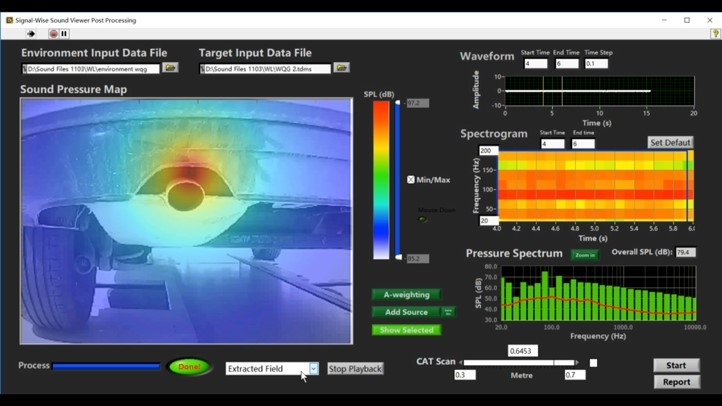
With technological advances, noise monitoring is becoming precise and efficient. The Bao'an Management Bureau of Shenzhen Ecology and Environment Bureau innovatively applied acoustic imaging technology to noise detection. This technology is equipped with a precisely arranged microphone array system that can capture noise sources in real time and generate visual heat maps, achieving sound source direction localization and imaging. Acoustic imaging devices have advantages such as non-contact detection, high-resolution imaging, and adaptability to multiple scenarios, capable of penetrating some obstructions and locating deeply hidden noise sources. In the field of noise source localization and sound field reconstruction, near-field acoustic holography-based sound source localization systems use microphone arrays to capture noise sources in real time and generate visual heat maps. SoundViewer Comprehensive noise diagnosis and analysis system and other tools provide technical support for precise noise source identification.
04 Noise simulation and prediction tools
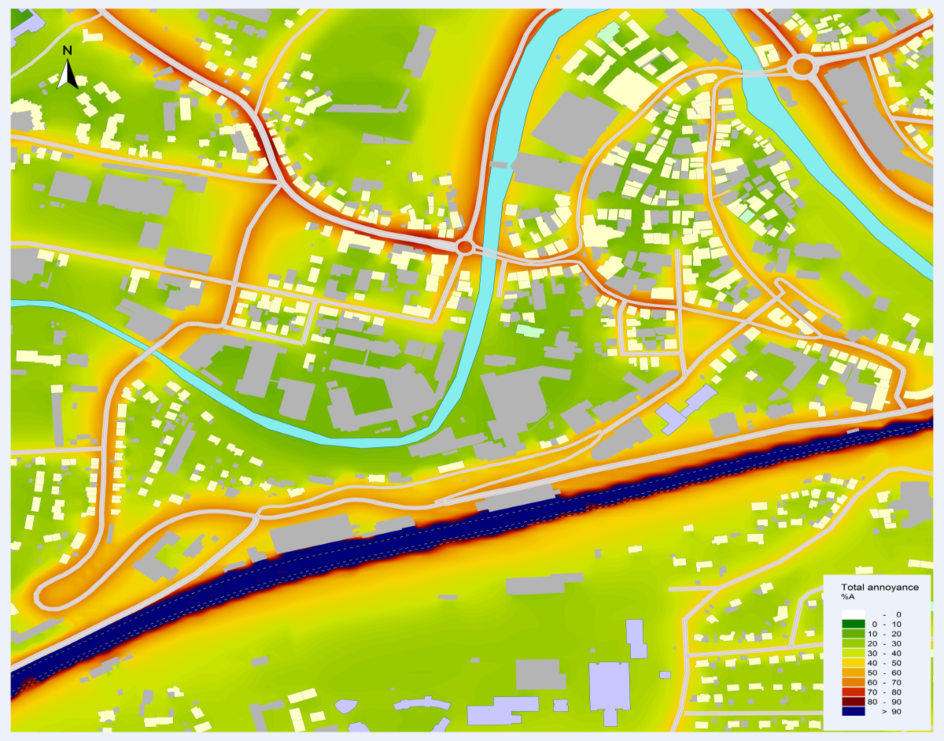
In the field of noise prediction and assessment, SoundPLAN noise simulation software since 1986 the year Braunstein + Berndt GmbH software designers released it, it quickly became the standard for outdoor acoustic software in Germany and gradually became an integrated software for noise simulation, mapping, and assessment worldwide. The latest SoundPLANnoise 9.1 version added the 2024 new standard of the year ISO 9613-2 for calculating sound attenuation during outdoor propagation. The software considers various types of measurement objects, including cylindrical bodies, stack directionality, and forest attenuation. SoundPLANnoise 9.1 It also enhanced 3D the user interface, providing new 3D building noise mapping functions that visualize noise propagation in unprecedented ways. The software can also calculate and predict various noise metrics, including LA, Leq, L10, Ldn, NEF, EPNL and others.
05 Data-driven governance practices
After pilot parks in Chengdu applied directional sound equipment, complaints from surrounding residents decreased 98% significantly. This equipment uses the "sound spotlight" principle to compress music signals into directional sound beams, achieving the dual goal of "dancers hear clearly (75-80 decibels) and meeting standards (≤ +30 meters away at ≤ 55 decibels)".
In noise detection at the Xinwanda factory area, Bao'an Management Bureau used acoustic imaging devices to precisely identify relatively high noise sources such as some air conditioning outdoor units and exhaust collection pipe corners, visually presenting noise distribution through color markings. This helped enterprises / and organizations determine noise reduction retrofit priorities and provided scientific basis and technical support for enterprises / and organizations.
06 Data-driven decision-making and management
Solutions based on real and accurate noise data not only assist on-site governance but also support urban planning and decision-making. The technical framework for sound environment zoning control follows the approach of "problem identification—goal setting—zoning—list formulation." It comprehensively considers land use nature, spatial layout, and noise impact to delineate priority protection zones, key control zones, and general control zones. Empirical studies in Haikou City show that sound environment zoning control helps ensure urban sound environment quality, promotes differentiated and precise sound environment management, and enhances the level of source prevention in noise control. The introduction of artificial intelligence technology provides a new technical path for noise pollution control. By integrating sensor networks, machine learning algorithms, and intelligent control systems, efficient data collection, accurate noise identification, and automated control responses can be achieved.
07 Future Outlook
Noise control is an important livelihood project to improve residents' quality of life, safeguard the public's right to tranquility and physical and mental health, and reflect the refinement and people-oriented concept of urban public services. Technical means and convention building can balance diverse needs and promote parks as shared spaces. The "monitoring - analysis - and governance" closed loop formed during governance provides a replicable micro-sample for smart cities in the field of noise and other environmental governance. [citation:1 As more cities adopt solutions based on real and accurate noise data, residents will enjoy more livable urban environments. From responsive governance to proactive planning, precise noise data is transforming the paradigm of urban sound environment management.
Acquisition of Real Noise Data,Noise Map,Noise Control,Acoustic Imaging,Noise Control,Noise Solutions