


What data support can the BOB human skeletal muscle simulation modeling software provide for the research and development of bionic robots?
Release time:
2025-08-13 16:56
Source:
From precise joint torque calculations to dynamic muscle energy simulations, modern simulation tools are transforming the mysteries of human biomechanics into a universal language for robot development.
The sophistication of human movement originates from 206 the coordination of skeletal blocks and 600 multiple muscles, forming a complex dynamic system with high degrees of freedom. A research team at Tsinghua University recently developed a full-body musculoskeletal model containing 700 muscle - tendon units, revealing the complexity of this system. The UK BOB human musculoskeletal simulation modeling software, as a professional biomechanical analysis tool, comes with a default configuration including more than 600 motor muscle units, capable of handling various biomechanical data formats, providing robot developers with precise insights into human movement mechanisms.
01 Multimodal Data Processing and Kinematic Analysis
BOB The core advantage of the software lies in its powerful multi-source data compatibility. The platform supports processing C3D files (based on Helen Hayes model), CALC files ( Perception Neuron export), MVNX files (from Xsens ) and five other mainstream motion capture data formats. This compatibility enables researchers to quickly convert real human motion data into simulation model inputs.
In terms of kinematic analysis, the software provides key functions such as anatomical trajectory reconstruction, body posture analysis, point position, / velocity, / and acceleration measurements. These data are crucial for humanoid robot gait planning. For example, the Tsinghua University team used similar technology to achieve precise modeling of the full-body musculoskeletal system and motion control process through hierarchical low-dimensional representation methods.
The latest version also enhances video synchronization analysis capabilities, allowing the plotting of rectified and non-rectified EMG signals synchronized with motion data, displaying physical muscle information such as muscle length, contraction speed, and muscle force. These real-time physiological parameters provide biological reference benchmarks for the sensitivity adjustment of robot actuators.

02 Dynamic Parameter Output and Muscle Force Modeling
Dynamic analysis is another core capability of the BOB software. It can accurately calculate key biomechanical parameters such as joint torque, ground reaction force, and joint contact force. These data directly determine the structural strength design and power system configuration of bionic robots.
The software uses Hill muscle model to simulate muscle contraction characteristics, with algorithms considering multiple factors such as muscle length, isometric muscle force, and contraction speed. This is consistent with the muscle modeling method used in the Tsinghua University MS-Human-700 model.
In terms of force prediction accuracy, a recent neuromusculoskeletal modeling study successfully predicted ankle dorsiflexion force curves by integrating high-density electromyography with finite element models ( R ² =0.95 ). BOB The mechanical simulation accuracy has reached industrial application standards.
The software also provides muscle energy / power calculation functions, enabling quantitative analysis of total muscle energy consumption under different movement states. These metabolic data offer biological reference indicators for optimizing the energy efficiency of humanoid robots, which is important for extending robot operation time.
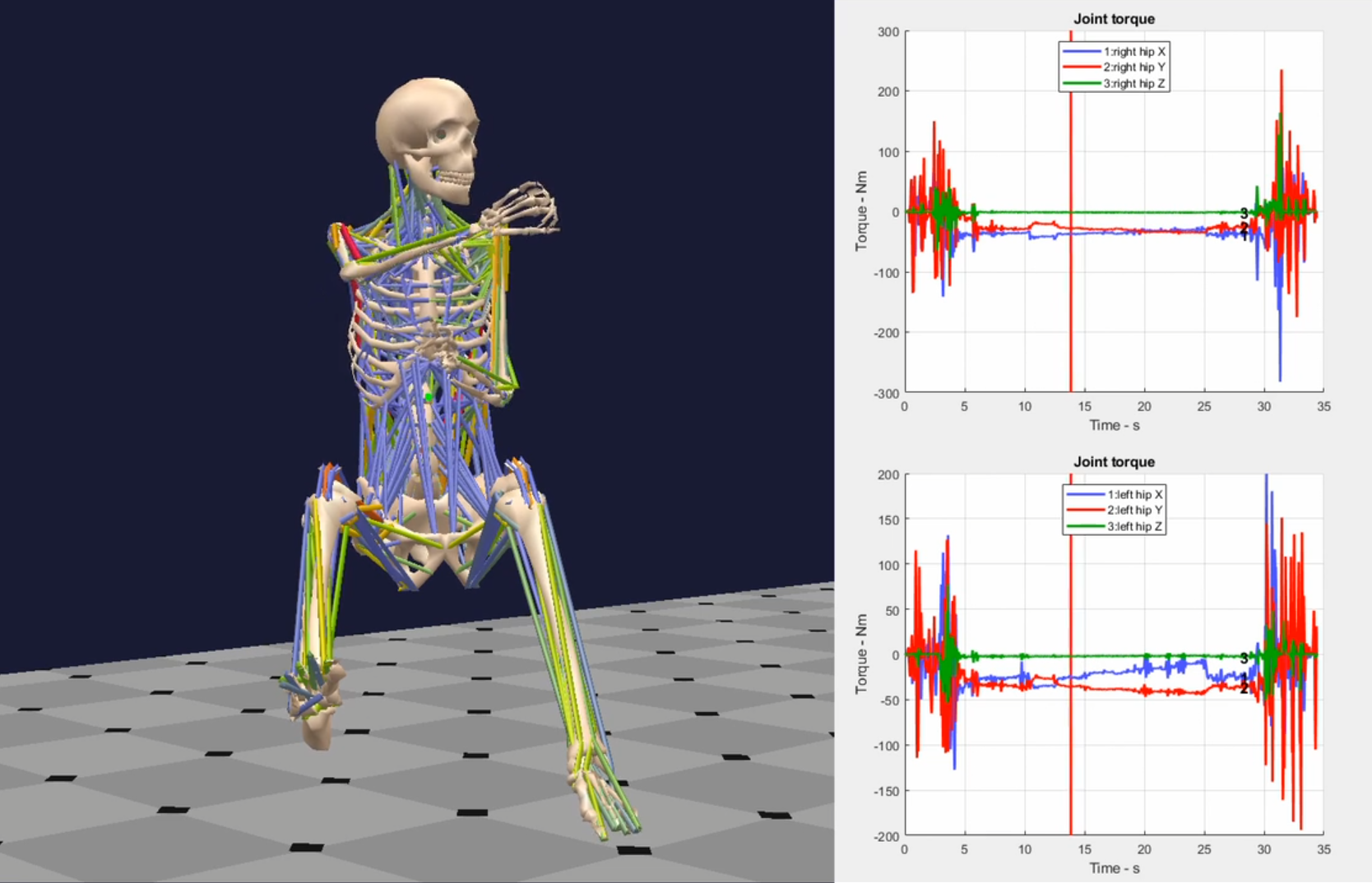
03 Personalized Modeling and Simulation Control
BOB The platform supports personalized musculoskeletal model construction, allowing users to create customized models based on medical imaging data of specific subjects. This personalized modeling capability is especially important for adaptation research in medical rehabilitation robots.
In control strategy development, the software's seamless integration with MATLAB enables researchers to rapidly iterate complex control algorithms. The hierarchical deep reinforcement learning method adopted by the Tsinghua University team achieved 700 muscle unit cooperative control on a similar platform.
Recent research progress shows that the field of predictive musculoskeletal simulation has developed two main types of methods: neurophysiology-based models (muscle reflex models and central pattern generators) and optimization-based black-box methods (optimal control and deep reinforcement learning). BOB The platform provides a validation environment for these two types of methods. In 8 month this year, the National-Local Joint Humanoid Robot Innovation Center released the “Gewu” embodied intelligence simulation platform, achieving a new breakthrough with a codebase covering over a hundred robots. BOB Biomechanical data output from
can provide baseline human motion parameters for such platforms, accelerating the integration of human-machine motion control.
04 Industry Applications and Frontier Integration BOB In the field of rehabilitation robots, 3 dynamic analysis modules can quantitatively simulate interaction forces between the human body and assistive devices. The Tsinghua University team used similar technology to achieve minimal contact force control for wearable exoskeleton robots. A review of computational bone remodeling models published in BOB month this year pointed out that bone tissue has significant piezoelectric properties, capable of converting mechanical stress into electrical signals. The mechanical simulation capability of NVIDIA 8 11 month day latest released The library implements ray tracing 3D Gaussian splatter rendering enables large-scale reconstruction of real-world scenes. This physically accurate simulation environment combined with BOB biomechanical data will create more realistic training scenarios for bionic robots.
With the Cosmos Transfer-2 model about to be launched, the speed of synthetic data generation will be greatly increased. BOB The high-precision human motion data generated by the software can serve as the foundational dataset for physical AI training, addressing the bottleneck of insufficient real data in robot training. The future of bionic robots lies in a profound understanding of the essence of human biomechanics. BOB Key parameters provided by the software such as joint torque, muscle strength, and energy consumption have become the basic dictionary for robot developers to decode human motion. With the emergence of tools like the national and local co-built humanoid robot innovation center "Gewu" platform, the vision of controlling over a hundred robots with a single code has become a reality. Meanwhile, BOB the accumulated human motion data is endowing these steel bodies with the rhythm of life.
BOB Human Skeletal Muscle Simulation Modeling Software,Human Motion Biomechanics Analysis,Bionic Robot Research and Design