


From Precision Validation to Deep Application: Human Skeletal Muscle Simulation Modeling Based on Data Provided by Markerless Motion Capture Devices
Release time:
2025-07-22 09:54
Source:
Twelve high-definition cameras stand quietly by the gymnastics arena, capturing the mechanical code of every athlete's airborne flip in real time as 3D data streams, without any physical markers.
In May last year, the national gymnastics championships introduced a markerless intelligent motion capture system for the vault and rings events for the first time. Using machine vision and deep learning technology, the system automatically identifies the athlete's body joints during aerial rotations, analyzing key technical parameters such as time, displacement, speed, height, and angle in real time, including core indicators like board angle, vault push angle, and rotational angular velocity.
This system enables coaching teams to precisely quantify the biomechanical characteristics of each movement, providing scientific basis for training adjustments. The underlying technological revolution supporting such applications is rapidly spreading in the global biomechanics research field.
✅ 01 Accuracy Verification, Breaking Through Laboratory Walls
Traditional marker-based motion capture systems (MMC) can achieve sub-millimeter accuracy in laboratory environments, but their strict requirements for professional settings and high costs limit widespread application. A study published in June 2024 in Technology and Health Care systematically evaluated the joint kinematic accuracy of markerless video motion capture systems (VMC) for the first time.
The research team tested 18 healthy subjects covering 17 joint degrees of freedom. Data showed that for shoulder, hip, and knee joint angle measurements, the average absolute errors between the markerless system and traditional systems were only 4.8°, 6.8°, and 3.5°, respectively.
However, challenges remain: tracking errors for hand and elbow movements reached as high as 13.7° and 27.7°, indicating that capturing complex upper limb motions still requires technological breakthroughs.
In early 2025, a team from the University of Calgary conducted a deeper comparison of two systems in cycling. They found that the OpenCap system performed excellently in sagittal plane joint angle measurements, with correlation coefficients (r values) for hip, knee, and ankle joint angles all exceeding 0.9.
✅ 02 OpenCap, Low-Cost Technological Revolution
The most disruptive innovation in markerless motion capture technology comes from the OpenCap open-source system developed by a Stanford University team, costing only 1% of traditional equipment (about $1,500).
The system requires only two calibrated iPhones and can complete data collection and analysis within ten minutes, generating key biomechanical parameters such as joint angles and joint loads. This portability extends research scenarios from professional laboratories to sports fields, clinics, and even home environments.
A study published in June 2024 in the Journal of Biomechanics further validated OpenCap's reliability in athlete rehabilitation assessment. Researchers tested athletes after anterior cruciate ligament reconstruction and found the system showed high consistency in sagittal plane knee and hip joint motion analysis (CMC > 0.94).
The University of North Carolina at Chapel Hill team confirmed in return-to-sport task assessments that OpenCap's average absolute error for lower limb joint angle measurements was 3.85°, comparable to existing markerless systems.
✅ 03 Deep Applications Across Multiple Fields
With continuous accuracy improvements, markerless motion capture technology is rapidly penetrating multiple professional fields.
In competitive sports, the scientific research team at the National Sports Administration's Gymnastics Management Center has applied the system to optimize athletes' technical movements. Through cluster analysis, the system compares data from different competitions to provide scientific basis for training adjustments.
In medical rehabilitation, a gait analysis system developed in 2022 based on BiLSTM deep learning algorithms significantly reduced system errors of the Kinect V2 sensor. After correction, the root mean square error of hip joint angles was less than 5°, enabling home-based rehabilitation assessments.
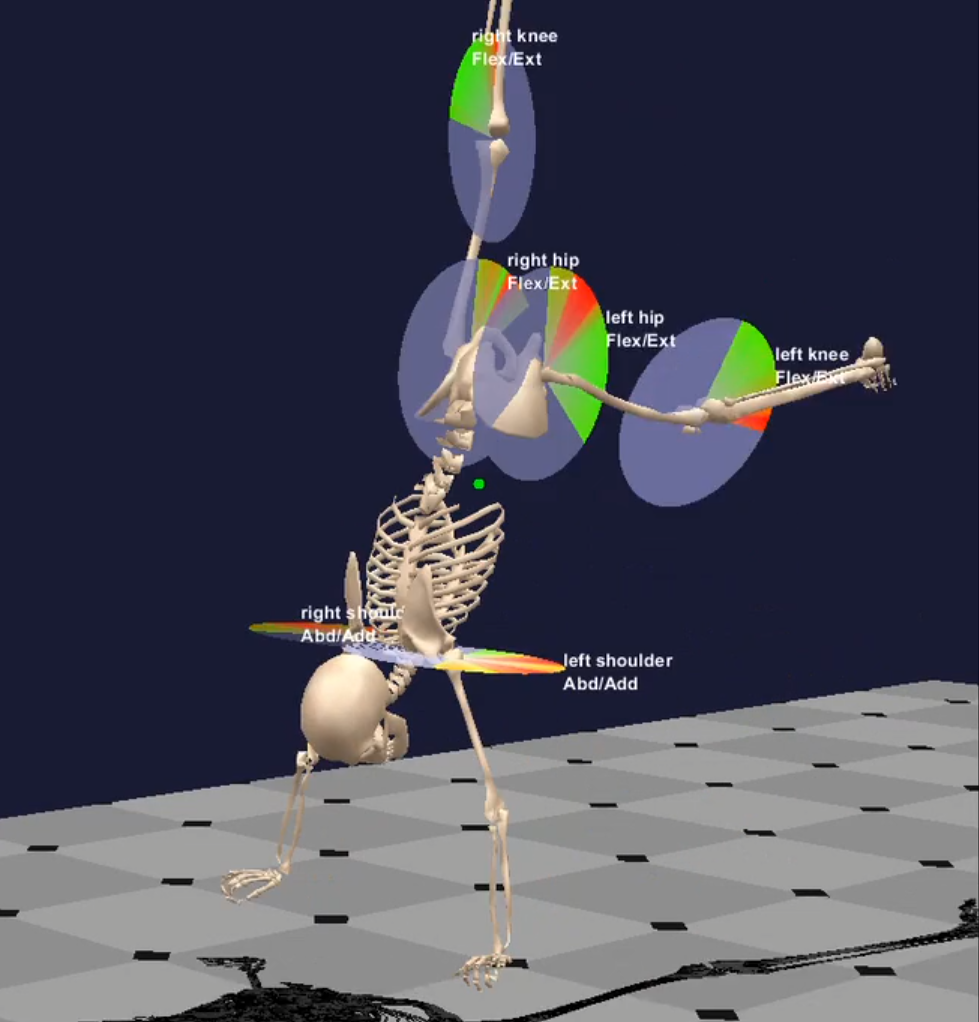
The industrial sector also benefits from this technological transformation. For example, BOB Human Motion Biomechanics Analysis Software By modeling and simulating human motion, it achieves real-time risk assessment of workers' movements, automatically identifying dangerous postures and issuing warnings.
✅ 04 Technology Integration and Future Directions
Current technological frontiers focus on multimodal data fusion and algorithm optimization. The German MOVE 4D system uses high-speed scanning at 180 frames per second to generate over 50,000 3D data points of the whole body, achieving research-grade accuracy.
A study published in December 2024 in the Journal of Biomechanics proposed a fully automated workflow combining the OpenPose model and bidirectional Kalman filtering, significantly improving tracking accuracy of complex motion trajectories.
Innovative Chinese companies such as Guangzhou Virtual Power have developed systems using seven cameras to achieve 360° 3D reconstruction, with motion capture success rates exceeding 98% under ideal conditions.
Notably, platforms like ErgoLAB have realized multimodal synchronous analysis of motion capture with eye movement, EEG, and physiological data, providing more comprehensive data support for human motion research.
With the development of 5G and edge computing technologies, the integration of markerless systems with musculoskeletal simulation models will accelerate breakthroughs. In the next three years, we may witness a complete transformation of clinical gait analysis standard procedures, real-time biomechanical feedback for athlete technical optimization, and occupational ergonomics assessments moving from laboratories to real work environments.
The true revolution of the OpenCap system lies in breaking the cost barriers of biomechanics research. Tasks that traditionally required $150,000 worth of laboratory equipment can now be achieved with just two smartphones at comparable accuracy.
Researchers have begun using data collected by OpenCap to drive OpenSim musculoskeletal models, achieving breakthrough progress in clinical gait analysis. With algorithm iterations, the shortcomings of markerless systems in upper limb motion capture are being rapidly addressed.
In the wave of technology democratization, daily technical optimization for professional athletes, rehabilitation monitoring for orthopedic patients, and even movement correction for ordinary fitness enthusiasts will all receive laboratory-level biomechanical support — marking the beginning of democratization in sports science.
Personalized musculoskeletal simulation modeling of the human body for sports,BOB Human Motion Biomechanics Analysis Software,OPENCAP Markerless Motion Capture