


How to overcome the model data interoperability barriers in the MBD-based digital manufacturing process from CAD → CMM inspection → PLM traceability?
Release time:
2025-07-21 12:02
Source:
How to break through the model data interoperability barriers in the CAD→CMM inspection→PLM traceability process based on MBD digital manufacturing?
Loss and variation of 3D model data in cross-system transmission have become the core pain points restricting high-end manufacturing efficiency. Under the global wave of digital transformation in manufacturing, a seamless data flow throughout design, inspection, and product lifecycle management has become the "Holy Grail" of smart manufacturing.
In the aircraft structural parts manufacturing workshop, process personnel face an awkward dilemma: the 3D MBD (Model-Based Definition) model sent by the design department contains complete geometric and manufacturing information, but when this data is transmitted to the coordinate measuring machine (CMM) for quality inspection and then fed back to the product lifecycle management (PLM) system, key information is lost or distorted during repeated conversions. 。
This not only leads to decreased inspection efficiency but also breaks the quality traceability chain. This scenario reflects a deep bottleneck in the current digital transformation of manufacturing— Interoperability barriers of cross-system model data. 。
01 Technical Barrier: The Pain of MBD Data Disconnection.
MBD technology replaces traditional 2D drawings with integrated 3D models and theoretically can become the single data source throughout the product lifecycle. Single data source. However, in practical implementation, data gaps among the three major systems—CAD, CMM, and PLM—have become the strangler of the "digital thread." Digital thread. According to a patent study published by the China Northern Vehicle Research Institute in 2024, in traditional processes, design models and process models belong to independent data systems and require manual conversion to establish associations. This separation leads to
a 34% loss rate of design intent during manufacturing. The loss rate of design intent during manufacturing reaches 34%. The feedback cycle from process to design is extended by 50%. 1。
Nanjing University of Aeronautics and Astronautics further revealed in its research on collaborative manufacturing of aircraft structural parts that distortion in the transmission of non-geometric information (such as tolerances and surface treatment requirements) is the core issue. Due to the lack of unified semantic expression, process personnel need repeated confirmation to interpret the design model, reducing collaboration efficiency by more than 30%. 9。
More severely, in the inspection phase, CMM equipment usually cannot directly read PMI (Product Manufacturing Information) data from the CAD system. A report from an aviation company shows that 67% of dimensional tolerances in inspection planning need to be manually re-entered. This not only lowers efficiency but also introduces the risk of secondary errors. 5。
02 Breakthrough Point: QIF Standard and Unified Data Architecture.
Solving interoperability barriers requires dual breakthroughs in data architecture and exchange standards. In June 2025, Siemens NX™ software announced native support for the QIF (Quality Information Framework) standard, marking the first time mainstream CAD platforms have achieved seamless output of inspection data. 2。
QIF as an end-to-end digital metrology standard, its value lies in building a traceable chain from design intent to inspection results. When CAD models carrying intelligent PMI annotations are exported in QIF format, CMM systems can directly parse inspection paths and tolerance requirements, eliminating manual conversion steps. 3。
At the data architecture level, the China Northern Vehicle Research Institute proposed a unified design and process model construction method that is quite forward-looking. This method establishes associations between design and process data models through feature-level mapping technology, forming unified data object management. 1 This kind of "one-time modeling, universal application" architecture has been validated in the aviation field, shortening process preparation cycles by 30%. 10。
03 Closed-loop Feedback: Achieving Digital Thread Through Bidirectional Interoperability.
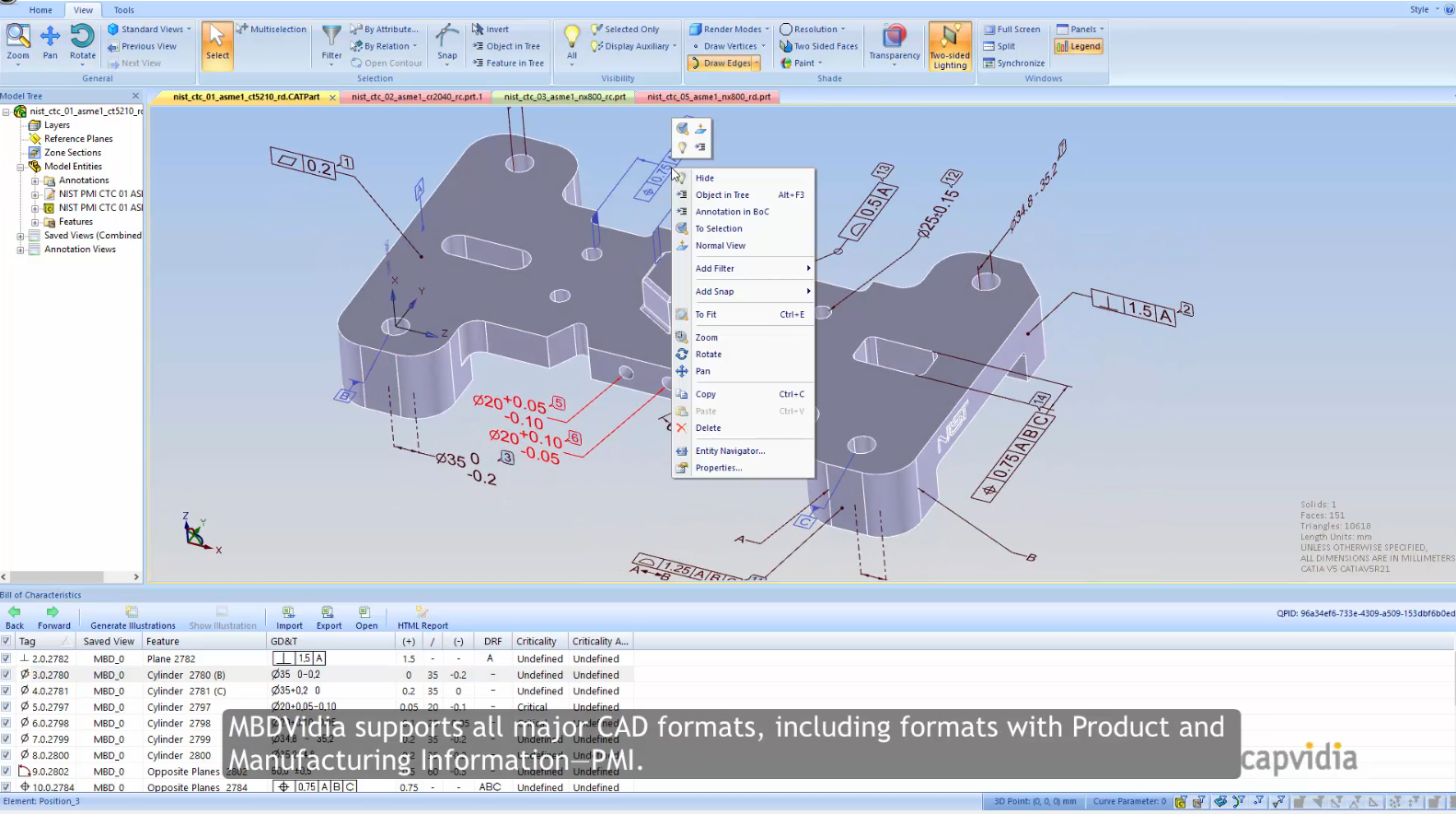
The real breakthrough lies in achieving bidirectional data flow. When inspection data can be fed back reversely to the design side, it forms a closed-loop optimization of "design-manufacture-inspection." Capvidia's MBDVidia software provides key technical support in this link by validating and refining QIF data, converting CMM measurement results into quality data packages recognizable by PLM systems. 4。
This process greatly improves quality traceability efficiency. A case study on an aircraft assembly line shows that MBD-based inspection data directly linked to product configurations in the PLM system reduces quality issue localization time from hours to minutes. More importantly, measurement data feeds back to design optimization, promoting the implementation of "Design for Inspection" (DFI) methods. 5。
Research from Skolkovo Institute in 2024 further points out that integration of MBSE (Model-Based Systems Engineering) and PLM requires interface modeling technology support. Managing data interfaces through Design Structure Matrix (DSM) ensures the integrity of cross-system data exchange. 6 This provides a methodological foundation for building enterprise-level digital threads.
04 Future Battlefield: AI-Driven and Full-Chain Automation.
Cutting-edge research is pushing interoperability to new heights. The July 2025 issue of Building Simulation published a study on enhanced obXML patterns, which, although focused on the construction field, offers inspiration through its approach to complex behavior modeling by extending patterns. In the manufacturing field, 8。
AI-based feature automatic recognition technology has become a new focus. Nanjing University of Aeronautics and Astronautics developed a collaborative design system for aircraft structural parts that uses multi-agent technology to achieve semantic-level communication between CAX software, increasing the synchronization accuracy of non-geometric information to 98%. 9。
With the digital twin technology becoming widespread, the CAD-CMM-PLM data chain is evolving into a real-time dynamic system. A pilot project by an aerospace company shows that by mapping CMM measurement data in real time to the digital twin in PLM, the product dimensional defect rate decreased by 56%, and the process iteration speed increased threefold. 10。
The global collaborative development network of the Boeing 787 proves that when 3D model data flows without loss the supply chain response speed can increase by 40%, and engineering change costs can be reduced by 65%. 5 Today, with the popularization of standards such as QIF and the application of interoperability solutions like MBDVidia, companies such as Dongfeng Motor and COMAC have begun to rebuild their data pipelines. 。
The digital thread extending from the design room to the workshop measuring machines is weaving into the neural network of the new generation of intelligent manufacturing. Those once isolated data islands will eventually merge into a global data ocean 610。
References
China Northern Vehicle Research Institute. "A Unified Model Construction Method for Design and Process Oriented to MBD Models," Invention Patent CN117763328A, March 2024. 1
Capvidia supports QIF in NX software to extend model-based definition (MBD) interoperability. U.S. Business Information, June 2025. 234
Bai Mingxing. 3D Process Design and On-site Visual Production Based on MBD Technology. "Aviation Manufacturing Technology," May 2020. 5
Jian Jianbang. "Research and Implementation of Collaborative Design and Manufacturing Technology for Aircraft Structural Parts Based on MBD." Master's Thesis, Nanjing University of Aeronautics and Astronautics, 2011. 9
Wu Tuanwei et al. Research on Model-Driven Digital Manufacturing Technology. June 2023. 10
Brovar Y. et al. Interface Modeling for Complex Systems Design: An MBSE and PLM System Integration Perspective. IFIP International Conference Paper, 2024. 6
Application of MBD Technology,Intelligent Manufacturing,Digital Transformation,3D model data,QIF Standard