


From Tolerance Optimization to Cost Control: How High-Precision MBD Models Under the QIF Standard Reshape the Quality Closed-Loop in Smart Manufacturing
Release time:
2025-07-18 09:43
Source:
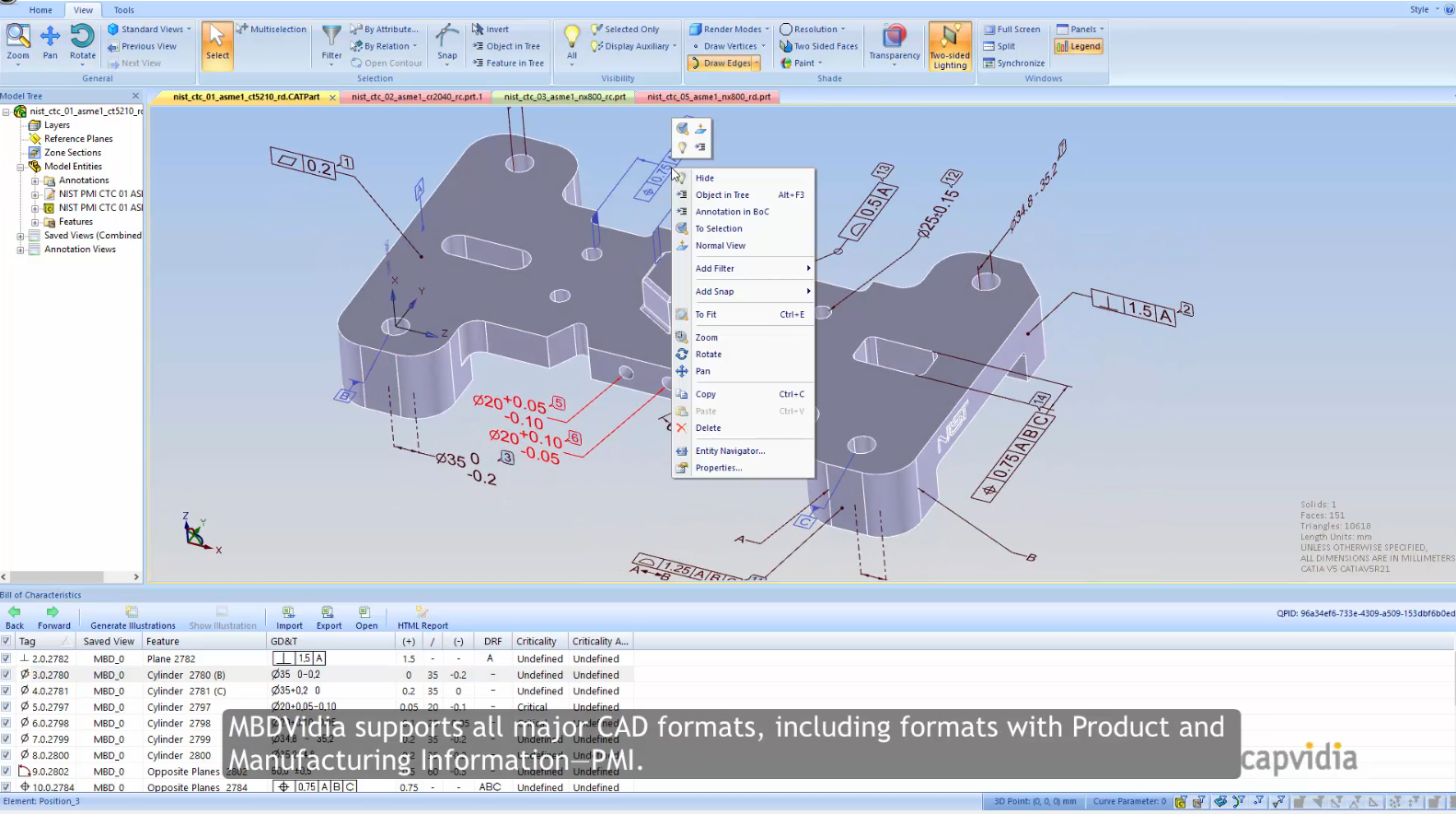
The bidirectional closed loop of 3D model data flow is becoming the core lifeline of quality management in the era of intelligent manufacturing.
At Boeing 787 in the R&D workshop, engineers once faced an awkward situation: the models carefully created by the design department 3D entered the manufacturing stage, but key tolerance information was manually re-annotated, and quality inspection required manual data transcription again. Each transcription increased the risk of errors, and each conversion added time costs.
This dilemma is a true reflection of the digital transformation process in the global high-end manufacturing industry. As product complexity increases and global supply chain collaboration demands grow, traditional methods relying on 2D drawings and manual data conversion can no longer meet the requirements for high-quality and efficient production.
Model-Based Definition ( MBD ) technology embeds product manufacturing information ( PMI ) directly into 3D CAD models, theoretically solving data transmission issues, but in engineering practice, cross-system interoperability and data continuity remain key bottlenecks hindering the formation of a quality closed loop.
01 Quality closed loop breakage, the hidden cost of manufacturing transformation
Digital transformation in the industrial sector has entered deep waters. Statistics show that more than 70% manufacturing enterprises have encountered " data breakage ” dilemma — Design models need format conversion when entering process planning, process data must be re-entered into manufacturing execution systems, and quality inspection results cannot be directly fed back to the design side.
A research team from Beihang University found a typical phenomenon when analyzing the status of aerospace manufacturing enterprises: although companies have adopted MBD technology for product design, the process design stage still relies on 2D CAPP systems, and the released process documents are still in 2D card form.
"CAD/CAPP/CAM are disconnected and independent from each other, product data is transmitted from 3D to 2D and back to 3D, inevitably causing data loss. ” Researchers Min Qing and others pointed out in "Research and Collaborative Application of R&D and Process Based on MBD technology".
This break causes a disconnect between tolerance design and actual manufacturing costs. In the traditional model, design engineers find it difficult to accurately assess the impact of tolerances on processing costs, while manufacturing engineers cannot effectively feedback actual deviation information from production to the design side, preventing the formation of a closed-loop quality improvement system.
02 QIF Standards, the key to breaking through digital thread interoperability
The dawn of solving this problem appears in the field of standardization. QIF ( Quality Information Framework ), as a CAD-agnostic standard designed specifically for end-to-end digital metrology and quality workflows, is becoming the key technical framework to open the meridians of digital manufacturing. CAD -independent standard, is becoming the key technical framework to open the meridians of digital manufacturing.
2025 In the year 6 month, the manufacturing industry witnessed a milestone event: Siemens NX™ software became the first mainstream QIF platform to natively support CAD the standard. This integration solved the problem of high-fidelity transmission of models between upstream and downstream systems, especially supporting intelligent MBD annotation and model-based feature definition ( PMI MBC ) providing underlying assurance for the continuity of the digital thread. The core value of
QIF lies in establishing a unified semantic framework. It standardizes the entire data structure from design intent expression ( GD&T ), inspection planning formulation to actual measurement data analysis, ensuring data is not distorted or degraded when flowing between CAD 、 CMM (Coordinate Measuring Machine) and PLM systems.
" By maintaining consistency with QIF and supporting model-based feature definition, we help manufacturers reduce errors, eliminate redundant work, and accelerate the transformation to model-based enterprises. "Capvidia CEO Tomasz Luniewski recently emphasized when announcing NX integration support.
03 High-precision MBD models, reconstructing the new foundation of the quality closed loop
Under the QIF framework, the value of high-precision MBD models is no longer limited to geometric shape expression but becomes the sole data source throughout the product lifecycle ( Single Source of Truth ).
The quality of PMI (product manufacturing information) annotations in the model directly determines the effectiveness of subsequent stages. Research shows that about 35% of manufacturing errors stem from incomplete or inaccurate PMI information. 3D annotations must follow four basic principles: standardization and consistency, information completeness, relevance, and user-oriented definition principles.
In the field of manufacturing special-shaped pipelines for aero engines, the research team at Zhejiang University developed a physically modulated dual-branch framework FP-3D achieved breakthrough progress. This framework extracts geometric latent features of structured embeddings through a pre-trained geometric autoencoder and innovatively designs a physical incremental modulation layer to capture strain increments sensitive to material properties, realizing end-to-end closed-loop optimization from process parameters to 3D shapes.
" Under the 6FBT On the system pipe dataset, FP-3D process parameter prediction MSE reduced compared to physics-informed neural networks by 28.6% , shortening the new product development cycle 60% above. ” The research results were published in " Engineering Applications of Artificial Intelligence ".
This innovation unifies the traditionally separated process parameter tuning and shape prediction, solving the " industry pain points of relying on experience for process tuning and lack of basis for shape prediction. ” .
04 Bidirectional data flow, the core engine of quality closed-loop
A true intelligent manufacturing quality closed-loop must have bidirectional data flow capability: not only accurately transmitting design intent to manufacturing and inspection stages but also feeding manufacturing and inspection data back to the design system to form a continuous optimization loop.
In this field, MBDVidia solution demonstrates advanced practices. It achieves QIF downstream automation from design to manufacturing: using CAD system-generated QIF data to automatically execute inspection planning, generate first article inspection (FAI) reports, and drive metrology workflows, greatly reducing manual rework and setup time. FAI .
More importantly, its upstream intelligence capability: sending production-verified QIF data back to the design system enables design engineers to optimize product design based on real manufacturing data, supporting design concepts oriented towards manufacturability and inspectability.
" Through QIF model data exported from NX can be verified, refined, and returned, promoting true closed-loop feedback among design, quality, and manufacturing. "Capvidia Recent announcements emphasized the breakthrough value of this bidirectional workflow.
The benefits of this closed-loop are directly reflected in cost control. Through precise tolerance analysis and optimization, manufacturers can avoid increased processing costs caused by overly conservative tolerance designs and reduce product failure risks due to insufficient tolerances. Industry data shows effective tolerance optimization can reduce 15%-20% of manufacturing costs.
05 Practical implementation, from technical standards to economic benefits
In the high-end equipment manufacturing field, quality closed-loop has generated significant economic benefits. An aerospace main engine manufacturer adopted a workflow based on QIF and achieved three key breakthroughs: MBD 工作流后,实现了三个关键突破:
- First article inspection (FAI) FAI report generation time shortened from an average of 16 hours to within 2 hours
- Process data preparation cycle compressed 40%
- Measurement result feedback to design stage reduced from weeks to hours
The automotive manufacturing industry is also reaping transformation benefits. A lightweight body case for new energy vehicles shows manufacturing cost reduction by 18.7% 。
These practices validate an economic logic: quality closed-loop management has shifted from a mere compliance requirement to a core competitiveness builder. It not only solves the quality problem of " making the product right ” but also achieves market success of " making the right product ” through optimizing the balance between tolerance design and cost control.
Early research at Beihang University foresaw this trend, proposing a process quality optimization planning method based on quality function deployment (QFD), integrating quality factors, technical characteristics, and cost constraints into a unified optimization framework. QFD .
06 Ecological collaboration, rise of domestic toolchains
With the maturity of international mainstream toolchains, the domestic industrial software ecosystem is also accelerating its layout QIF standard support. 2025 At the beginning of the year, several leading domestic CAD manufacturers began integrating QIF output capabilities, companies like Hongyu Precision launched fully independent MBD platforms, and domestic toolchains such as Kaimu, Ganzlab are rapidly developing under policy guidance.
Cross-system interoperability has become the focus of ecosystem construction. MBDVidia Already supports Siemens and achieved three key breakthroughs: NX 、 PTC Creo 、 SOLIDWORKS and Autodesk Inventor native MBD ensuring full compatibility among design, quality, and manufacturing systems.
This compatibility is especially important for global supply chains. When OEM manufacturers use NX design models, suppliers use SOLIDWORKS When conducting process design, based on QIF and achieved three key breakthroughs: MBD The model ensures seamless data flow across systems and enterprises, eliminating errors and delays caused by traditional manual data conversion.
07 The future is here, the implementation of digital twins' " last mile ”
With the deepening application of digital twin technology in manufacturing, high-precision MBD models, as the digital mapping basis of physical entities, have become increasingly important. However, the effectiveness of digital twins highly depends on the quality of the models and the closed-loop feedback capability of actual production data.
Model quality management is the last mile for the implementation of digital twins. ” Industry experts point out that without high-quality, traceable, and feedback-capable model data streams, digital twins will become " digital bonsai ”。
FP-3D The framework's successful application in the field of metal plastic forming provides a universal methodology for multi-physical field coupled intelligent manufacturing systems. By constructing a unified geometric latent feature intermediate representation at a consistent feature scale, it innovatively integrates physical incremental modulation layers and feature radial transfer modules to achieve interactive mapping between process attributes and 3D shapes.
This technical approach represents the future direction of quality closed-loop management: a deep integration of physical mechanisms and deep learning, transitioning from local parameter optimization to system-level closed-loop transformation.
Back to Boeing's story. Nowadays, by adopting a based-on QIF and achieved three key breakthroughs: MBD workflow, 787 the data transfer steps on the production line have reduced from 12 to 3 the first article inspection cycle has shortened by 75% and tolerance design changes have decreased by 40% Global supply chain manufacturers work based on the same QIF data source, eliminating quality risks caused by misunderstandings.
"QIF is not just a simple data format, but the DNA 。” of reconstructing the quality value chain," said a digital manufacturing expert. When tolerance optimization truly connects to cost control, and when 3D the model becomes the golden data stream throughout the product lifecycle, the quality closed loop of intelligent manufacturing truly completes its transformation from proof of concept to value creation.
With the maturity of domestic toolchains and the popularization of industry standards, high-precision QIF models based on MBD are spreading from high-end manufacturing fields such as aerospace and automotive to general manufacturing, reshaping a new paradigm of quality closed-loop management. This process will determine whether Chinese manufacturing can win dual advantages in quality and cost in the second half of digital transformation.
MBD Model Quality Management,Digital Twin,Intelligent Manufacturing,QIF Standard,MBD Quality Closed Loop,Digital Thread