


In-depth exploration of virtual verification and MBD workflows: How to resolve the "data trust crisis" in the era of smart manufacturing?
Release time:
2025-06-18 15:01
Source:
Introduction: When Digital Models Become a "Rashomon"
In 2025, the manufacturing industry faces an awkward situation: 3D models have become the universal language of product development, but different departments see different "truths." The designer's perfect model may lose critical tolerances in the process department; the version validated by the simulation team may be replaced by outdated data on the production line. This "digital Rashomon" phenomenon is eroding the efficiency benefits promised by smart manufacturing.
Virtual Validation was supposed to be the guardian of this transformation, but in practice, it often becomes a "post-checker." The real challenge is: how to ensure that every decision is based on the same "truth" as MBD (Model-Based Definition) data passes through multiple systems like CAD, CAE, CAM, and CMM?
The Ideal and Reality of MBD: Data "Distortion" During Transmission
MBD technology promises to carry all manufacturing information in 3D models, eliminating the ambiguities of 2D drawings. Practices in the aerospace industry show that adopting MBD can reduce engineering changes by 60%. But in the workshop, engineers' complaints are endless:
- "Supplier parts fully comply with the model but can't be assembled because PMI (Product Manufacturing Information) was lost during STEP conversion."
- "Quality inspection reports show deviations, but no one can clarify whether it's a machining error or an issue with the model annotations themselves."
- "The simulation team uses a model version two iterations behind the design team, causing interference during trial production."
These are not technical failures but the most typical "data trust crisis" in digital transformation. When models pass through different software environments, key information is like literature translated multiple times, with semantics continuously lost.
Three Lines of Defense in Virtual Validation
Leading companies are building a three-layer protection system, with various specialized software playing key roles:
First Line of Defense: Data Consistency Check
Like plagiarism detection systems for academic papers, specialized tools can compare whether 3D models in different formats "express consistently." An aerospace company found that their STEP file conversions lost 30% of PMI information, directly causing subsequent machining errors. After adopting a toolchain supporting the QIF (Quality Information Framework) standard, such error rates dropped by 75%.
Among these tools, MBDVidia, through bidirectional interoperability, can verify the integrity of model data between mainstream CAD platforms like Siemens NX and PTC Creo, ensuring PMI annotations are transmitted without loss during conversion. Similar functions are found in PTC's Creo ModelCHECK and Siemens' JT2Go, but cross-platform compatibility remains an industry pain point.
Second Line of Defense: Cross-Disciplinary Conflict Warning
A classic case in the automotive industry: the electrical team's model version was two iterations behind the structural team's, causing harness interference with the car body during trial production. New generation validation tools like COMPAREVIDIA can automatically mark such "spatiotemporal misalignments." Its intelligent comparison algorithms can identify version differences and geometric conflicts between models from different disciplines.
Dassault Systèmes' 3DEXPERIENCE platform also offers similar functions but focuses more on collaboration within the PLM environment. PUNDIT takes a different approach by using AI to analyze deviations between measured point clouds and design models, tracing back whether the issue lies in design, process, or machining.
Third Line of Defense: Manufacturing Deviation Prediction
The most advanced approach extends virtual validation to the production site. A precision instrument manufacturer, through PUNDIT AI analysis, detected in advance that thermal deformation of the machining center would cause key dimension deviations, avoiding scrapping an entire batch of parts. Similar technologies are seen in Hexagon's PC-DMIS and Zeiss's CALYPSO, though the latter focuses more on post-processing CMM inspection data.
Polarization of Industry Solutions
Facing this challenge, the market has formed two completely different response strategies:
The "Unified Universe" by Tech Giants
Siemens Xcelerator and Dassault 3DEXPERIENCE attempt to solve the problem with a unified data environment. The advantage of such solutions is that data does not need conversion, but the implementation cost deters most companies—it requires a complete overhaul of existing IT infrastructure.
The "Translator" Strategy of Agile Tools
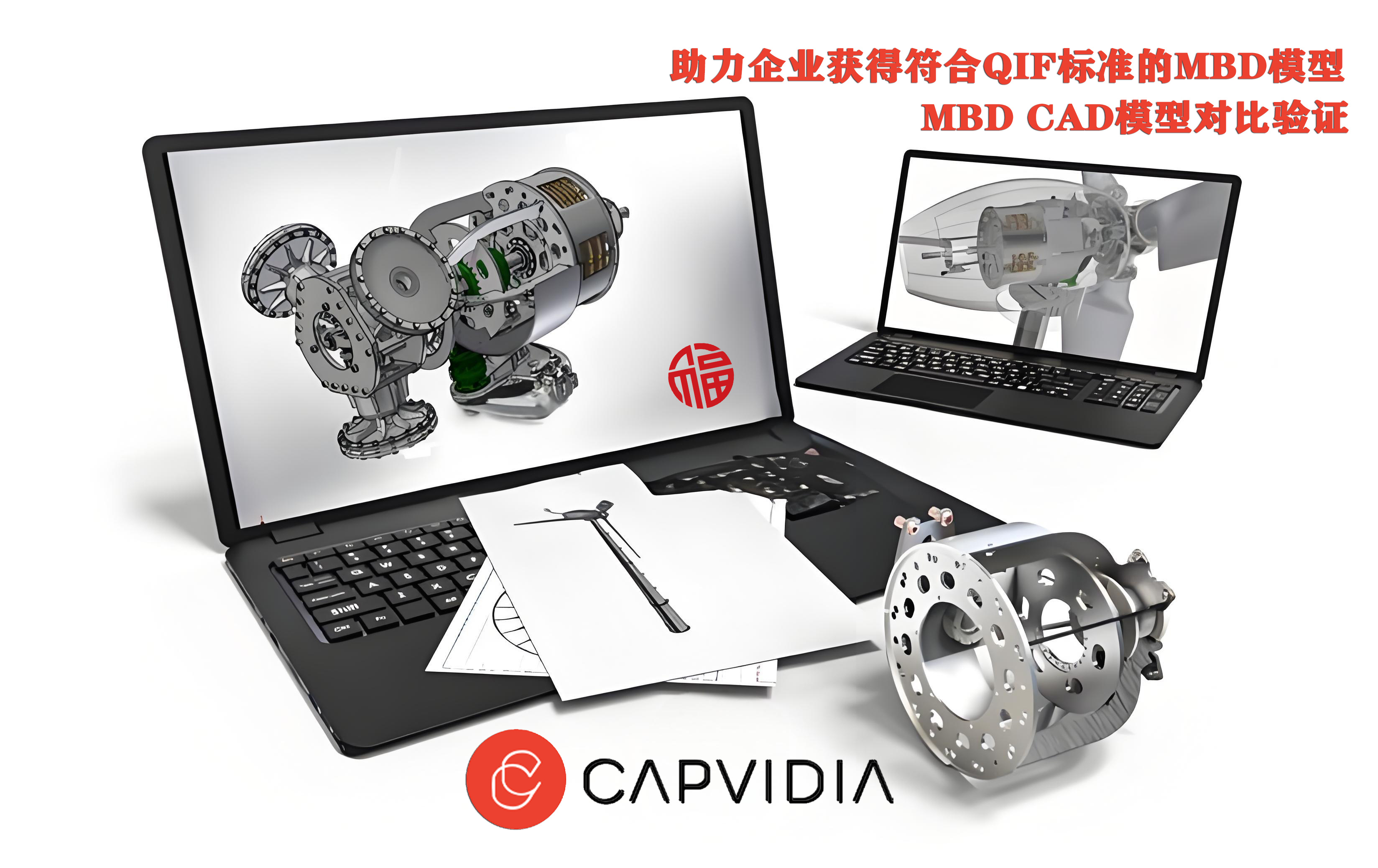
A group of specialized software represented by CAPVIDIA does not change existing enterprise processes but acts as a "data bridge." Its MBDVidia supports the QIF standard and can maintain PMI semantic consistency across different CAD systems like NX and Creo; COMPAREVIDIA focuses on version comparison and conflict detection. Such solutions usually require only 2-4 weeks for implementation and are especially popular among small and medium-sized enterprises.
Future Battlefield: The Data Foundation of Digital Twins
As digital twins become standard, the accuracy of MBD data will determine whether a factory's "digital mirror" is trustworthy. Recently, a smart factory's digital twin frequently misreported equipment failures, rooted in mismatches between bearing tolerance annotations in the original model and sensor data.
This reveals a deeper trend: virtual validation is shifting from "post-checking" to "full-process guardianship." The collaboration between Siemens and CAPVIDIA demonstrates this possibility—through the QIF standard, model data generated by NX can directly drive inspection planning, and measured results can feedback to the design system, forming a closed loop.
Conclusion: Redefining the "Qualified Model"
This transformation ultimately aims to answer: In the era of digital manufacturing, what qualifies as a "qualified" model? Obviously, merely passing checks through CAD software is not enough; it must maintain semantic consistency across all downstream systems. As Boeing discovered in the 787 project: the true value of MBD lies not in the 3D model itself, but in whether it can become the "single source of truth" throughout the product lifecycle. Successful companies treat virtual verification as the "immune system" of the MBD workflow, rather than a "band-aid." In this battle to defend data credibility, tool selection is important, but what needs to change more is the mindset—from "My model is fine" to "Our models must be consistent."
Model-based definition,MBD Workflow,MBD Model Quality Management,Virtual Verification,CAPVIDIA