


How much do you know about Model-Based Definition (MBD) toolchains?
Release time:
2025-06-13 16:33
Source:
MBD Technology Drives Digital Transformation in Manufacturing, Toolchain Becomes Key Support
In recent years, with the rapid development of Industry 4.0 and smart manufacturing, Model-Based Definition (MBD) technology is gradually replacing traditional 2D drawings and becoming the core data carrier for Product Lifecycle Management (PLM). MBD integrates Product Manufacturing Information (PMI) through 3D models, including dimensions, tolerances, and process requirements, achieving seamless connection between design, simulation, manufacturing, and inspection. However, the widespread application of MBD relies on a complete toolchain support. How do software and platforms collaborate across stages from CAD design to quality inspection? Which tools can truly solve enterprise pain points? Today, we will delve into the composition of the MBD toolchain.
Core Components of the MBD Toolchain
1. 3D Design and Annotation Tools
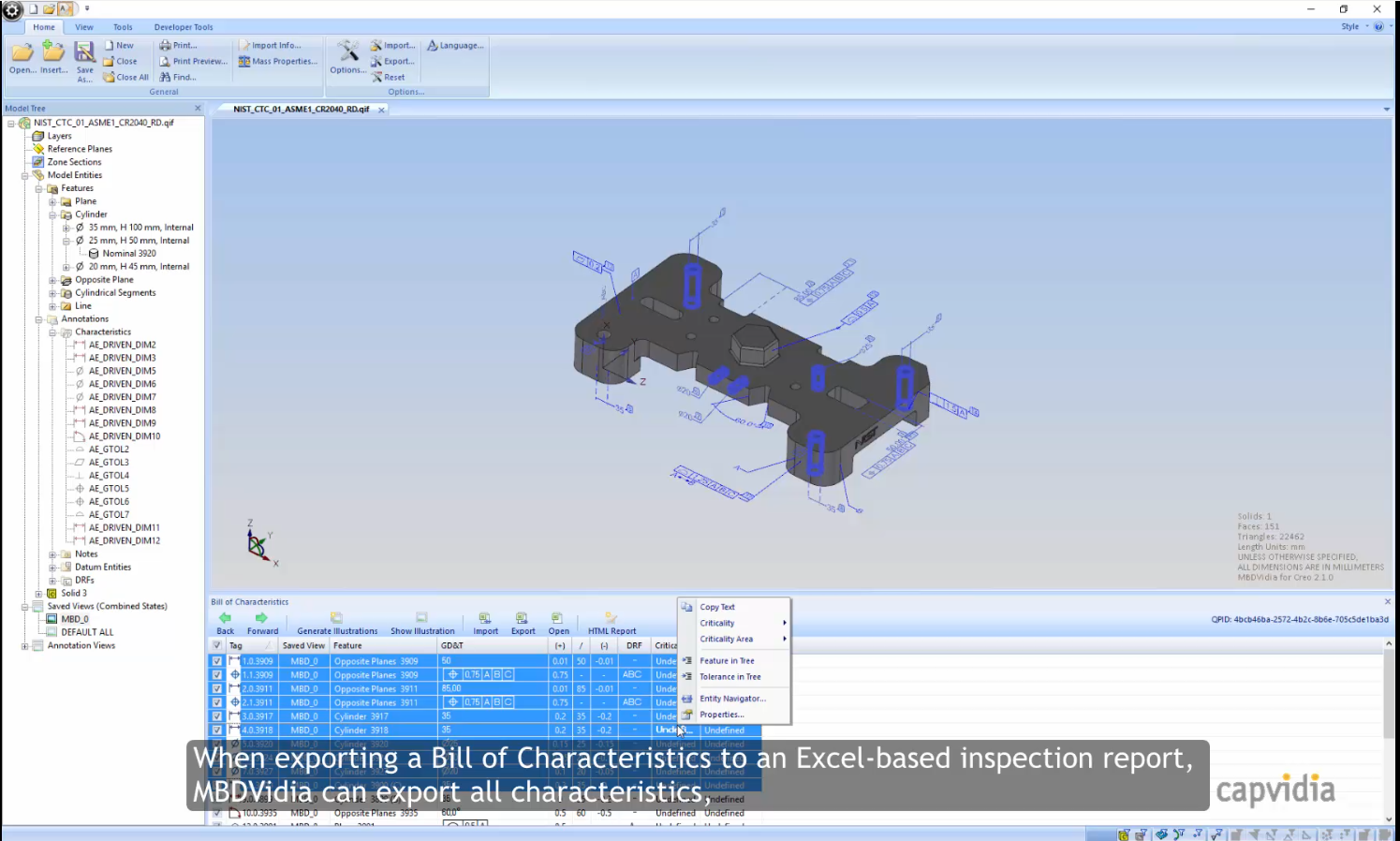
The starting point of MBD is 3D CAD modeling. Mainstream tools such as SolidWorks, CATIA, NX, and Creo all support PMI annotation, allowing engineers to directly define geometric tolerances (GD&T), surface roughness, and other manufacturing information on the model. However, data interoperability between different CAD systems remains an industry challenge, especially when the supply chain involves multiple software suites, making accurate transmission of model information crucial. MBDVIDIA supports PMI data conversion between mainstream CAD systems, with technology certified by NIST. Its application in the aerospace field has shown significant reduction in data loss issues.
2. Simulation and Verification Tools
MBD models are not only used for design but also require simulation to verify manufacturability. For example:
- Structural simulation (ANSYS, Altair HyperWorks)
- Tolerance analysis (3DCS, CETOL)
- System simulation (MATLAB/Simulink)
However, simulation tools usually depend on high-quality data input. If GD&T information in the MBD model is lost or incorrect, it may lead to deviations in analysis results. COMPAREVIDIA provides 3D model difference analysis, visually displaying geometric and PMI changes between versions to ensure high-quality and reliable MBD models.
3. Manufacturing and Inspection Execution
The ultimate goal of MBD is to guide production, so CAM (Computer-Aided Manufacturing) and CMM (Coordinate Measuring Machine) must accurately read manufacturing requirements from the model. For example:
- CNC machining (Mastercam, PowerMill)
- 3D printing (Materialize Magics)
- Quality inspection (Hexagon PC-DMIS, Zeiss CALYPSO)
However, many manufacturing enterprises report that due to data compatibility issues between different systems, CMM equipment may fail to correctly recognize GD&T in MBD models, resulting in low inspection efficiency.
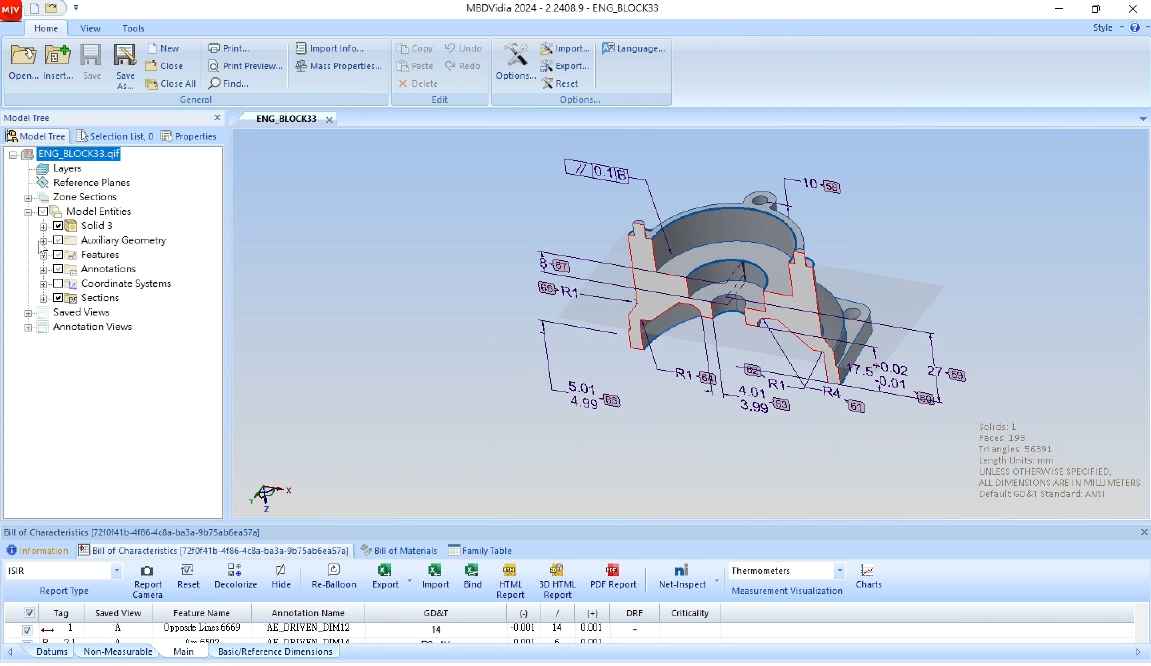
MBDVIDIA software helps enterprises obtain truly human- and machine-readable MBD models, solving data compatibility problems. MBDVIDIA can generate QIF format models, a data format recommended by the National Institute of Standards and Technology (NIST). It establishes seamless connections between CAD, CAM, and CMM, ensuring precise execution of MBD requirements in manufacturing and inspection. Statistics show that enterprises adopting QIF can improve inspection efficiency by over 30% and reduce error rates by 50%. Meanwhile, PUNDI software helps enterprises evaluate uncertainty in inspection plans through simulation, ultimately providing the optimal inspection plan.
CAPVIDIA: Industry Benchmark for MBD Data Interoperability
As a leading company in MBD data exchange and verification, CAPVIDIA's solutions have been adopted by global manufacturing giants such as Boeing, Airbus, General Electric (GE), and BMW. Its core advantages include:
✅ Cross-platform compatibility: Supports all mainstream CAD formats (CATIA, NX, SolidWorks, etc.), ensuring lossless transmission of PMI data.
✅ Intelligent GD&T verification: AI-assisted checking of GD&T annotations for compliance, reducing design errors.
✅ Lightweight collaboration: 3D PDF and QIF technologies optimize supply chain collaboration, reducing dependence on specialized software.
CAPVIDIA CEO John Willats stated: "MBD is the cornerstone of future manufacturing, but data silos remain a major obstacle. Our mission is to enable free flow of MBD data across different systems and teams, truly achieving 'model once, use throughout.'"
Conclusion
The improvement of the MBD toolchain is an important part of smart manufacturing, and data interoperability is the core challenge. In the future, with the advancement of standardization, MBD is expected to fundamentally change traditional manufacturing models. Choosing the right toolchain partners will be the key to successful digital transformation for enterprises.
MBD Model-Based Definition,Intelligent Manufacturing,MBD Toolchain,MBDVIDIA,COMPAREVIDIA