


The Unique Advantages of Grid-Based DIC Strain Measurement in FEM/DIC Collaborative Validation
Release time:
2025-06-10 09:52
Source:
Introduction
In modern engineering and materials science, accurate strain measurement is crucial. With the continuous development of Digital Image Correlation (DIC) technology, strain measurement methods based on mesh models have gradually become a research hotspot. Especially when combined with Finite Element Method (FEM) analysis, the advantages of this approach become even more significant. Next, let's delve into how FEM/DIC collaborative verification can enhance the accuracy and efficiency of strain measurement.
Basic Principles of DIC Technology
Digital Image Correlation (DIC) is a non-contact measurement technique based on image analysis. It extracts deformation information from the sample surface by comparing images taken before and after loading using image processing algorithms. The advantage of this technology lies in its adaptability to complex shapes and large deformations, making it widely applied in many fields.
Role of Mesh Models
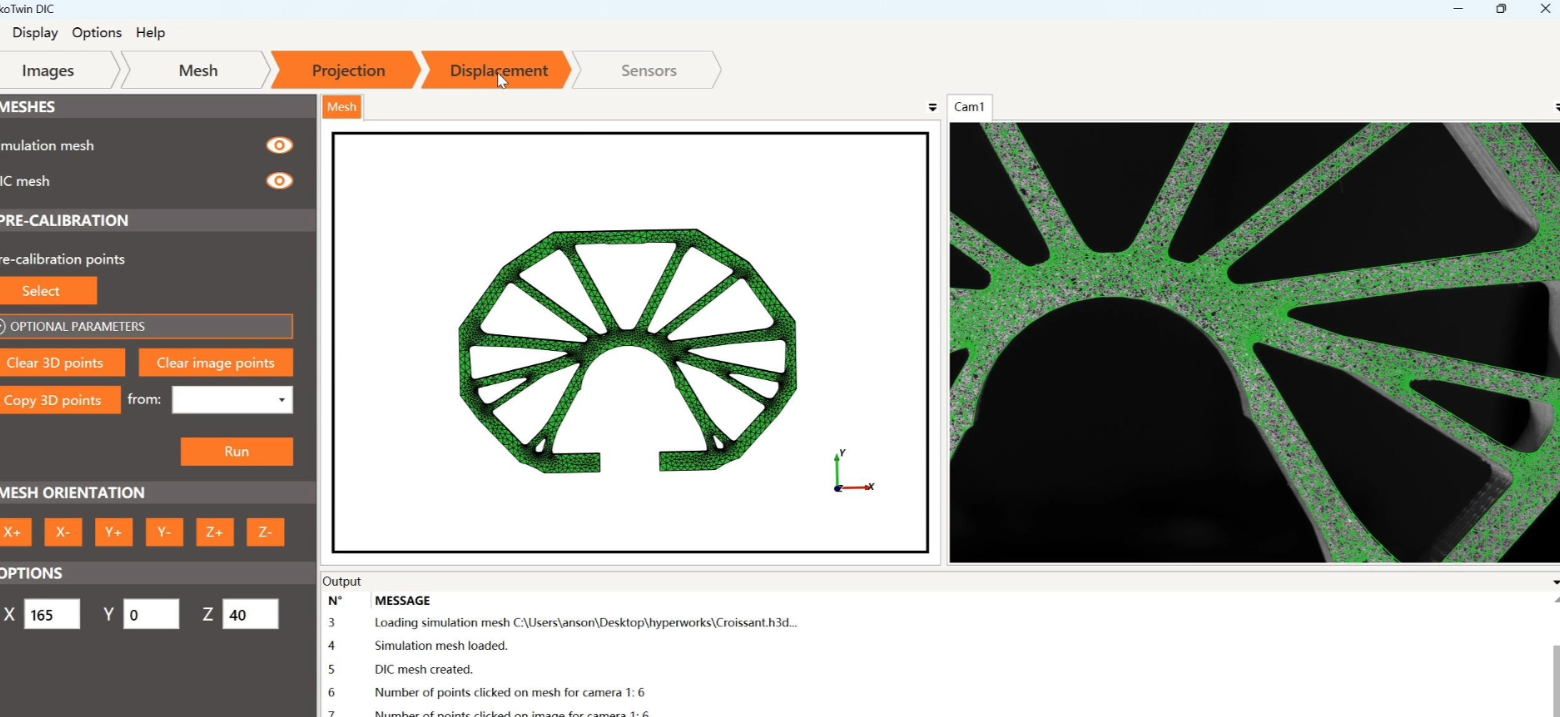
The application of mesh models in novel DIC is extremely critical. It divides the measurement area into multiple small units, making strain calculation more precise. By applying an appropriate mesh on the sample surface, the DIC system can more effectively track and analyze the deformation of each small region, thereby obtaining comprehensive strain distribution information.
Necessity of FEM/DIC Collaborative Verification
In practical applications, relying solely on DIC measurement results may involve certain errors. FEM/DIC collaborative verification provides an effective solution. By comparing the surface deformation measured by DIC with FEM analysis results, the accuracy of the model can be better validated and potential errors adjusted.
Advantages of Mesh Model-Based DIC Strain Measurement
Mesh model-based DIC strain measurement has the following significant advantages:
- High Precision: The introduction of mesh allows for more refined local strain measurements, capable of capturing minute deformations.
- Non-contact Measurement: Avoids interference that may be caused by traditional contact measurements, with strong adaptability.
- Real-time Monitoring: DIC technology can achieve dynamic monitoring, suitable for various experimental environments.
Case Study
Taking a material fatigue test as an example, researchers conducted real-time monitoring of the material's strain distribution through FEM/DIC collaborative verification. The results showed that mesh model-based DIC not only improved measurement accuracy but also provided consistent results under different loading conditions. This enabled researchers to gain a deeper understanding of material behavior under complex loads.
Future Development Directions
With advances in computing technology and optimization of image processing algorithms, the application prospects of FEM/DIC collaborative verification are broad. In the future, more new materials and more complex structures will become research focuses. The combination of DIC technology and FEM advantages will shine in these fields.
Conclusion
In summary, mesh model-based Digital Image Correlation (DIC) strain measurement has significant advantages in accuracy and efficiency. Combined with FEM/DIC collaborative verification, it can better enhance the reliability of measurement results, providing strong support for materials science and engineering applications. We look forward to continued exploration and innovation in this area in the future!
FEM/DIC Collaborative Verification,DIC Based on Grid Model,Strain Measurement