


How to make 3D CAD models the sole source of data? Explore best practices for implementing MBD / MBE!
Release time:
2025-06-04 10:17
Source:
Introduction
In today's highly competitive manufacturing industry, improving work efficiency and product quality has become the focus of every enterprise. As the core of design, 3D CAD models, if used as the sole data source in the workflow, can greatly simplify information flow, saving time and costs. Implementing MBD (Model-Based Definition) / MBE (Model-Based Enterprise) is an effective way to achieve this goal.
What is MBD / MBE?
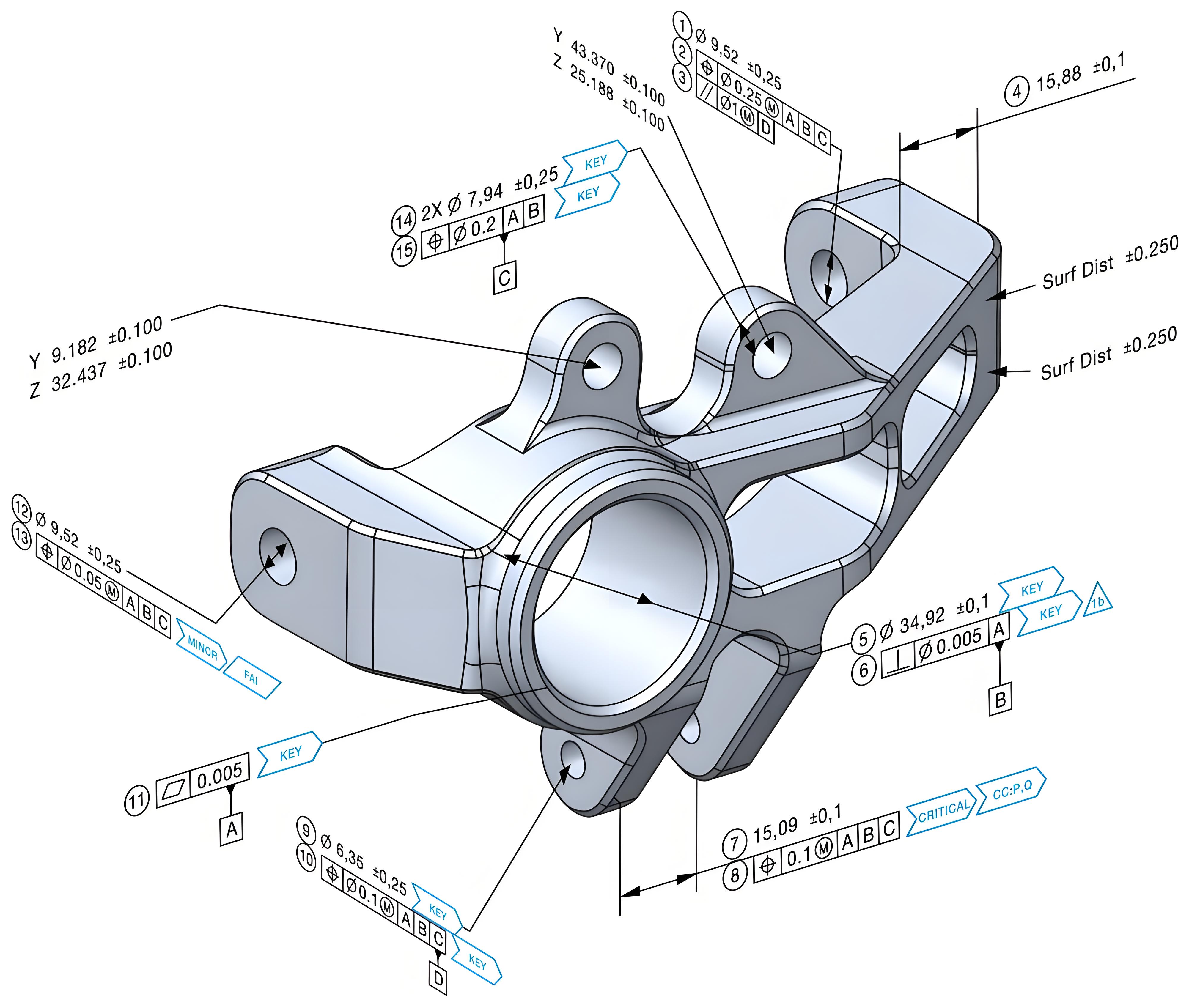
MBD, or Model-Based Definition, is a method of conveying all design, manufacturing, and inspection information through 3D CAD models. It is not just a graphical model but a complete information package containing various metadata such as materials, surface treatments, dimensional tolerances, and more. In other words, the MBD workflow no longer relies on traditional 2D drawings but directly communicates information through 3D models.
The Significance of Implementing MBD / MBE
So, why implement MBD / MBE? First, it improves design accuracy. By eliminating the possibility of secondary interpretation, engineers and manufacturers can better understand design intent, reducing misunderstandings and errors. Second, MBD centralizes information management, enhancing data traceability and consistency. Finally, it accelerates time-to-market, giving enterprises a competitive edge!
How to Implement MBD / MBE?
To make the 3D CAD model the sole data source, the implementation of MBD / MBE can start from the following aspects:
1. Define Standards
First, enterprises need to establish a clear set of standards to ensure all designers follow unified specifications when creating 3D models. This includes rules for model construction, methods for information annotation, and data management processes.
2. Train the Team
Second, team training is crucial! Ensuring every designer is familiar with the concepts and applications of MBD / MBE and proficient in related tools and software can effectively improve work efficiency.
3. Introduce Advanced Tools
Additionally, leveraging modern CAD software, product lifecycle management systems, and third-party MBD support software can more efficiently realize MBD / MBE. For example, using tools that support parametric modeling allows easy embedding of various design information within the model.
4. Establish Feedback Mechanisms
Finally, establish a good feedback mechanism so team members can raise questions and suggestions at any time, continuously improving the implementation process. For example, hold regular meetings to discuss the application of MBD / MBE in actual work to adjust strategies promptly.
Success Case Sharing
Speaking of successful cases of implementing MBD / MBE, a well-known automobile manufacturer must be mentioned. After introducing MBD, their design team was able to collaborate on the same platform, increasing information transmission efficiency by 30%. More importantly, product time-to-market was shortened by 20%, and customer satisfaction also rose!
Conclusion
In summary, making the 3D CAD model the sole data source in the workflow is an important step in implementing MBD (Model-Based Definition) / MBE. Although the process may face challenges, as long as standards are adhered to, teams are trained, advanced tools are introduced, and feedback mechanisms are established, fruitful results will surely be achieved. Let us look forward together to the era of informatization, where MBD / MBE can bring transformation and innovation to more enterprises!
Implement MBD (Model-Based Definition) / MBE,MBD Workflow