


Ariane Group collaborates with EikoSim Company || EikoTwin series optical strain measurement products are applied in the RAPID R&D project, saving 30% of time costs!
Release time:
2023-02-03 12:08
Source:
As an engineer, a significant amount of data management is often required in Excel or internal Python scripts to establish and test the correlation of FE simulations. The leader in European space launchers, the Ariane Group, collaborated with EikoSim on several R&D projects, including the RAPID R&D project ("MUTATION") funded by the Ministry of Defense. This project aims to develop an industrial platform for testing simulation dialogues, addressing faster and safer R&D challenges by improving modeling reliability.
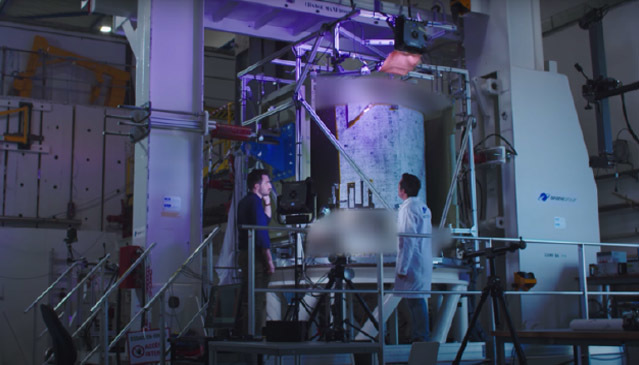
Galileo Allocator Project
During the R&D process of this project, a key use case is the qualification testing of the Galileo allocator for the Ariane 6 version. The allocator is a system placed below the launcher fairing, used to release one or more satellites into orbit during the launcher mission. This test is conducted on a flight model, meaning that only qualified load conditions are applied to the structure, but failure has never been reached. Therefore, the goals are dual:
- To verify the performance of the structure under these load conditions;
- The adequacy of the simulation model is demonstrated in the latter use case, allowing for a satisfactory correlation to infer predictions for more complex and harder loads.
 Modeling consists of a shell model and 3D sub-models of its critical areas. In practice, post-test analysis must demonstrate that the model can predict the overall performance of the structure, as well as an acceptable difference between the model and test results through various instruments (especially regarding linear overall performance).
The establishment of the MUTATION project was to enable direct testing within the platform. Based on this perspective, this test responded to an opportunity: to evaluate new instrumentation processes, embed extensive instrumentation, and optimize test simulation correlation through "solid mechanics digital twins" for post-test analysis.
How did the Ariane Group save 30% of analysis time by collaborating with EikoSim?
With the support of the General Delegate for Armament, the Ariane Group aims to make the verification process smoother and more efficient by participating in this R&D project, enhancing confidence in simulation models and eliminating unnecessary physical tests. A key element identified by the project leader is that the current process still involves many hands-on activities, such as the very common sensor post-processing in Excel. Florent Mathieu explained: "Currently, this is almost an industry standard, which means there is significant room for improvement, especially for structural tests involving a large number of sensors." In fact, in this project, simulation engineers spent hundreds of hours just managing data in Excel.
EikoTwin DICSome sensor management has been provided, but it is not applicable to non-DIC users. Pierre Baudoin, research engineer and project leader at EikoSim, stated: "Collaboration with the Ariane Group helps identify forgotten pain points and define use cases that will bring the most long-term value to our partners." "Post-processing of a large number of sensor signals is one of them, and EikoTwin Lite was born for this purpose."

The software theoretically has a very simple value proposition: to aggregate all sensors around the FE model and provide global comparisons. In practice, a significant amount of operations is needed to actually analyze all available data, including the sensor calculations themselves, as well as aggregating features or result visualizations. Using Excel, these operations require extensive specific internal development for each case.
Due to the large scale of the components and the need to verify that they are not damaged during testing, over 200 strain gauges were installed on the allocator. The correlation of a large amount of experimental data simulation presents a series of challenges. First, simulation predictions need to be provided for this set of sensors and updated quickly when the model is modified. Second, dedicated tools are needed to automatically import experimental data from a large number of strain gauges and display test simulation comparisons effectively.
Thus, the qualification test of the Galileo allocator provides an opportunity to validate different strain assessment strategies for the strain gauges. The strain predictions for the most sensitive areas come from higher-order 3D elements. To estimate the strain values at the strain gauge locations, a series of local coordinate systems were defined to align their first axis with the axial direction of the specified strain gauge. Then, for each strain gauge, the three-dimensional strain tensor is represented in the local coordinate system. Finally, the first component of this tensor is expressed at the relevant simulation nodes, and the predicted values for each load case are derived. This method is customized for this specific test and draws on experiences from previous qualification activities of the Galileo 5 probe.
At the same time, alternative methods for predicting strain gauges based on the surface displacement field obtained from the initial simulation were also evaluated. In this method, strain calculations are automatically performed within the plane of the surface elements. The local coordinate systems are defined according to Abaqus conventions: axis 1 is obtained by projecting the global X-axis onto the element surface, or if the global X-axis is perpendicular to the element surface, by projecting the global Z-axis. Therefore, only an angle needs to be specified to define the geometric direction. Finally, the normative strain predictions are determined by calculating the least squares best fit of the parabolic displacement field through the normative area. The local strain field is obtained directly from the polynomial coefficients. This does not mean that the second method is more general; it can be extended to many situations based on the application. The results of both methods are shown in Figure 7. All results have been standardized. Despite significant differences in their implementation, both methods yield similar results for the studied set of strain gauges.
 Jérémy Pradelli, CAE engineer at the Ariane Group, stated: "With this software, data management alone can save about 40% of time, which means hundreds of hours. Future developments may save over 60% of data management time."
 How does the Ariane Group use EikoTwin to improve simulation correlation?
The H3d (Altair Hyperworks) format has been chosen to provide a pathway between Hyperworks (the pre- and post-solution chosen by the Ariane Group) and EikoTwin. Nicolas Swiergiel, optical expert at the Ariane Group, stated: "This connection was developed over a few months, and now our engineers can import and export data to the EikoTwin platform without any data conversion." "To maintain the robustness of the platform, a streamlined data flow between the tools we selected is crucial," Jérémy Pradelli continued, "We can also expect higher robustness and fewer human errors." The issue with CAE engineers using Excel is that it requires them to build everything from scratch for each new project. Despite their best efforts, this can lead to user errors after spending hundreds of hours copying and pasting data. Using a more integrated solution also ensures that everyone uses the same post-processing algorithms for a given sensor, and that algorithm has been reviewed by experts. Therefore, engineers will spend less time on data management and no longer need to worry about the correctness of their simulation parameters.
The natural continuation of this work is to allow full integration with the latest verification, validation, and uncertainty quantification (VVUQ) techniques. EikoSim has already begun this work, particularly by integrating measurement uncertainty into the analysis process, which is crucial for CAE engineers to justify their modeling choices. Finally, the platform is inherently modular, as other measurement techniques have already been integrated, such as marker tracking for linear strain or fiber optic measurements.
DIC Experiment,Simulation verification,FM Model Validation,Strain measurement,Optical Measurement,Structural Design Verification