


Which parameter indicators of the MBD model affect the reliability of 3D visual assembly?
Release time:
2025-08-25 15:29
Source:
With the advent of the intelligent manufacturing era, model-based definition ( MBD ) technology is becoming the core pillar of digital transformation in the aerospace, aviation, and high-end equipment manufacturing industries. Its data quality directly affects the reliability and production efficiency of 3D visual assembly. MBD The model integrates manufacturing information such as product dimensions, tolerances, and process information into the 3D model, achieving a leap from 2D drawings to 3D models. However, not all MBD models can guarantee the reliability of 3D visual assembly; the key lies in the quality and control of a series of parameter indicators.

01 Geometric accuracy and quality
MBD The geometric accuracy of the model is a fundamental factor affecting assembly reliability. The model must have high-precision geometric representation and strict tolerance control to ensure consistency between virtual assembly and physical assembly. In traditional 2D processes, expressing the internal structure of parts often requires using a single cutting plane or a single cutting cylinder, etc. However, MBD the technology can accurately and clearly express complex structures and process content through the 3D model itself. In the machining process of key aerospace parts (such as impellers), the 3D design quality of the process model directly relates to the operability of later assembly. These models need to support operations such as rotation, zoom, sectioning, and measurement so that production line staff can accurately understand assembly requirements.
02 Completeness and machine readability of PMI information
Product Manufacturing Information ( PMI ) completeness and machine readability are core indicators for evaluating MBD model quality. PMI Including key manufacturing data such as dimensional tolerances, geometric tolerances, surface roughness, annotations, etc., these PMI annotations must be "machine-readable" ( Machine-Readable ) to ensure that the model definition can be correctly transmitted to downstream workflows. CAPVIDIA company's MBDVidia software provides MBD Ready Check function, specifically used to check PMI annotation definitions to ensure they meet machine-readable requirements. This check is crucial to ensuring the reliability of 3D visual assembly.
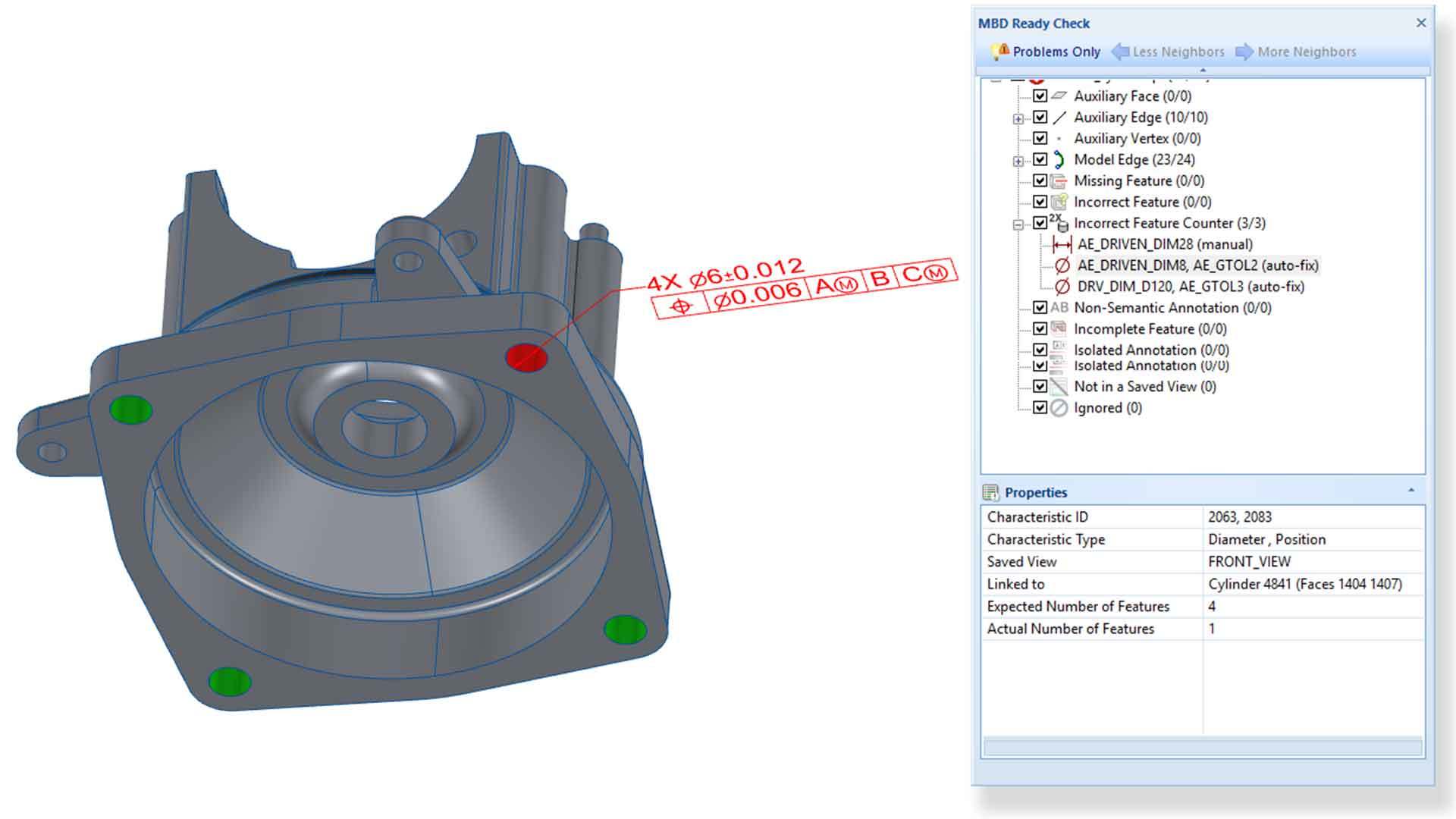
03 Data interoperability
Data interoperability indicators measure MBD the ability of models to be exchanged and shared between different systems. High-end manufacturing typically uses multiple CAD software, such as CATIA 、 SolidWorks 、 PTC Creo 、 Siemens NX etc. Cross-platform compatibility becomes a key factor in ensuring assembly visualization reliability. Capvidia company provides comprehensive integration support for the latest versions of Siemens NX software, leveraging QIF standards to enhance the implementation of model-based characteristic definition ( MBC ). This interoperability strengthens the digital thread from design to quality and manufacturing for original equipment manufacturers ( OEM ) and their global supply chains.
04 Application of model quality management tools
To improve MBD model reliability, many companies have developed specialized model quality management tools. CAPVIDIA company's MBDVidia They are products specifically designed to support MBD workflows. Besides ensuring the correctness of MBD model definitions, they can further unleash the potential of MBD models. The software supports CATIA 、 SolidWorks 、 PTC Creo 、 Siemens NX common CAD file formats. At the same time, corresponding CAD plugins have been launched for major MBD systems, such as MBDConnect for Creo 、 MBDConnect for NX and FormatWorks for SOLIDWORKS etc.
These tools help users perform MBD model quality inspection and management, ensuring the model's PMI compliance with QIF standards.
05 Integration capability of measurement data
MBD Another important parameter of the model is the integration capability of measurement data, that is, whether actual measurement results can be fed back to the MBD model to form closed-loop control. This indicator directly affects quality tracking and controllability during the assembly process. CAPVIDIA The MBDVidia solution supports importing measurement results into the MBD model to improve product quality and business insights. This "true closed-loop operation" capability is an important hallmark of digital transformation. By comparing actual measurement data with the original MBD model, enterprises can continuously optimize design and assembly processes, improving the reliability and accuracy of visual assembly. This closed-loop feedback mechanism is a key technical link in achieving model-based enterprise ( MBE ) transformation.
06 Degree of model lightweight processing
In the 3D visual assembly process, the degree of model lightweight processing directly affects the efficiency of on-site applications. Complex assembly models may contain large amounts of data, which poses challenges to terminal devices on the production floor.
The approved 3D process must meet the requirement of "outputting process models as lightweight data" to reduce system burden. At the same time, the 3D models and 3D annotations must be intuitive and easy to understand to facilitate use by on-site operators. Lightweight processing needs to find a balance between maintaining model accuracy and reducing data volume, ensuring that production line employees can MES smoothly view and operate 3D process models on the platform without performance issues affecting assembly reliability.
MBD Parameter indicators of model quality have become key markers for measuring the digital maturity of enterprises. The aerospace industry is actively promoting 3D process technology research and application based on MBD this, using it as a catalyst for transformation towards lean manufacturing, agile manufacturing, and intelligent manufacturing. With the QIF ( Quality Information Framework ) and other international standards becoming widespread and CAD continuous support from manufacturers, MBD quality management of models is becoming more automated and intelligent. In the future, through AI-driven automatic inspection and quality prediction technologies, combined with comprehensive application of digital twin technology, MBD the reliability of models in 3D visual assembly will be further enhanced, providing a solid foundation for the digital transformation of manufacturing.
3D Visualization Assembly,MBD Technology,Industrial Automation,Digital Transformation,MBD Model Quality Management,PMI Inspection,3D Model Reliability