


Mitigating EIA Risks: Detailed Explanation of Simulation Standards, Methods, and Software Differences Between Outdoor Noise Prediction and Indoor Assessment
Release time:
2025-08-22 17:56
Source:
In today's accelerated urbanization process, noise pollution has become an indispensable part of Environmental Impact Assessment ( EIA ). Accurately and scientifically predicting and assessing noise is crucial for public health and quality of life. This article will provide a detailed analysis of the simulation standards, core methods, and differences among mainstream software for outdoor noise prediction and indoor assessment, helping you comprehensively avoid EIA risks.
01 Importance of Noise Prediction and Assessment and EIA Risks
Noise Environmental Impact Assessment ( EIA ) has become a mandatory requirement in the planning, approval, and operation processes of various construction projects. Inaccurate noise prediction may lead to failure in environmental approval, legal disputes, or costly later modifications. Therefore, using internationally recognized simulation standards and reliable software tools to precisely quantify noise impact is a key step to avoid EIA risks.
02 Simulation Standards and Methods for Outdoor Noise Prediction
Outdoor noise prediction usually follows international standards (such as ISO 9613-2 ) or technical guidelines issued by environmental protection departments of various countries (such as China's "Technical Guidelines for Environmental Impact Assessment - Acoustic Environment" ( HJ2.4-2009 ). These standards specify various attenuation factors to be considered during noise propagation from the source to the receiver. The core principle is based on acoustic propagation models, mainly considering factors including:
* Geometric divergence: natural attenuation of noise with distance.
* Air absorption: energy loss of sound at different frequencies during propagation through air.
* Ground effect: absorption and reflection of sound by ground vegetation, soil types, etc.
* Obstacle shielding: diffraction and shielding effects caused by buildings, sound barriers, etc.
* Meteorological conditions: effects of temperature, humidity, wind direction, and wind speed on sound wave propagation.
The "fan model" is a calculation method used by many professional software (such as SoundPLAN ). It emits rays from the receiver point covering the entire area, accurately calculating the acoustic contributions of various entities such as sound sources, reflectors, and sound barriers, ensuring comprehensive and reliable results.
03 Specificity and Core Methods of Indoor Noise Assessment
Indoor noise assessment focuses more on the propagation characteristics of sound sources within enclosed spaces, involving interactions between sound waves and building envelope structures (walls, windows, doors, ceilings), including sound insulation, absorption, and reverberation. The core of the assessment includes:
* Analysis of building structure sound insulation performance: evaluating the ability of walls, doors, and windows to block outdoor noise or noise from adjacent spaces.
* Indoor sound field distribution: analyzing the distribution of sound pressure levels formed by reflection and superposition of sound sources indoors, with special attention to noise levels at important functional points (such as office workstations, hospital beds).
* Reverberation time control: excessively long reverberation time reduces speech clarity and needs optimization through sound-absorbing materials.
Indoor assessment usually requires combining multiple parameters such as room geometry, surface material absorption coefficients, and sound source characteristics to build a more refined acoustic model.
04 Mainstream Noise Simulation Software Tools and Application Differences
Choosing appropriate professional software is essential for accurate noise prediction and assessment. The following are widely used software tools in the industry, each with its focus:
1) SoundPLAN Noise simulation prediction software
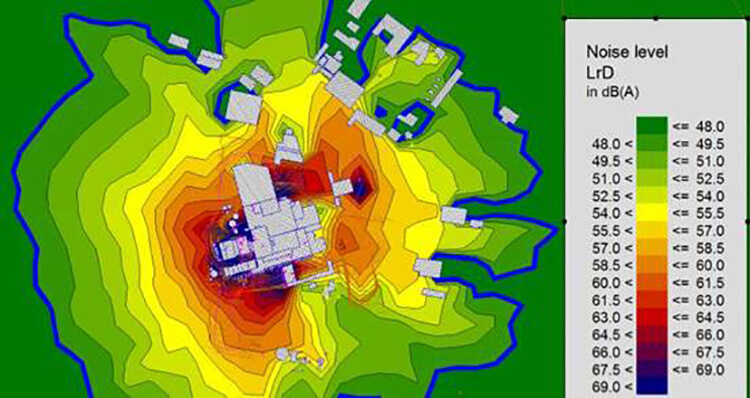
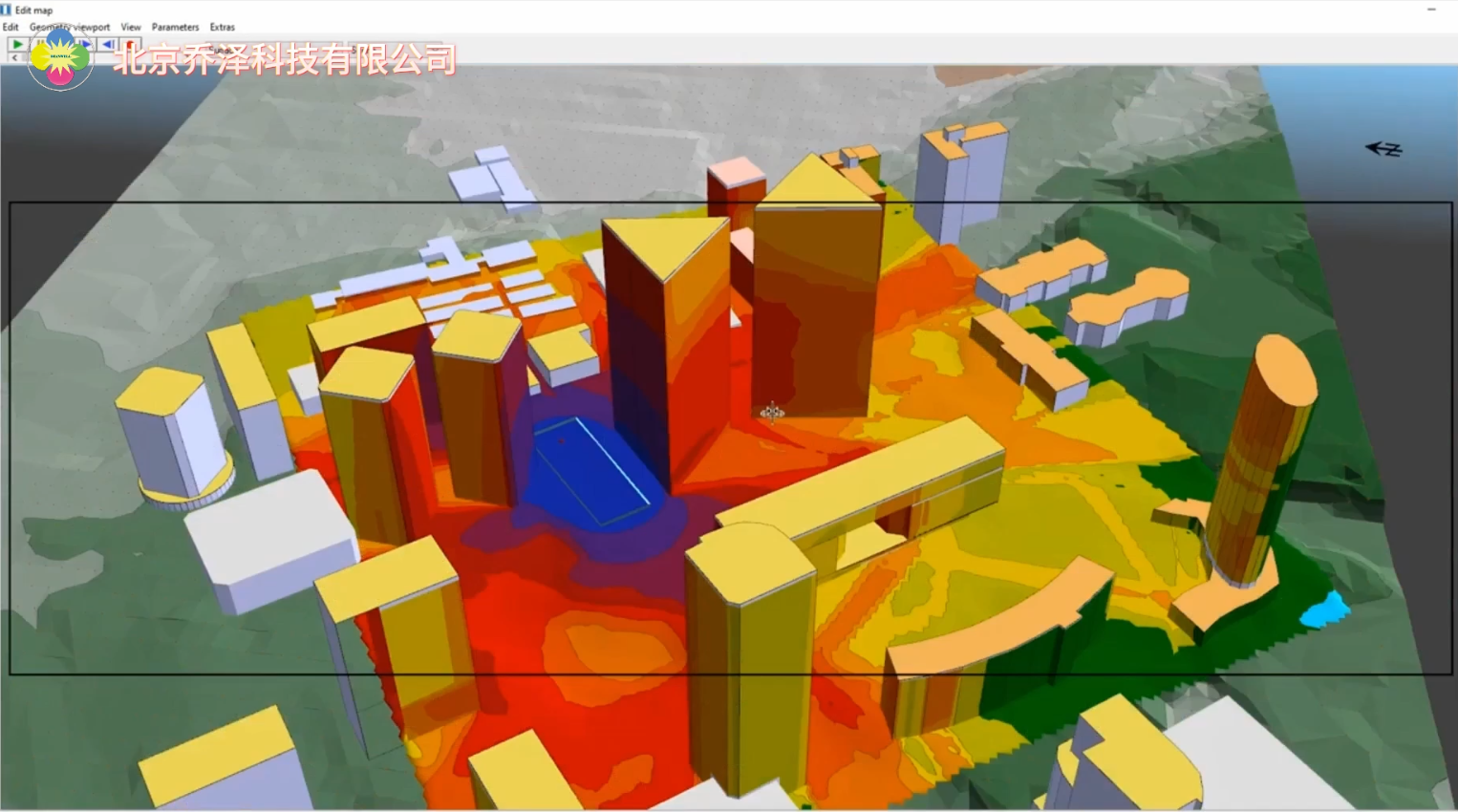
SoundPLAN Originating from Germany, it is one of the leading software in noise prediction, mapping, and assessment, widely used for outdoor noise prediction. Its 2024 year released SoundPLANnoise 9.1 version added 2024 new standard of the year ISO 9613-2 for calculating sound attenuation during outdoor propagation. This software is powerful, with modeling, calculation, and assessment based on ISO and other standards. It can simulate geometric attenuation, ground effects, surface reflections, and shielding caused by obstacles, while also considering air absorption attenuation and multiple reflections by buildings. It can generate color-coded noise maps, contour maps, and building facade sound pressure level distribution maps. It has many successful applications in road traffic noise, industrial equipment noise (such as power plant cooling towers), and rail transit sound barrier noise reduction effect simulation. It is worth noting that some studies point out limitations in handling complex physical phenomena such as sound wave interference.
2) EIAProN (Professional Noise EIA Auxiliary Software)
This is an auxiliary tool specially designed for domestic noise EIA professionals, fully compliant with the new Chinese guidelines. The software is divided into four functional modules: basic data, comprehensive prediction, special prediction, and tool programs. Its biggest feature is its alignment with domestic EIA practice, capable of handling comprehensive impact prediction of industrial sources, highway sources, and railway sources, and providing special prediction functions such as sound barrier design analysis and noise source contribution decomposition. It is more user-friendly for domestic users but mainly focused on the domestic market.
3) d&b NoizCalc
This is a free software jointly launched by d&b audiotechnik and SoundPLAN GmbH mainly used for far-field noise interference prediction of large sound systems at outdoor events (such as concerts). It is based on the ISO 9613-2 and Nord 2000 standard, can import system settings from ArrayCalc and apply them to 3D terrain models to predict the far-field impact of speaker systems under outdoor conditions, helping designers assess the noise impact of events on the surrounding environment.
4) Dassault Systemes SIMULIA MANATEE
This software focuses on the simulation analysis and optimization of electromagnetic vibration noise of motors ( e-NVH ) It provides electromagnetic - structure - acoustic multiphysics coupled simulation, capable of accurately tracing the sources of electromagnetic vibration noise, offering parametric scanning and multi-objective optimization. It is mainly applied to motor noise issues in electric vehicles, aerospace, precision instruments, and other fields.
5) PKPM Acoustic environment simulation software
PKPM and SoundPLAN collaborated to customize an acoustic environment simulation software to meet China's green building standards. It achieves indoor and outdoor acoustic environment simulation analysis, used to assess noise distribution around buildings and optimize sound insulation design of building envelopes, widely applied in green building certification projects.
05 How to Avoid EIA Risks: Selection and Application Recommendations
Avoiding noise EIA risks requires a combination of scientific methods, appropriate tools, and standardized processes.
1) Clarify requirements and standards: First, determine the predictive evaluation standards to follow based on the project type (road, factory, building, outdoor activities) and local regulations.
2) Choose appropriate software:
* Focusing on macro-regional noise planning, road traffic noise, and industrial noise outdoor propagation, SoundPLAN it is a comprehensive and globally validated choice.
* For environmental impact assessment reports of specific domestic construction projects, EIAProN may be more targeted and convenient.
* For handling electromagnetic noise of equipment such as motors and transformers, SIMULIA MANATEE specialized tools like these are more suitable.
3) Emphasize data quality and model validation: Even the best software requires accurate input data. The accuracy of sound source parameters, geographic information, and building data is crucial. When possible, use a small amount of on-site measured data to validate and calibrate the model, greatly improving the credibility of prediction results.
4) Understand software limitations: Know the applicable scope and assumptions of the software used. For example, SoundPLAN there are shortcomings in accurately simulating sound wave interference; complex scenarios require supplementary validation with more professional acoustic simulation software (such as methods based on Boundary Element Method BEM or Finite Element Method FEM )
Scientific and accurate noise prediction and evaluation are key to passing environmental impact assessments and avoiding later risks. Choosing software like SoundPLAN this, which has been industry-validated, deeply understanding its application scenarios and limitations, and combining it with actual monitoring data for validation, can effectively control noise pollution and ultimately achieve harmony between environmental protection and project development.
06 Scientific tools are essential to avoid EIA risks.
Choosing appropriate simulation tools and methods is crucial to avoid EIA risks. Outdoor atmospheric dispersion simulation needs to fully consider local meteorological conditions, terrain features, and pollution source characteristics, selecting models and parameters that comply with guideline requirements. Noise assessment requires precise measurement of sound source characteristics, consideration of obstacles and reflective surfaces in propagation paths, and use of verified reliable models.
With technological advances, modern EIA software functions are increasingly powerful. EIAProA software provides a user-friendly input/output interface, convenient and practical, fully functional, and aligned with new guideline requirements. SoundPLAN The software has advantages such as strong operability, high repeatability, intuitive expression, large data volume, and convenient analysis.
Luohu District of Shenzhen used SoundPLAN to create noise maps and found that the proportion of the population directly affected by noise along roads is as high as 50% above. After simulation optimization using SoundPLAN the noise at the vertical section of the south wall of the substation, at a height of 20 meters, can be controlled below 50 decibels. After comprehensive noise reduction treatment of laboratory fans, daytime noise can be successfully controlled below 55 decibels. The precise predictions provided by professional software make environmental impact assessments no longer just theoretical. They provide solid data support for urban planning, industrial layout, and environmental management, ultimately achieving a balance between economic development and environmental protection.
Noise Simulation,Noise Prediction,Environmental Impact Assessment Risk,Noise Control,Noise Control