


How do aerospace and automotive industry companies use models to define and manage the entire lifecycle of products?
Release time:
2025-07-29 16:15
Source:
From design drawings to scrapping and recycling, the digital thread is fundamentally changing product management in high-end manufacturing.
At Mercedes-Benz in Kecskemét, Germany - engineers have completed the reconstruction and optimization of the entire final assembly workshop in a virtual environment before the production of the new generation of cars. Through digital twin technology, the factory's coordination process has been reduced 50% , and the speed of production line transformation has doubled.
Meanwhile, in an aviation laboratory across the Atlantic, researchers use a dynamic adaptive predictive maintenance framework to precisely control the maintenance timing of aircraft engines before failure 1-2 cycles, improving 70-90% operational efficiency compared to traditional methods. These innovative practices mark model-based product lifecycle management as a core competitiveness in high-end manufacturing.
01 Aerospace Industry, Model-Driven Revolution
Aircraft engines are known as the "crown jewel" of modern industry. Their entire lifecycle involves many random and cognitive uncertainties. Traditional R&D often faces long iteration cycles, low manufacturing pass rates, and difficulties in use and maintenance. As engine loads continue to increase, the impact of various uncertainties grows.
A research team from Tsinghua University points out that the industry urgently needs to build an uncertainty design system for aircraft engines, quantitatively evaluating and controlling performance dispersion at each design stage to achieve comprehensive optimization of performance, reliability, robustness, and cost throughout the lifecycle.
In the field of predictive maintenance, dynamic adaptive frameworks based on machine learning are changing the traditional fixed-interval maintenance model. Researchers compared autoencoders (AE) long short-term memory networks (LSTM) and Gaussian process regression (GPR) methods and confirmed that GPR can precisely control maintenance timing to 1-2 cycles before failure. 1-2 cycles.
Another breakthrough comes from random sampling class balancing and voting feature selection techniques. This technology solves the data imbalance problem in aircraft engine remaining life prediction, enabling the XGBoost model to reduce the root mean square error of predictions on subsets to FD003 11.88% , improving over traditional methods by . Such models act like a "health prophet" for aircraft engines. 23%。这类模型如同为航空发动机装上了“健康预言家”。
02 Automotive Industry, Digital Twin Leads Efficiency Leap
The automotive industry is undergoing a similar digital transformation. Mercedes-Benz, as an industry pioneer, has deeply integrated the "digital-first" concept into its manufacturing system. The company has completely changed traditional production modes through a digital twin environment built on the - NVIDIA Omniverse platform. At the Kecskemét plant in Hungary, Mercedes-Benz established the world's first production base with a complete full-plant digital twin. Planners can optimize workshop layouts and production line supply configurations in a virtual environment and validate new plans without interrupting actual production.
This virtualization approach brings significant benefits: project planning and implementation time is shortened by weeks, coordination processes are reduced - , and the startup cost of new production lines is greatly lowered. In the paint shop at the Rastatt plant in Germany,
AI 50% monitoring systems have achieved energy savings. Jörg Burzer, a member of the Mercedes-Benz Group Board of Management, stated: "Integrating 20% and digital twins fully into the digital production system has opened a new era in automotive manufacturing." This technological integration enables the company to flexibly manufacture electric, hybrid, and gasoline models on the same production line while ensuring that vehicles rolling off the line have the latest software.
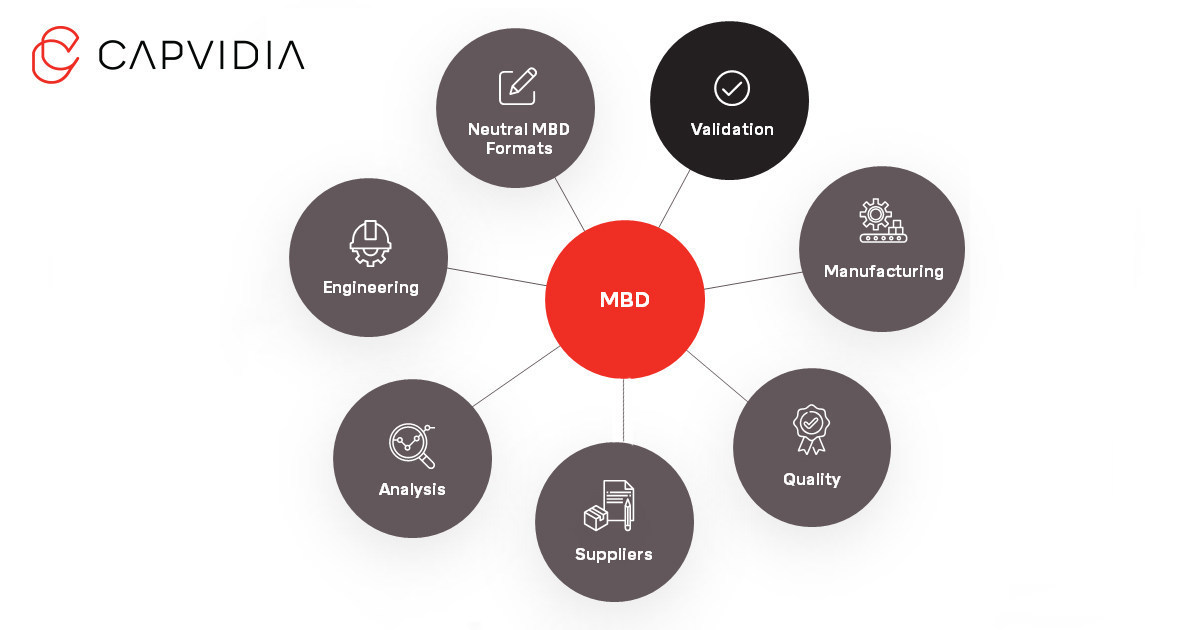
03 Model Technology, The Digital Thread Throughout the Lifecycle - A core technological trend across aerospace and automotive industries is that model-based definition (MBD) is replacing traditional drawings as the core carrier of product lifecycle management. This shift enables collaborative management of the entire process from conceptual design to scrapping and recycling on a unified model basis. In aerospace, a collaborative product lifecycle quality management system stores, organizes, manages, and controls quality-related data and business processes throughout the product lifecycle, ensuring consistency, effectiveness, security, completeness, and traceability of quality-related data. Capvidia's energy savings. 、MB.OS MBDVidia MO360 software provides key support in this field, achieving interoperability across
CAD
systems. The solution supports native data from Siemens NX,
PTC Creo, 3D-PLM SOLIDWORKS,
and Autodesk Inventor, ensuring full compatibility between design, quality, and manufacturing systems. 软件在这一领域提供关键支持,实现了跨CAD系统的互操作性。该解决方案支持Siemens的NX、PTC Creo、SOLIDWORKS和Autodesk Inventor的原生 Siemens 数据,确保设计、质量和制造系统之间的完全兼容性。
At the same time, the software's bidirectional interoperability allows downstream automated workflows and provides verified quality data upstream, forming a closed-loop feedback among design, manufacturing, and inspection.
04 Future Trends, Uncertainty Design and Management
With continuous technological evolution, two major industries are jointly advancing towards a new stage of smarter and more autonomous product lifecycle management. The deep integration of digital twin technology and artificial intelligence will become a key development direction.
In the aviation field, researchers are exploring the integration of AE anomaly detection and GPR probabilistic modeling hybrid methods, which may become the standard configuration for the next generation of aviation predictive maintenance. Meanwhile, research on digital twins assisting the full lifecycle management of aircraft engines shows that this technology can achieve precise mapping and real-time interaction with the physical engine entity, providing strong support for design optimization.
The automotive industry will further deepen the integration of the virtual and physical worlds. Mercedes-Benz's practice shows that digital twin technology not only optimizes production processes but also extends to the product usage phase, forming a complete digital closed loop. - Mercedes-Benz's practice shows that digital twin technology not only optimizes production processes but also extends to the product usage phase, forming a complete digital closed loop.
With the advent of the industrial 5.0 era, model-based enterprises ( MBE ) are becoming the evolutionary direction of high-end manufacturing. This transformation will not only improve product quality and production efficiency but also promote manufacturing towards more sustainable and flexible directions. Led by the aerospace and automotive high-end manufacturing industries, model-based full lifecycle management is reshaping the innovation paradigm of modern industry.
Boeing, through digital design and manufacturing collaboration, has achieved a paperless design process for its 777 model aircraft, shortening the R&D cycle 40% , and reducing engineering rework 50% . A380 Airbus, 4 from Spain, Germany, the United Kingdom, and France, 5 cities achieve remote, heterogeneous information integration and parallel collaborative work, shortening the development cycle by A340 % 25 and reducing costs by 50 %.
These data confirm the huge benefits brought by model-driven product lifecycle management. When the last aircraft engine is retired and the last traditional car rolls off the line, their product stories have been precisely written in the world of models since the design's inception — this is no longer a science fiction scenario but a real picture of industrial digital transformation.
MBD Toolchain,Model-based definition,Product Lifecycle Management