


Special environmental test chambers are becoming valuable tools for failure analysis of products or components in industries such as electrical appliances and automobiles.
Release time:
2025-07-17 11:28
Source:
When the Tesla Model 3 completed the -30°C extreme cold endurance test and became a trending topic, few paid attention to the fact that its battery management system had already undergone 1800 temperature cycle tests in a test chamber. In the field of industrial reliability engineering, special environmental test chambers are stepping out from behind the scenes to the forefront, becoming "digital detectives" that decode product failure. According to the "2025-2030 China High and Low Temperature Test Chamber Industry Market Research and Investment Prospect Analysis Report," the domestic market size exceeded 4.2 billion yuan in 2024, with an expected growth rate of over 18% this year. This technological revolution in quality and reliability is reshaping the quality control logic of manufacturing.
The "Extreme Laboratory" of Failure Analysis
At a new energy battery factory in Dongguan, a battery pack that underwent 200 cycles of -40°C to 85°C thermal shock testing revealed a defect of increased electrolyte viscosity at low temperatures. Engineers controlled the low-temperature endurance decay rate within 12% by adjusting the formula. Similar cases are becoming the norm in the industry. Special environmental test chambers simulate extreme conditions, compressing potential risks in the product lifecycle to appear within days or even hours.
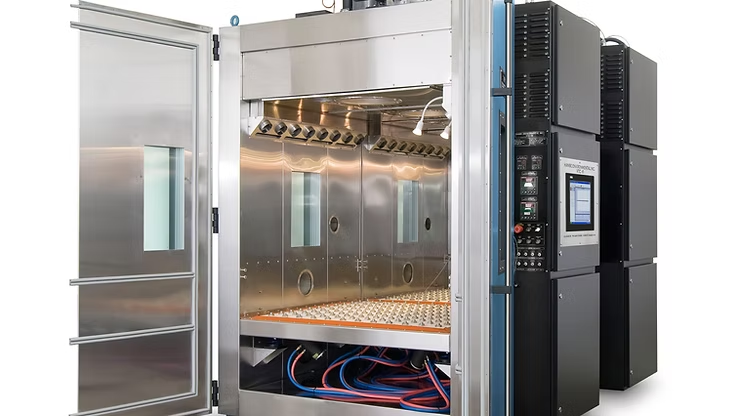
The automotive industry relies on this especially. A domestic brand reduced the failure rate of the car door sealing system from 3.7% to 0.5% through alternating high and low temperature tests; meanwhile, the ECU control module of electric vehicles exposed abnormal capacitor values during 120°C high-temperature testing, directly driving upgrades in electronic component selection standards. HANSE Special Environmental Test Chamber Equipment providing ±0.5°C temperature control accuracy makes it possible to analyze microscopic parameters such as material thermal expansion coefficients.
Technological Iteration Drives Analytical Innovation
Modern test chambers have evolved from single temperature control to composite environmental simulation platforms. Guangdong Weis Laboratory Equipment launched an intelligent control system capable of a rapid change rate of 10°C per minute, combined with a 316L stainless steel inner liner design, which can simulate desert temperatures of 70°C and resist salt spray corrosion. The newly released GB/T 10586-2025 "Technical Specification for Damp Heat Test Chambers" further standardizes equipment performance parameters, providing comparable data foundations for failure analysis.
This technological advancement significantly improves analysis efficiency. The semiconductor industry uses 125°C/1000-hour accelerated aging tests to reduce chip solder joint failure probability by 73%; the aerospace field employs extreme temperature variation tests from -70°C to 180°C to expose structural stress risks in spacecraft materials in advance. As an engineer from a testing agency said, "Test chambers do not create extreme environments, but rather a time machine for product failure."
A New Paradigm of Cross-Industry Collaboration
The demand for failure analysis is breaking down industry barriers. Biopharmaceutical companies borrow temperature shock methods from the automotive industry to evaluate vaccine activity decay under 2-8°C refrigeration and -70°C ultra-low temperature conditions; consumer electronics manufacturers introduce military-grade vibration and damp heat composite tests to solve the persistent problem of phone blackouts in cold regions. This cross-industry integration has spawned modular equipment designs, such as DHT®'s CHDHT intelligent control system for cold, hot, dry, and wet components, which can quickly switch test modes to adapt to different industry standards.
Market feedback confirms this trend. According to statistics from China Automotive Technology and Research Center, new energy vehicle companies using intelligent environmental testing equipment have seen a 61% reduction in warranty claims for the three-electric system; the electronics manufacturing industry has increased PCB delamination defect detection rates by 40% through 85°C/85%RH constant temperature and humidity tests. With breakthroughs in temperature control accuracy (reaching ±0.3°C) and energy efficiency ratios of domestic equipment, special environmental test chambers are transitioning from exclusive equipment for large enterprises to standard tools for quality improvement and efficiency enhancement in small and medium-sized manufacturers.
In this quality revolution, the role of test chambers has surpassed simple detection equipment, becoming a reliability link connecting R&D, production, and service. When a certain power battery completes its 1000th charge-discharge cycle inside a test chamber, it records not only the charge-discharge curve but also a condensed product life epic — and this is the most compelling technical narrative of failure analysis.
Manufacturing Process and Details,Special Environmental Testing,High Acceleration Life Test,High and low temperature shock test,Product Failure Analysis