


The environment "purgatory" tempers Chinese manufacturing, with reliability test chambers becoming invisible guardians
Release time:
2025-06-30 12:25
Source:
Salt fog corrosion, extreme cold lock-up, humid heat short circuit—these "fatal flaws" of industrial products are being precisely predicted.
In the scorching 70°C Gobi Desert of Turpan, a new energy vehicle suddenly lost power; on a -40°C frigid morning in Mohe, the hydraulic system of construction machinery completely froze—these real-world product failures are now being accurately replicated and solved in laboratories. Environmental reliability testing, once hidden at the back end of the industrial chain, has now become a core battlefield for China's manufacturing to leap to high-end.
01 Extreme Environments: The "Demon-Detecting Mirror" for Products
In 2024, a research team from Hunan Electric Vocational and Technical College subjected high-voltage motor insulation materials to continuous testing under salt fog, humid heat, and sudden temperature changes. Results showed that after 175 hours of salt fog corrosion, the domestically produced high thermal conductivity mica tape insulation resistance remained above 500MΩ, far exceeding national standards; however, when the temperature suddenly changed by more than 50°C, microcracks appeared at the material interface, and the elastic modulus dropped by 18.17%.
"Environmental adaptability determines the life and death line of products," said research leader Du Xiehe. "The severity of laboratory simulations must exceed actual application scenarios by 30% to expose potential failures."
Dalian University of Technology's polar materials research is even harsher. When carbon fiber composites are subjected to -50°C, 4.5cm ice accretion, and 70W/m² ultraviolet radiation simultaneously, their tensile strength fluctuates by 10%. Sun Wei's team found through orthogonal experiments that for every 15°C drop in temperature, the material's brittleness critical point shifts by 12%; ultraviolet radiation is the "number one killer" causing resin aging. (Source: "Study on the Interaction between Carbon Fiber Composites and Polar Environmental Factors")
02 Three-Integrated Test Chamber: The "God's Hand" Simulating Nature
To replicate these extreme scenarios, environmental reliability test chambers have become key carriers. Modern equipment has evolved from single-factor testing to **"temperature-humidity-vibration" three-integrated testing:**
- Temperature shock: instantaneous transition from -70°C to +180°C, replicating the transport of electronic products from polar regions to deserts.
- Salt fog corrosion: continuous spraying of 5% sodium chloride solution for 1000 hours, accelerating ten years of marine environment corrosion.
- Multi-axis vibration: 6-degree-of-freedom hydraulic platform simulating ship roll (Chen Lijia's team data shows that with 20% sensor error, ship motion forecast deviation remains <15%).
The technical barrier of such equipment lies in the **precise coupling of environmental parameters**. For example, in automotive testing, it is necessary to simultaneously achieve road vibration +85°C engine compartment high temperature +95% humidity, with errors controlled within ±0.5°C/±2%RH. (Source: China Automotive Technology and Research Center "Analysis of the Impact of Environmental Conditions in Automotive Test Fields on Vehicle Reliability Test Results")
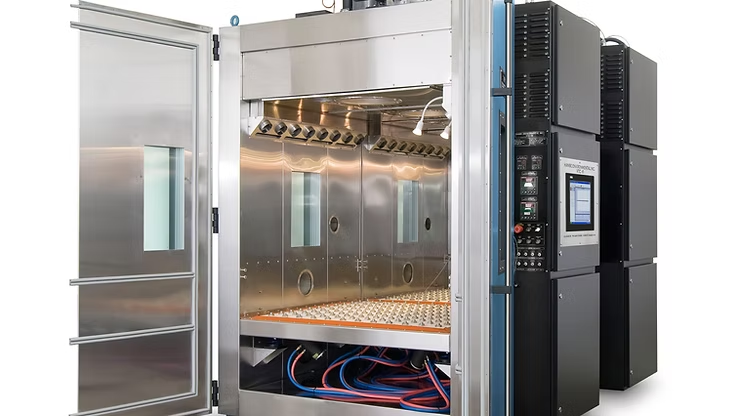
Currently, domestic laboratories have scaled up the application of composite environment chambers, such as HANSE Special Environment Test Chamber and other products, which can physically integrate vibration tables and temperature-humidity chambers to avoid test interruptions caused by sample transfers.
03 From "Passive Detection" to "Active Design"
The value of environmental testing is shifting from end-stage detection to the front end of R&D:
The shipbuilding industry is leading the transformation. Wuhan University of Technology developed an "Environmental Uncertainty Forecast Model" that, by incorporating variables such as wave interference and data transmission delays, improves ship maneuvering motion forecast accuracy by 40%.
"Extreme environmental data is now introduced at the design stage," said Professor Chen Lijia. "The verification cycle for new ship types' polar seaworthiness has been shortened by 60%."
The aviation sector further converts test data into design parameters. Statistics from the China Aviation Comprehensive Technology Research Institute show that after adopting availability assessment models:
- Equipment failure repair time reduced by 35%
- Incidence of "stubborn failures" such as compressor liquid hammer decreased by 50%
- System availability increased from 0.67 to 0.92
Conclusion: The "Extreme Survival Game" in Laboratories
As China's high-speed trains race across frozen plateaus and wind turbine blades face 12-level typhoons, the confidence of these "steel bodies" comes from thousands of "death tests" in laboratories. According to CNAS statistics, in 2023 there were 1,172 accredited third-party environmental laboratories, a 47% increase compared to three years ago.
At a testing center in Suzhou, an engineer is placing a medical device into a -40°C test chamber. "This is equivalent to a Siberian cold wave continuously attacking for 72 hours," he said, pointing to the fluctuating data on the screen. "We must ensure it never abandons its mission to save lives under any extreme environment."
Environmental reliability testing has surpassed the scope of quality control and become a source of product innovation. As an international certification expert said: "Whoever masters extreme environment simulation capabilities holds the pass to the future market."
Accelerated Aging Technology,HANSE Special Environment Test Chamber,High Acceleration Life Test,Product Failure Analysis