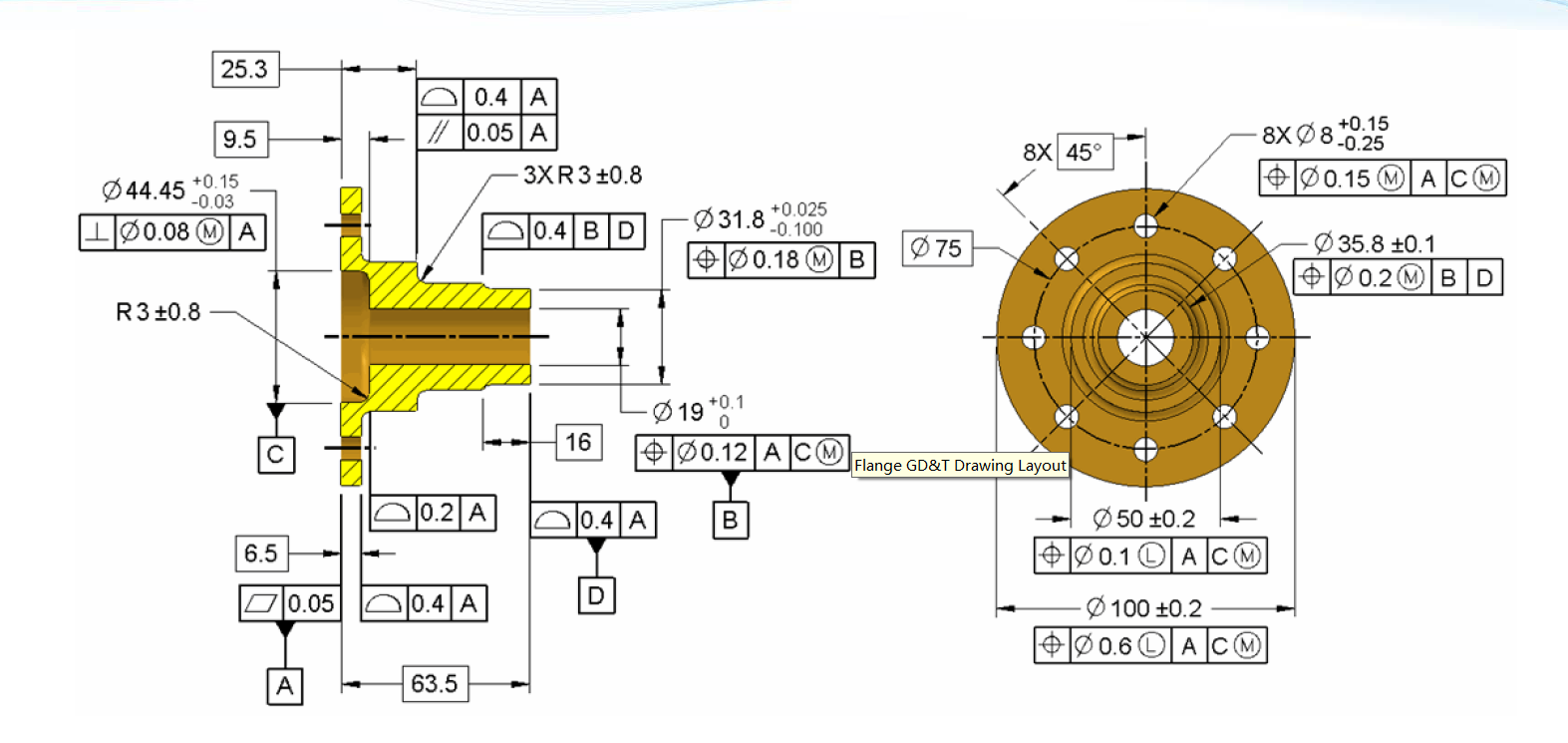
Breaking the Two-Dimensional Shackles: Unlocking the Maximum Value of MBD in Industrial Manufacturing
Release time:
2025-05-29 14:07
Source:
In the field of industrial manufacturing, traditional 2D drawings are gradually becoming a bottleneck for digital transformation. As product complexity soars, issues such as unclear geometric descriptions, version confusion, and inefficient cross-department collaboration are increasingly prominent. Model-Based Definition (MBD) technology, by embedding all information such as geometric dimensions, tolerances, and process requirements into a 3D digital master model, is reshaping the manufacturing process. How can MBD truly realize its potential? Industry expert Norm Crawford and the ITC Infotech team have provided key pathways. (Recently read the interview series with ASME certification expert Norm Crawford (DCS, 2023) and the ITC Infotech white paper "Model Based Definition: Replacing Technical Drawings" (2023), and would like to share some thoughts.)
Foundation: GD&T is the "universal language" of MBD
Norm Crawford, an expert with 40 years of experience in GD&T (Geometric Dimensioning and Tolerancing), emphasizes: "The biggest obstacle to MBD is not technology, but corporate culture and lack of GD&T knowledge." Many companies mistakenly believe that MBD can automatically correct design defects, but this is not the case. If the design team does not master GD&T standards (such as ASME Y14.5), even with MBD, downstream machining and inspection stages will still fail due to misunderstanding tolerance requirements.
Typical case lessons A supplier of aerospace components experienced a 30% rework rate because designers misused linear dimensioning and failed to clearly constrain the degrees of freedom of critical mating surfaces, causing the CMM inspection program to be unable to align assembly functions. After specialized GD&T training and optimizing the datum framework to an "A-B-C" sequence, tolerance analysis efficiency improved fourfold.
Practice: The 3D master model must run through the entire process
ITC Infotech points out in its report that the value of MBD must be realized through "single source of truth" Implementation:
Design stage Embed PMI (Product Manufacturing Information) directly in CAD software (such as NX/SOLIDWORKS/CREO) to avoid version mismatches caused by parallel management with 2D drawings.
Manufacturing stage CNC programs can directly read model tolerance data. An automotive parts factory shortened programming time by 70% by driving machining centers with MBD models.
Inspection stage Coordinate Measuring Machines (CMM) automatically interpret model annotations. Medical implant company Stryker used MBD models to generate inspection paths, reducing quality inspection time for complex curved parts from 8 hours to 1.5 hours.
Collaboration trap warning Norm Crawford observed that many companies claim to "involve manufacturing departments early," but only send models without tolerance annotations, causing collaboration to fail. The correct approach is: Annotate key constraints using GD&T language (e.g., "Datum A restricts 4 degrees of freedom"), enabling manufacturers to propose process optimizations based on functional requirements.
Transformation case: From "drawing dependency" to model-driven
The comeback of a medical device company : A hip prosthesis manufacturer once had a 0.1mm hole offset in batch parts due to inconsistencies between 2D drawings and model versions. After introducing MBD:
Design side: Defined the surface profile tolerance and datum system of the acetabular cup in SOLIDWORKS
Quality inspection side: Used 3D PDF to dynamically highlight critical tolerance areas Result: Product launch time accelerated by 40%, and first-pass yield increased from 82% to 98%.
Future: Bridging cultural and generational gaps
Despite mature technology, cultural resistance remains the biggest challenge. Norm found that: "Veteran employees often see MBD as a threat to their positions" While younger engineers are more open, university education still lags. Although schools like Purdue University offer GD&T courses, most mechanical engineering programs have yet to incorporate MBD into their core curricula.
ITC Infotech suggests companies break through step by step:
Key insights When a heavy machinery company required suppliers to be ASME GDTP certified, the first-pass rate of MBD models jumped 58%—proving that "building standard capabilities" is more critical than software investment. 。
Conclusion
MBD is not simply "3D replacing 2D," but reconstructs manufacturing logic through a digital master thread. Its greatest effectiveness is released when:
GD&T becomes the unified language for design, manufacturing, and inspection;
The master model runs through the entire lifecycle, eliminating information silos;
Cultural transformation and standard certification lead the way.
As Norm Crawford said: "The value of MBD is not in the model itself, but in how it enables product functional requirements to be transmitted without loss to every stage." When companies overcome both cultural and technical gaps, MBD will become the core bridge to Industry 4.0.