


Exploring the relationship between CMM measurement plan evaluation and MBDVidia, CompareVidia, and PUNDIT
Release time:
2025-04-11 01:14
Source:
Introduction
In today's manufacturing and measurement fields, the importance of CMM measurement plan evaluation is self-evident. It not only helps enterprises ensure product quality but also enhances production efficiency. This article will delve into the relationship between CMM measurement plan evaluation and MBDVidia, CompareVidia, and PUNDIT, as well as how they collectively adhere to the QIF standard.
What is CMM Measurement Plan Evaluation?
In manufacturing and measurement fields, the evaluation of CMM (Coordinate Measuring Machine) measurement plans is a core process to ensure product quality, optimize production processes, and address complex manufacturing challenges. Its importance is first reflected in the dual control of product quality and compliance: through scientific planning of measurement paths, defining key dimensions and tolerance ranges, the evaluation ensures coverage of all critical features, avoiding quality risks caused by missed or incorrect inspections, while meeting strict international standards (such as ISO, ASME) in industries like automotive and aerospace, thus avoiding legal or safety liabilities. Secondly, the evaluation of measurement plans is directly related to production efficiency and cost control. Reasonable path planning and resource allocation can shorten equipment operation time, reduce idle or repeated measurements of high-value CMM equipment, and early detection of manufacturing deviations can significantly lower scrap rates and rework costs in mass production. For complex parts (such as curved surfaces or aero-engine blades), the evaluation focuses on probe selection, measurement point density, and coordinate system alignment strategies to ensure the reliability of high-precision data and provide consistency support for multi-process collaboration, thereby promoting process improvement. Additionally, the data quality generated by measurement plans directly determines the feasibility of Statistical Process Control (SPC) and digital manufacturing (such as digital twins in Industry 4.0), laying the foundation for data-driven decision-making. Facing global supply chain challenges, unified evaluation standards enhance comparability of inspection results from different suppliers, reduce disputes, and quickly respond to design changes or process adjustments, shortening product iteration cycles. With the development of smart manufacturing, measurement plan evaluation must also be compatible with automated systems (such as robotic loading and unloading) and new measurement technologies (such as optical scanning), improving inspection efficiency by integrating multi-source data and optimizing measurement point distribution with AI. Overall, CMM measurement plan evaluation is not only a key step for technology implementation but also a strategic support for enterprises to achieve "zero defects" goals and adapt to smart manufacturing transformation. Its systematic verification capability spans the entire value chain of quality, efficiency, cost, and innovation, serving as an important guarantee of competitiveness in high-end manufacturing.

The Role of MBDVidia
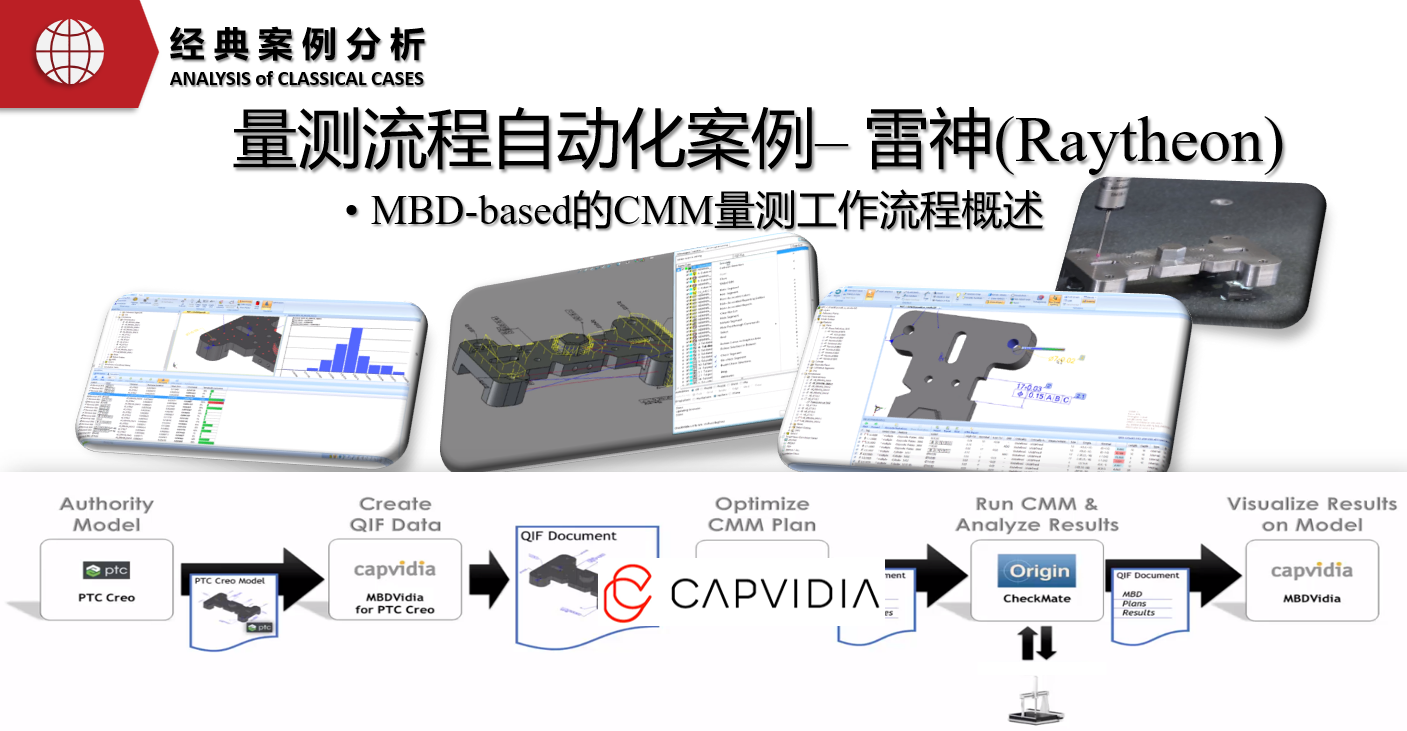
MBDVidia (Model-Based Data Visualization) is a powerful tool designed to generate, inspect, and repair visualized MBD models to improve the efficiency of R&D, design, and manufacturing. It integrates PMI product manufacturing information and product quality inspection results with 3D CAD design models, circulating MBD models in QIF format throughout the R&D, design, and manufacturing processes, enabling engineers and technicians to make quick decisions. MBDVidia plays an important role in CMM measurement plan evaluation by providing graphical data displays that help teams better understand measurement results.
Advantages of CompareVidia
CompareVidia is another indispensable tool focused on comparing differences between various measured MBD models. Through CompareVidia, enterprises can easily identify whether the MBD model used as the measurement plan's inspection standard is accurate, thereby optimizing resource allocation. This quality assurance tool for inspection standards greatly enhances the accuracy and authority of CMM inspections.
The Relationship Between PUNDIT and the QIF Standard
PUNDIT is an intelligent CMM inspection simulation software primarily used to reduce CMM measurement uncertainty, optimize measurement plans, and improve control over the measurement process. The Quality Information Framework (QIF) includes measurement plans and results that are closely related to PUNDIT software. The existence of PUNDIT enables CMM measurement plan evaluation to be conducted in a standardized environment, ensuring seamless data integration between different systems, effectively improving the accuracy of measurement plans and results, and promoting enterprises to obtain MBD models that better comply with QIF standards.
How to Achieve Synergy?
By effectively combining MBDVidia, CompareVidia, and PUNDIT, enterprises can achieve synergy in CMM measurement plan evaluation. This synergy not only improves measurement accuracy but also accelerates decision-making. Imagine that when all data and tools are efficiently integrated, enterprises can stand undefeated in a rapidly changing market.
Conclusion
In summary, CMM measurement plan evaluation is not only a highly technical process but also a complex system closely linked with various tools and standards. By reasonably utilizing MBDVidia, CompareVidia, and PUNDIT, enterprises can achieve significant results in quality control and production efficiency. In the future, with continuous technological advancement, CMM measurement plan evaluation will undoubtedly usher in new development opportunities.
CMM Measurement Plan Evaluation