


Unveiling the Mystery of On-Site Acoustic Measurement: Methods and Applications
Release time:
2025-04-04 00:49
Source:
Basic Concepts of On-site Acoustic Measurement
In today's society, the acoustic environment has a significant impact on our quality of life. On-site acoustic measurement, as the name suggests, refers to the measurement of sound in a specific environment. This type of measurement not only helps determine the intensity, frequency, and duration of sound but also reveals the characteristics of sound propagation, thereby providing data support for architectural design, urban planning, and noise control.
What are the methods of on-site acoustic measurement?
So, what exactly are the methods of on-site acoustic measurement? Here are some commonly used measurement techniques:
1. Sound Pressure Level Measurement
Sound pressure level measurement is one of the most common on-site acoustic measurement methods. Using professional equipment, it measures the sound pressure level at a specific location, usually in decibels (dB). This method is suitable for assessing noise pollution, industrial noise, and similar situations.
2. Spectrum Analysis
Spectrum analysis goes deeper; it not only measures the decibel value of sound but also analyzes its frequency components. This technology is commonly used for environmental noise monitoring and audio equipment tuning. Through the spectrum, the distribution of sound energy at different frequencies can be clearly seen, facilitating targeted improvements.
3. Echo Measurement
Echo measurement is another important on-site acoustic measurement method. By emitting sound and recording the time it takes for the reflection to return, it can determine the acoustic characteristics of a room. This is especially important in the design of concert halls and theaters.
4. Three-dimensional Sound Field Reconstruction
The intelligent sound reach theory uses intelligent statistical optimization of triangulation principles to determine the position of any sound source in three-dimensional space; the Helmholtz equation least squares method reconstructs the optimal sound field distribution based on input sound signals. The combination of these two forms rake noise control technology, enabling the visual sound instrument to allow users to detect and analyze any complex noise source and its generated three-dimensional sound field.
Applications of On-site Acoustic Measurement
The application scope of on-site acoustic measurement is quite broad, covering multiple fields.
1. Architectural Acoustics
In architectural acoustics, on-site acoustic measurement helps designers optimize the sound quality of rooms, ensuring occupants enjoy a good acoustic environment. For example, in the design process of concert halls, acoustic measurement is an indispensable step.
2. Noise Control
In urban noise control, on-site acoustic measurement is used to assess noise sources and provide a basis for noise mitigation measures. Through measurement, effective noise control plans can be formulated to improve the urban living environment.
3. Acoustic Product Development
In the development of acoustic products, on-site acoustic measurement also plays a crucial role. By testing acoustic performance, the R&D team can optimize product design and enhance its market competitiveness.
4. Application of On-site Acoustic Measurement in the Automotive Industry
Acoustics is vital in the automotive industry, helping to improve vehicle quality, safety, and comfort. Effective sound management can reduce unnecessary noise, create a quieter cabin, and improve in-car communication. Good acoustic engineering can also enhance the perception of luxury and refinement, helping brands stand out in the market. Moreover, as electric vehicles become more common, managing noise and vibration is increasingly important to address new acoustic challenges.
Sonocat is a valuable tool in the automotive industry, providing precise real-time absorption, intensity, and direction analysis. Its features help engineers accurately identify noise sources, enabling targeted acoustic performance improvements. The probe's durable design and high sensitivity make it ideal for capturing detailed acoustic data inside vehicles, thereby better controlling noise and enhancing the driving experience.

5. On-site Noise Source Localization and Sound Field Reconstruction
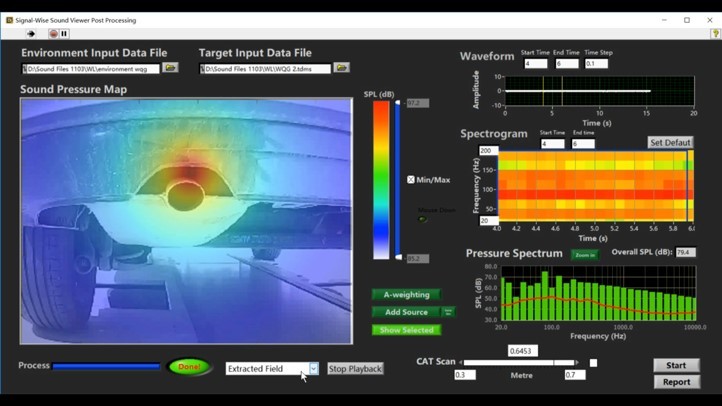
Visual Sound Instrument Previously, common noise detection and analysis tools on the market could only provide a single physical quantity at the measurement point, such as a microphone giving the sound pressure level or a sound intensity meter giving the sound intensity level at the measurement point. These traditional measurement methods could not provide a global concept, especially failing to obtain all acoustic physical quantities on any structural surface. Meanwhile, traditional methods could only determine the azimuth of the sound source but not the longitudinal distance.
Visual Sound Instrument In addition to simultaneously determining the positions of multiple sound sources in three-dimensional space, including azimuth and longitudinal distance, it can also provide the distribution of all acoustic physical quantities on any shaped structural surface and within three-dimensional space, analyze sound transmission through any material or structure or panel, and analyze sound radiation from transmission components during speed changes. The visual sound instrument's detection, analysis, and display frequency band and dynamic range are consistent with the measurement microphone. The wider the microphone's frequency band and the greater its dynamic range, the wider and greater the visual sound instrument's real-time display frequency band and dynamic range. For example, if the microphone's frequency band is 20Hz - 20KHz and the dynamic range is 140dB, the visual sound instrument's detection and analysis results will be 20Hz - 20KHz, 140dB. The visual sound instrument's spatial resolution of sound sources is independent of sound wave frequency.
Conclusion
In summary, on-site acoustic measurement is a highly practical technology with diverse methods and wide applications. Whether in architectural design, environmental noise management, or acoustic product development, on-site acoustic measurement plays a crucial role. It is hoped that this article can provide some insights into your understanding and application of acoustic measurement!
On-site acoustic measurement