


What impact and benefits does the analysis and evaluation of human biomechanics data have on the design and optimization of exoskeleton robots?
Release time:
2023-07-26 14:00
Source:
Exoskeleton robots, simply put, are robots that are "worn outside the human body". They are designed based on bionics and ergonomics, also known as "wearable robots". It feels very much like Iron Man's armor, and what makes people happy is that the cool battle suits from movies have now entered our lives.Exoskeleton robots are a new type of assistive device that can help healthy individuals complete tasks that originally require significant strength or high skills, and assist people with physical disabilities to work and live better. Exoskeleton robots generally consist of a support system, a power assist system, and a body motion control system. The support system is mainly responsible for the load-bearing and support of the exoskeleton; the power assist system has strong thrust, enabling the robot to perform actions that are difficult for the human body to accomplish; the body motion control system is the core of the exoskeleton robot, which can achieve accurate motion control of the human limbs based on an in-depth understanding of human physiological structure. The key to exoskeleton robots lies in a deep mastery of human kinematics and physiology, as well as a high precision in simulating and controlling their movements. Therefore, we believe that the analysis and evaluation of human motion biomechanics data are very important for the design and optimization of exoskeleton robots. So, what is the relationship between the two? We can analyze it from two aspects:
1. Accurate human motion biomechanics data can greatly assist in the design and optimization of exoskeleton robots.
The anthropomorphism of exoskeleton robots requires a thorough understanding and mastery of human physiological structure and motion mechanisms during the design process. Based on the motion characteristics of each joint during human activities, reasonable degrees of freedom and ranges of motion should be designed. For example, designing and assembling a medical rehabilitation exoskeleton for the elbow that has one degree of freedom for flexion and extension, driven by shape memory alloy wires, plays an important role in this process: to estimate the necessary torque at the joint for a specific patient, a simulation software called Body Biomechanics (BoB) was used. BoB is a human musculoskeletal model in MATLAB/Simulink, consisting of 36 segments of the skeleton and 666 muscles. This tool was developed by Coventry University (UK) and has two versions: one for inverse dynamics and the other for direct dynamics. In the inverse dynamic model, BoB calculates joint torques, muscle load distributions, and joint contact forces. The software can simulate the inverse dynamic behavior of the human body, taking the patient's height, weight, and movements as input, and outputting data such as joint torques. In the forward dynamic model, BoB can calculate movements caused by muscle activation and external forces. Therefore, BoB is a very powerful tool with strong graphical capabilities and data post-processing functions. In particular, the elbow joint is the joint between the humerus of the upper arm and the radius and ulna of the forearm, allowing the hand to move towards and away from the body. The elbow joint features 2-DOF; on one hand, one degree of freedom is for flexion and extension, while on the other hand, one degree of freedom is for anterior-posterior movement. The angle range for flexion and extension is estimated to be between 0 and 150 degrees, but in activities of daily living (ADL), the functional range is estimated to be between 30 and 120 degrees. In sit-up exercises, the average angle for sit-ups is 71 degrees, and the average angle for sit-ups is 81 degrees (Figure 2). Generally, in ADL, the total range for anterior flexion is about 50 degrees, and for lifting, it is also 50 degrees.
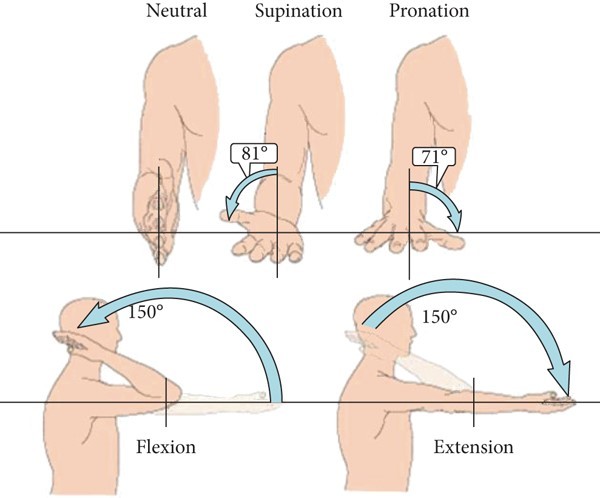
Figure2The normal range of motion for the elbow joint.
In this case, the simulation configured the following parameters: weight 80 kg, height 1.8 m, the motion trajectory of the right elbow joint between 0 and 150 degrees, and a movement frequency of 0.25 Hz. Additionally, a force of 20N was applied. From the simulation, it can be seen that to successfully complete the rehabilitation task for the elbow joint, a torque of about 3.5 N·m is required (Figure 3). In this case, it is assumed that the patient has clearly lost motor function, and all forces are completed by the exoskeleton.

Figure3 (a) BoBThe simulator is configured in the flexion and extension state of the elbow joint.(b)The simulation results of the necessary torque for the elbow joint.
Finally, indesigning the exoskeleton structure for the elbow joint, considering the comfort of the medical rehabilitation process, based on anthropomorphic measures:

Figure4A wearable exoskeleton for elbow medical rehabilitation, equipped with shape memory alloy actuators.
2. The mutual promotion between exoskeleton robots and human biomechanics assessment.
Biomechanics assessment is a method for studying human movement and mechanical properties, which can evaluate the state and ability of human movement by measuring parameters such as movement trajectory, force, and speed. Mechanical exoskeletons, as assistive devices, can help people complete tasks that originally require significant strength or high skills, such as lifting heavy objects and climbing stairs. During the completion of these tasks, mechanical exoskeletons record parameters such as human movement trajectories, forces, and speeds, which can be used for biomechanics assessment.
When using mechanical measurement techniques to assess the functions and effects of exoskeleton robots, the following can be done:
1.Motion analysis: Using motion capture systems and video monitoring to record the movements of mechanical exoskeleton users, including gait, sitting, standing, walking, and other activities.
2.Force plate measurement: Measuring the forces and reactions between the mechanical exoskeleton and the user by placing force plates between the exoskeleton and the ground.
3.Electrical measurement: Detecting muscle activity and muscle strength of the body, as well as biological electrical signals of the body, through electrodes and sensors.
4.Pressure distribution analysis: Observing the pressure distribution between the mechanical exoskeleton and the body through sensors placed at different locations.
Through the above biomechanics assessment techniques, we can further understand the interaction between the mechanical exoskeleton and the user, as well as the impact of the mechanical exoskeleton on body movement and posture, thereby improving the application effectiveness and safety of the mechanical exoskeleton.
Of course, through the biomechanics assessment of exoskeleton robots, understanding the movement state and ability of the human body when using mechanical exoskeletons is also very helpful for improving and enhancing human movement capabilities and performance.
Tokyo Denki University in Japan has designed and developed a 7-DOF exoskeleton rehabilitation robot (Figure 5). This robot uses positional signals for control, specifically monitoring the patient's position and the interaction forces between the patient and the exoskeleton. The rehabilitation training movements performed by the patient are controlled by the signals from the exoskeleton robot. The rehabilitation robot SUEFUL-7 developed by Saga University in Japan (Figure 6) can adjust its center position in real-time during training. This method ensures that the relevant joints of the exoskeleton robot correspond to the relevant joints of the patient as closely as possible, but this function also limits the types of movements the exoskeleton robot can perform in coordination with the patient, restricting the patient's range of motion. The HAL series of exoskeleton robots was developed by a research team led by Professor Sankai Y. at Tsukuba University in Japan. This product has now been handed over to Cyberdyne, a company in Japan, for production and transformation, and the product was introduced to the U.S. market in 2017, having received approval from relevant authorities. The HAL-SJ model is a motion-assist type of upper limb exoskeleton with a single joint: the elbow joint movement is driven by a motor, making it a single-degree-of-freedom exoskeleton robot. The range of motion for this elbow joint is almost similar to the daily range of motion of the human elbow, from 0° to 120°. The motor is installed close to the human elbow joint, and the exoskeleton's motion transmission method is direct drive. The control method detects the surface electromyographic signals from the skin surface of the upper arm, which have a certain potential difference. The system collects this electromyographic feedback signal and sends it to the control module for final control of the rehabilitation training. Data statistics from multiple tests of the HAL series exoskeleton indicate that the reasonable rehabilitation training mode of this exoskeleton has a very significant effect on improving the functional rehabilitation of the upper limbs.

Figure 5 Tokyo Denki University

Figure 6 Saga University SUEFUL-7
We all believe that in the future, exoskeleton robots will definitely reach a level of human-machine integration. To achieve this goal, exoskeleton robots need to recognize, judge, and predict human movement intentions during motion. Utilizing the proactive characteristics of biological electromyographic signals to predict human movement intentions in advance is a very good solution for achieving real-time human-machine interaction with exoskeleton robots. Collecting motion files from exoskeleton robots and combining them with the electromyographic signals of the human body during movement, integrating the human movement biomechanics simulation model with electromyographic information, will provide significant assistance for the design of human-machine integrated exoskeleton robots.

Summary:
Exoskeleton robots have significant application value in motion assistance and rehabilitation. Research and exploration of exoskeleton robots have unlimited development potential, and in this process, tools for human biomechanics simulation modeling and other biomechanical analysis auxiliary devices will play an important role. Only by truly achieving "human-machine integration" can exoskeleton robots bring more surprises to humanity and social development in the future!
Human Biomechanics Analysis Software,Exoskeleton Robot,Wearable Exoskeleton,Robot,Sports Biomechanics