


2026 MBD Implementation Plan for Industrial Manufacturing Enterprises: A Practical Guide to MBD Data Inspection and Repair
Release time:
2026-07-13 15:48
Source:
1
MBD data inspection and repair is essential for implementing the MBD system in industrial manufacturing. Core Foundation
Currently, China’s manufacturing sector is accelerating the transition from traditional 2D drawing-based systems to fully 3D MBD workflows. As a prerequisite step, MBD data inspection and repair directly determine the accuracy of downstream end-to-end data.
MBD (Model-Based Definition) Establishing the 3D model as the single source of truth throughout the product lifecycle also amplifies the cascading risks of data errors. Even a minor annotation discrepancy or missing attribute can trigger a chain reaction of rework across design, process engineering, and manufacturing. MBD data validation and repair serves as a critical defense line against errors originating from this single source. By employing automated verification mechanisms, it ensures at the source the completeness, compliance, and manufacturability of model information, thereby establishing a reliable data pipeline from design to intelligent manufacturing. This framework provides an indispensable digital foundation of trust for the MBD ecosystem and forms the core assurance enabling MBD technology to progress from “being able to be drawn” to “being able to be built.”
Definition and Explanation of MBD Data Inspection and Repair
- Model Attribute Check: Automatically verify that the model’s basic information is correct and complete. This includes the model name, system of units, material, density, accuracy, version number, approval status, and so on. For example, an error in the system of units could lead to dimensional deviations throughout the entire part.
- Modeling Normativity Verification: Verify that the 3D model’s construction process adheres to established standards. For example, ensure that standard hole features are used instead of arbitrarily extruded surfaces, that critical dimensions are driven by parameters, and that coordinate systems are clearly defined.
- 3D Model-based Product Definition (PMI) Compliance Check: Verify that the Product Manufacturing Information (PMI) on the model is accurate, complete, and compliant with standards. This includes checking dimensions, geometric tolerances, datums, surface roughness, and other annotations to ensure they conform to international standards such as ISO 16792. Specialized tools can automatically detect common issues like “auxiliary geometry reference errors” and “missing features.”
- Manufacturability Analysis: Identify manufacturing risks early through simulation analysis during the design phase. For example, verify that a part’s minimum wall thickness meets process requirements, or confirm tool accessibility when machining deep cavities and narrow slots, thereby preventing collisions during actual machining.
- Data Repair and Optimization: After identifying the aforementioned issues, correct the erroneous data. This includes repairing faulty geometric models, fixing problematic PMI annotations, or making bulk changes to model properties, among other tasks.
A Survey on the Current Status of MBD Implementation in China’s Manufacturing Industry in 2026
According to publicly available data released by the Intelligent Manufacturing Industry Research Institute in 2026, the adoption rate of MBD systems among domestic manufacturing enterprises above a designated size has reached 37%. Approximately 62% of these companies have encountered production rework caused by errors or omissions in 3D data during the initial implementation phase. Therefore, implementing robust preliminary MBD data validation and correction can significantly mitigate associated risks.

2
MBD Data Inspection and Repair Core Process With standardized operating procedures
MBD data validation and repair have standardized, practical implementation procedures, so companies do not need to independently develop the entire workflow; they can directly adopt the industry’s established, proven framework.
Step-by-step breakdown of standardized procedures for the entire process
Import of 3D raw data
Unified support for mainstream CAD formats enables batch data uploads.
Multidimensional Automated Detection
Over one hundred validation rules across three categories: geometric accuracy, annotation completeness, and association logic.
Automatic Category Repair
Automated batch correction has been implemented for common formatting errors and missing attributes.
Manual Review and Verification
For complex parameter-related issues, professional technical personnel shall perform a secondary verification and correction.
Data Ingestion and Archiving
Compliant data that passes validation is automatically synchronized to the enterprise PLM system for archiving.
Key Considerations for Detection Adaptation Across Different Data Formats
For 3D models in various mainstream CAD formats such as CREO, NX, CATIA, and SolidWorks, the adaptation rules for MBD data inspection and repair differ to some extent. When deploying these systems, enterprises need to configure tailored rules for their commonly used formats to ensure 100% inspection coverage. If third-party tools like MBDVdia are imported to perform inspection and repair tasks, this approach is better suited to support domestic industrial manufacturing companies as they transition to MBD.
3
MBD Data Inspection and Repair Adaptable to Different Manufacturing Scenarios Landing Scheme Framework
Manufacturing enterprises of varying sizes and operating in different industries have significantly different requirements for implementing MBD. The MBD data validation and repair system must be flexibly adapted to suit the specific context; there is no need to blindly pursue costly end-to-end deployment—lightweight implementation solutions are also viable. Of course, for a greenfield facility, achieving full-scale implementation in one go would be highly ideal.
🏭 Small and Medium-Sized Discrete Manufacturing Enterprises · Lightweighting Solutions
For small and medium-sized discrete manufacturers with 100–500 employees and fewer than 500 product SKUs, a lightweight deployment model is available. This approach eliminates the need to purchase expensive standalone systems; instead, a standardized toolkit combined with annual technical support can meet their requirements.
Beijing Qiaoze Technology The CAPVIDIA system product launched is precisely this lightweight MBD deployment solution, and it includes 2D Drawing Data Management Software - BALLOON2D 3D Model Data Inspection and Repair Tool- MBDVIDIA 3D model data comparison and validation tool COMPAREVIDIA as well as multiple MBD plugins for CAD systems.
Lightweight · Fast
🚀 Heavy Equipment Manufacturing Company · End-to-End Solutions
For heavy equipment manufacturers in sectors such as heavy industry and aerospace—where product architectures are complex and part counts often exceed ten thousand—it is necessary to embed MBD data inspection and repair modules directly into existing PLM and CAD systems. This enables an end-to-end closed-loop workflow with automatic validation upon data modification, thereby preventing errors and omissions during subsequent data workflows.
End-to-End · Deep Integration
Key Points for Avoiding Common Risks During the Landing Process
4
Common issues in the implementation of MBD data validation and repair Technical pain points Solution Approach
Many companies encounter various technical compatibility issues when implementing MBD. For pain points related to MBD data validation and repair, mature industry solutions are available for reference.
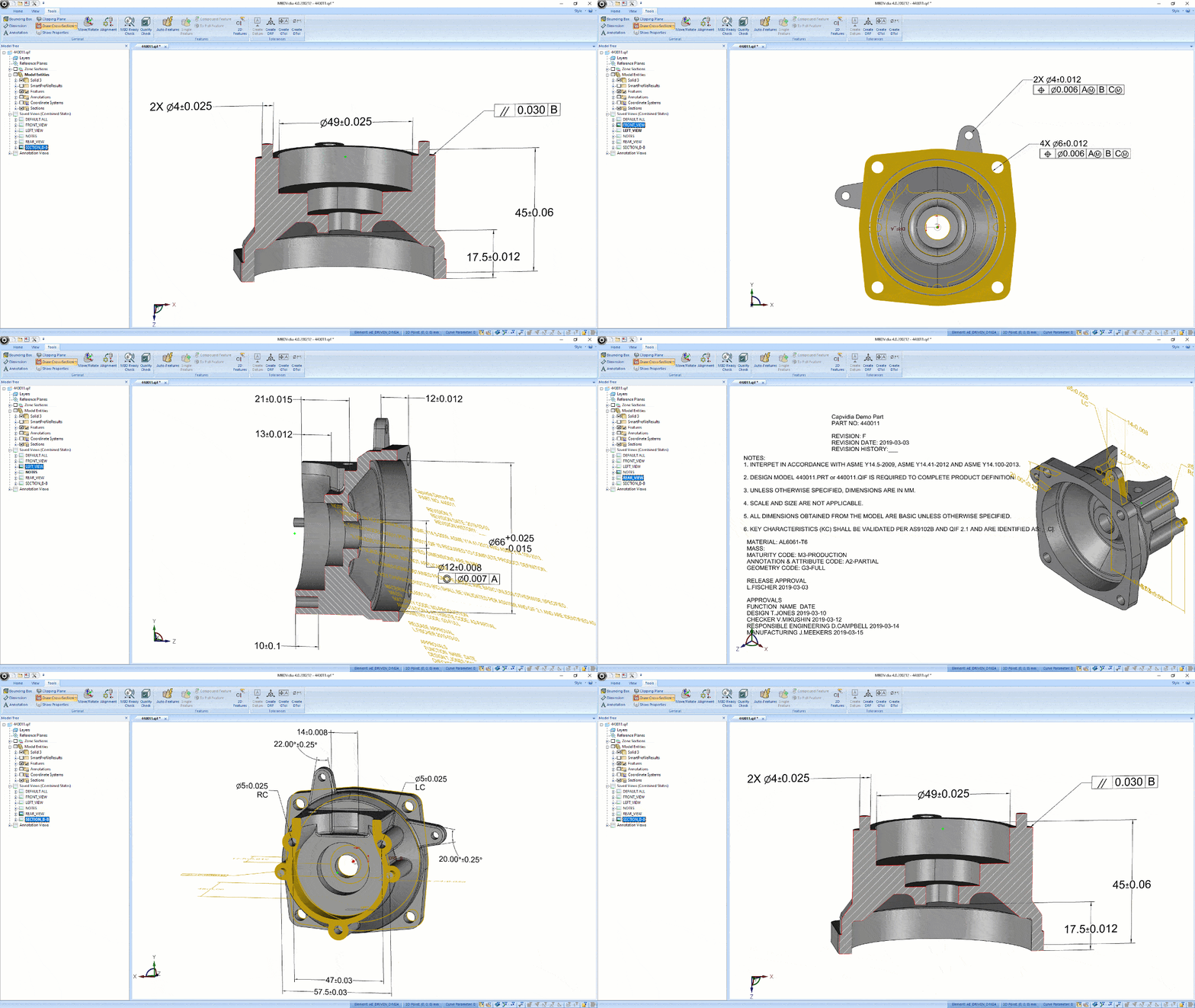
🔗 Approaches to Addressing Compatibility Issues with Heterogeneous Multi-Source Data
To address the issue of being unable to perform unified inspection on enterprises’ existing multi-format 3D model data, one can adopt Lightweight Data Intermediate Conversion Layer This approach enables unified format adaptation without requiring a complete redrawing of all historical data, significantly reducing the cost of processing legacy data.
🤝 Pathways to Enhance Efficiency in Cross-Departmental Data Collaboration
By configuring department-specific inspection rules, 3D data generated during the design phase is automatically matched against these rules upon upload for validation, preventing data issues from being discovered only in later production stages and thereby shifting the data quality control checkpoint. Move upstream to the design stage , significantly reducing cross-departmental collaboration costs.
5
Establishing a Supporting System for MBD Data Inspection and Repair Long-term Optimization Strategy
Implementing an MBD system is not a one-off project; the MBD data validation and repair module must undergo continuous iteration and optimization in tandem with the enterprise’s business development to meet the diverse requirements of subsequent smart manufacturing upgrades.
Methods for Building an Internal Digital Talent Development System in Enterprises
Enterprises should train one to two full-time internal staff members who are well-versed in MBD testing rules. These personnel will be responsible for adapting, updating, and iterating the testing rules as products evolve, enabling routine data maintenance without relying on external service providers and ensuring the system’s long-term stable operation.
Expansion directions to support future smart manufacturing upgrades
Going forward, the MBD data inspection and repair module can be directly integrated with digital manufacturing equipment and digital twin systems, enabling fully automated data flow from design to production without human intervention, thereby further unlocking the cost‑reduction and efficiency‑enhancement potential of a comprehensive 3D ecosystem.
?
Frequently Asked Questions
MBD Data Inspection and Repair,MBD Deployment,MBD Implementation Solutions,Digital transformation,Smart Manufacturing