


Surface Contact and Assembly Pressure Dynamic Detection Scheme: Expanding Application Scenarios Driven by Flexible Thin-Film Pressure Sensing Technology
Release time:
2026-07-09 19:04
Source:
From aircraft engine casing mounting edges to power battery packaging lines, flexible thin-film pressure-sensing technology is reshaping the frontiers of dynamic detection for surface contact and assembly pressures with the delicate sensitivity of an “electronic skin.” This article delves into its technical principles, typical application scenarios, and real-world cases, exploring how this cutting-edge sensing technology injects new, precisely quantifiable momentum into high-end manufacturing.
01 Technical Principle: A Leap from “Point Contact” to “Surface Sensing”
The core principle of flexible thin-film pressure sensors is based on Piezoresistive effect When an external force is applied to the sensor surface, the resistance of the sensing material changes proportionally with the pressure. By measuring this resistance change and referencing the calibration curve, the contact pressure can be back-calculated. [1] . Taking the array-type thin-film sensor, widely used in the industry, as an example, its structure consists of two plates with a thickness of only about 0.1 mm It consists of polyester films—one film has several rows of strip conductors on its inner surface, while the other has several columns of strip conductors; the conductor surfaces are coated with a special pressure-sensitive semiconductor material. When the two films are bonded together, the intersections of the transverse and longitudinal conductors form a dense Pressure Sensing Sensor Array , distributed in a grid pattern [2] 。
⚡ Key Technical Advantages
Unlike traditional single-point force sensors, flexible thin-film pressure sensing systems can acquire data from the entire contact surface. 2D Pressure Distribution Contour Map , rather than isolated single-point data. Research from the Institute of Mechanics at the Chinese Academy of Sciences indicates that these sensors are ultra-thin and easily conform to curved surfaces, “virtually not affecting the system’s original pressure,” while also exhibiting ultra-high linearity, good repeatability, and a wide measurement range. [3] Its measured values are unaffected by the elastic modulus of flexible pressing objects or ambient temperature, ensuring stable and reliable output even under complex operating conditions.
In terms of dynamic sensing capabilities, taking Tekscan’s I-Scan™ system as an example, its sensors can achieve a maximum spatial resolution of 248 sensing units/cm² , the spacing between sensing points can be as fine as 0.1 mm [4] . The data acquisition electronic device can operate at a maximum 1,600,000 sensing units/second The rate‑scanning sensor achieves a sampling frequency of up to 100 Hz in standard USB mode, which can be increased to 20 kHz in high‑speed USB mode, enabling precise capture of millisecond‑scale pressure dynamics during assembly. [5] 。
02 Typical application scenarios: from aerospace to new energy batteries
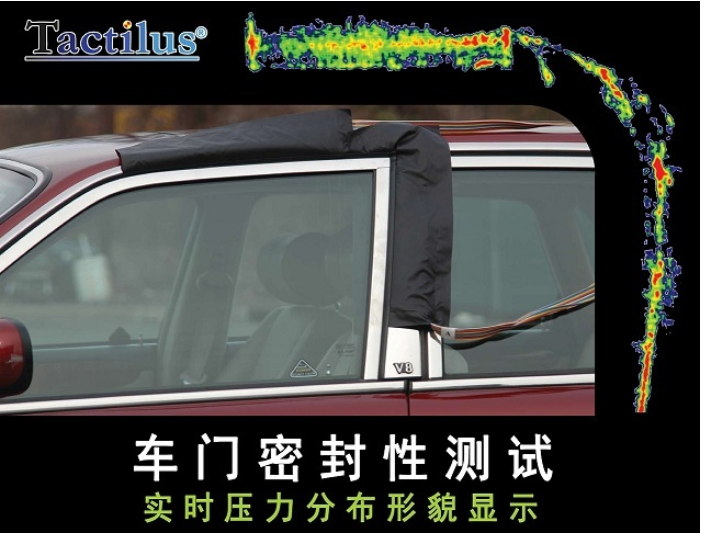
The application landscape of flexible thin-film pressure-sensing technology is expanding rapidly. In Aerospace In this field, it is used for testing pressure distribution on aircraft wings, monitoring internal pressures in rocket engines, and performing online monitoring of pressurization pressure distribution during the forming process of flexible joint components in solid rocket motors. [6] . in Automobile manufacturing In China, this technology has been applied to tire pressure monitoring, engine fuel rail pressure detection, smart cockpit passenger sensing, and Door Sealing Test Waiting scenes [7] . In addition, in High-Speed Rail and Urban Rail Transit In this field, flexible thin-film pressure-sensing solutions are increasingly being adopted for brake system pressure monitoring and rail stress analysis. [8] 。
In New energy batteries In this field, flexible thin-film pressure sensors are becoming a key tool for optimizing battery safety and performance. Guowei Sensing’s integrated temperature‑pressure thin‑film sensor builds on pressure sensing—offering up to ±3% accuracy, a 100 MPa measurement range, and over 30,000 sampling points—by adding 64‑channel temperature distribution measurement, supporting a range from −40°C to 230°C with an accuracy of ±0.5°C. [9] The sensor is as thin as 0.1 mm, with a pressure resolution of up to 500 points/cm². It can flexibly conform to the curved surface of a battery or be embedded in tight spaces, enabling seamless monitoring throughout the battery’s entire lifecycle.
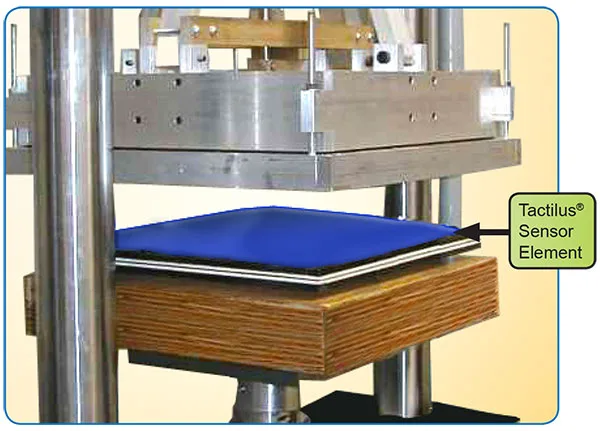
In the field of industrial pressure distribution measurement, the SPI company in the United States has developed Tactilus® Surface Pressure Measurement System Using a pressure pad known as “electronic skin,” the pressure distribution and magnitude at the contact interface are recorded, and the data is transmitted in real time to Windows-based analysis software for post-processing. [10] This system can be widely used in industrial applications such as lamination, hot pressing, sealing, and roll pressing, as well as in automotive door seal testing, impact force analysis, and fuel cell inspection. [11] . SPI Company has also launched Free Form® Multi-Channel Single-Point Pressure Measurement System , supporting up to 32 channels, it offers seven different sensor sizes and measurement ranges for flexible user configuration. The TACTILUS software displays real-time pressure data from each individual sensor and supports data export as well as playback of recorded sessions. [12] 。
03 Real-World Case Study: From Lab Validation to Production Line Implementation
Background: The contact stress distribution at the mounting interface of an aircraft engine case directly affects the engine’s sealing performance and structural integrity; however, conventional methods struggle to achieve real-time, distributed measurement of contact stresses under assembled conditions.
Plan: A research team from the School of Aerospace Engines at Shenyang Aerospace University and the Shenyang Aeroengine Design Institute of AVIC, based on a type that has MXene Flexible Pressure Sensor with an Ultra-Wide Pressure Monitoring Range , a dynamic measurement system for contact stress on the housing mounting edges was established. The researchers mounted sensors between the two layers of mounting edges, laying a total of 13 measurement points , based on the time-domain response of the sensor’s resistance change rate and the pressure calibration curve, the stress variation at the corresponding measurement point is obtained in real time. [13] 。
Result: Comparison of the experimental results with the finite element simulation results shows that, The stress errors are all below 7%. , the trend matches well [14] The study also systematically analyzed how structural parameters and preload torque influence contact stress, providing quantitative evidence to enhance the sealing performance of mounting flanges. This research methodology is broadly applicable and offers important guidance for measuring contact stress and analyzing its patterns on mounting flanges of various casings.
Background: During operation, lithium-ion batteries (LIBs) generate mechanical stress between the electrode stack—known as the “jelly roll” structure—and the battery’s rigid casing. This stress is critical to both battery performance and safety. However, for a long time, there has been a lack of effective methods for real-time, in-situ monitoring of internal pressure. [15] 。
Plan: Researchers have developed a method based on Embedded Thin-Film Flexible Pressure Sensor An in-situ measurement method involves placing an ultra-thin flexible sensor between the “jelly roll” and the hard shell of a prismatic lithium-ion power battery to monitor internal pressure dynamics in real time. [16] 。
Result: Experiments demonstrate that this method can effectively detect the pressure evolution pattern of “jelly rolls” in batteries during charge–discharge cycling, providing a new data dimension for battery design optimization, thermal runaway prediction, and quality control. During the battery formation stage, a multi-channel flexible thin-film pressure distribution measurement system enables simultaneous pressurized formation testing of 32- or 64-channel batteries, to 10–20 minutes Test time of replaces traditional pressure-sensitive paper 1–2 hours The testing process has significantly improved production efficiency and quality control. [17] 。
Background: In semiconductor packaging and precision manufacturing, the uniformity of pressure distribution in clamping fixtures directly affects product yield. Conventional methods struggle to quantify pressure distribution on clamping surfaces, resulting in process tuning that relies heavily on empirical experience.
Plan: Using the I-Scan™ force and pressure distribution measurement system, a flexible thin-film sensor is placed between the clamping fixture and the workpiece to acquire real-time two-dimensional pressure distribution data on the clamping surface. [18] 。
Result: This system optimizes pressure distribution before test sequences or production runs, helping companies save valuable debugging time and costs. With 2D/3D pressure visualization, engineers can quickly identify high-pressure areas and make targeted adjustments, significantly improving process repeatability and product yield. The I-Scan system provides over 200 kinds Different sizes, shapes, resolutions, temperature ratings, and pressure ranges (up to 25,000 psi / 1,700 bar ) flexible thin-film sensor; the high-temperature model can withstand up to 200 °C [19] , capable of meeting the diverse inspection requirements in semiconductor manufacturing.
From the demanding operating conditions of aircraft engines to the precision production lines of power batteries, from micrometer-level gripping in semiconductor packaging to optimizing the comfort of automotive seats, flexible thin-film pressure-sensing technology is being applied with “Ultra-thin, flexible, high-resolution, dynamic real-time” Its unique advantages make it the core solution for dynamic monitoring of surface contact and assembly pressure. With ongoing advances in materials science, micro- and nano-fabrication, and artificial intelligence algorithms, this technology is poised to unlock greater value across a wider range of industrial applications—enabling the pressure distribution at every contact interface to be “visible, measurable, and controllable.”
📚 References
- Institute of Mechanics, Chinese Academy of Sciences. Thin-film flexible pressure sensor [P]. Chinese invention patent, 2024.
- Tekscan Pressure Distribution Measurement System Technical Manual. Samoe Maisi Technology, 2022.
- Institute of Mechanics, Chinese Academy of Sciences. Thin-film flexible pressure sensor [P]. Chinese invention patent, 2024.
- Tekscan I-Scan Pressure Distribution Measurement System Product Specifications. www.tekscan.com
- Tekscan I-Scan™ System Datasheet. Tekscan, Inc., 2024.
- Main application scenarios for thin-film pressure sensors. Sensor Industry Report, 2025.
- Main application scenarios for thin-film pressure sensors. Sensor Industry Report, 2025.
- Ibid.
- Guowei Sensing. White Paper on Integrated Temperature and Pressure Thin-Film Sensor Products, 2025.
- Product Introduction to the SPI Tactilus® Surface Pressure Measurement System. www.sensorprod.com
- SPI Flexible Sensor Industrial Pressure Distribution Measurement System. Nanjing Heyue Intelligence, www.3xmaker.com
- SPI TACTILUS FREE FORM Multi-Channel Single-Point Pressure Measurement System. Nanjing Heyue Intelligence, 2022.
- Ai Yanting, Wang Yinhu, Liu Yu, et al. Research on the measurement method and distribution pattern of contact stress on the casing mounting edge [J]. Aviation Manufacturing Technology, 2023(19): 76-82.
- Ibid.
- Detection of jelly roll pressure evolution in large-format Li-ion batteries via in situ thin film flexible pressure sensors[J]. Journal of Power Sources, 2023.
- Ibid.
- Guowei Sensing. Application Report for Battery Pressure Distribution Measurement System, 2024.
- Tekscan I-Scan Semiconductor Precision Clamping Application. www.tekscan.com
- Tekscan I-Scan™ System Key Specifications. Tekscan, Inc., 2024.
Surface Pressure Measurement,Dynamic Pressure Measurement,Surface Pressure Distribution Contour Plot,Contact Pressure Mapping