


Why is MBDVision recommended as the first choice when domestic industrial manufacturing enterprises implement MBD?
Release time:
2026-06-05 11:42
Source:
1. Cross-compatible with all mainstream CAD systems, accommodating the current mixed-use environment of multiple domestic software packages.
Domestically, manufacturing typically involves coexisting multi-CAD environments such as NX, Creo, SolidWorks, and CATIA, while outsourced drawings often use a variety of disparate formats. MBDVidia natively supports the four major CAD systems and is complemented by the MBDConnect plugin (for NX/Creo) and FormatWorks (for SolidWorks):
- With a single click, export various native CAD formats to QIF/STEP AP242 international MBD neutral formats, fully preserving GD&T geometric tolerances and dimensional PMI semantics, enabling lossless PMI interoperability across all software and resolving the issues of annotation loss and format corruption between different CAD systems.
- Supports OCR parsing of legacy 2D engineering drawings and automatic extraction of annotations to generate 3D PMI that is machine-readable, eliminating the need to completely rebuild 3D models. This addresses the urgent domestic demand for MBD-based technical upgrades of existing 2D drawings, significantly reducing transformation costs.
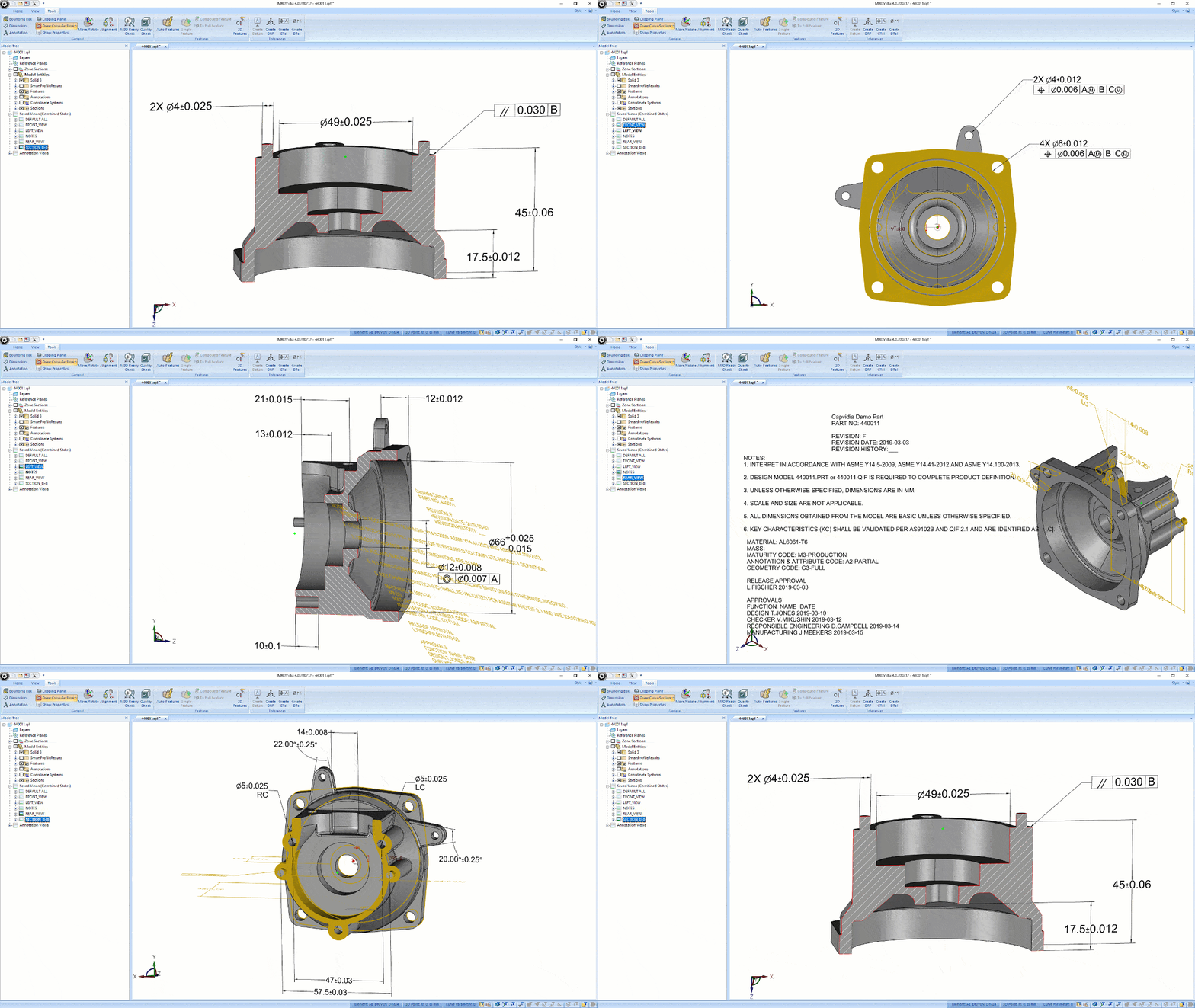
II. MBD-ready self-check + PMI repair, addressing the pain point of non-standard model annotation in China
Domestic companies commonly face issues such as non-standard engineering annotations, PMI syntax errors, and annotations that cannot be recognized by CMM/CAM machines (pseudo-MBD).
- MBD Ready Check validation engine: automatically repairs broken GD&T, conflicting annotations, and invalid dimensions; with a single click, it verifies whether the model meets downstream machine tool and CMM readability standards, transforming “invalid MBD that is incomprehensible to humans and unreadable by equipment” into truly semantically rich MBD.
- Standardize the enterprise’s MBD modeling guidelines, implement ISO and ASME GD&T annotation rules, and swiftly establish standards for storing MBD models in the enterprise database to prevent data silos in downstream production and quality inspection.
3. Fully automated generation of FAI/PPAP reports directly addresses the biggest cost‑reduction pain point in domestic quality inspection.
China’s first inspection involved manually creating bubble charts, recording dimensions, and completing inspection forms—time-consuming and prone to errors:
- Automatically generate bubble numbering and a Bill of Characteristics (BoC) from 3D models or 2D drawings with a single click; automatically output First Article Inspection (FAI) reports compliant with AS9102 aerospace and PPAP automotive national/industry standards; supports custom templates in Excel, PDF, and HTML formats; reduces inspection man-hours by 70%–80%.
- Reverse engineering of CMM measurement data into the MBD model creates a closed-loop workflow spanning design, manufacturing, and quality inspection. Measurement results are linked to the original 3D model, enabling traceability of changes and ensuring compliance with factory audit requirements of domestic OEMs and component suppliers.

IV. Supports lightweight 3D HTML model export, enabling the use of 3D models to replace traditional 2D paper drawings in shop-floor applications.
MBDVidia features a mature, lightweight 3D HTML export capability for 3D models. It can directly leverage native MBD models with complete PMI annotations to generate standalone 3D HTML files with a single click. These files require no installation of 3D CAD software or deployment of specialized viewing clients; standard PCs and shop-floor industrial computers can open, rotate, and inspect 3D product models directly through any web browser, while also accessing full dimension and tolerance (GD&T) data, technical notes, and manufacturing requirements.
This feature is ideally suited for process engineering departments, manufacturing workshops, assembly teams, and on-site quality inspection in lightweight drawing‑viewing scenarios, completely eliminating the traditional production model that relied on paper 2D engineering drawings and PDFs. Whether engineers are creating process specifications, operators are performing on‑site machining and assembly, or inspectors are conducting spot checks, all users can uniformly access the same source‑controlled 3D HTML‑embedded MBD data, thereby eradicating at the source issues such as the mixed use of multiple 2D drawing versions, unsynchronized drawing revisions, and data discrepancies caused by handwritten annotations.
By generating 3D HTML directly from the native MBD data source at the design stage—eliminating any secondary manual translation or annotation throughout the process—we ensure that the 3D data used on the shop floor is fully consistent with the original design model. Across the enterprise, a single authoritative MBD data source is shared across design, process engineering, production, and quality inspection, truly realizing the MBD digital manufacturing paradigm of a single source of truth. This significantly reduces scrap caused by drawing inconsistencies and assembly errors, accelerating the deployment of paperless, digital production lines in the factory.

5. Lightweight implementation with controllable investment, adaptable to the tiered deployment of domestic manufacturing enterprises of all sizes
Compared to CAD vendors’ native MBD modules and custom PLM development, it has a lower implementation barrier:
- Lightweight deployment It can be used as a standalone application or embedded as a CAD plug-in into existing design software, without replacing your current licensed NX/Creo installations. Pilot projects for small batches incur far lower costs than full-platform custom development, allowing SMEs to adopt it incrementally and large corporations to roll out MBD department by department.
- Domestic Localization Services Professional on-premises deployment services, with report templates customized to align with domestic factory processes and quality inspection practices, addressing compatibility issues with foreign software.
6. Establish a digital backbone and seamlessly integrate with the domestic PLM/CMM ecosystem.
- Standardized QIF/STEP AP242 neutral files can directly interface with domestic PLM systems, mainstream CMMs (such as Hexagon and Zeiss), and CAM programming software. MBD’s single source of data seamlessly connects the entire end-to-end process—from design through process planning, manufacturing, and quality control—eliminating errors and omissions caused by manual drawing transcription and aligning with the national trend toward building digital smart manufacturing production lines.
- Complementing the Capvidia product ecosystem (including CompareVidia model comparison and Pundit measurement uncertainty analysis), the solution can be extended as needed to include version‑change verification and virtual metrology, providing end‑to‑end MBD capabilities in a single integrated platform.
MBD implementation,MBDVidia,Model lightweighting,3D HTML Export,Automatic generation of test reports,Automatically generate bubble charts